
-
 Argentina
-
 Australia
-
 Austria
-
 Belgium
-
 Brazil
-
 Canada
-
 China
China
-
 Czech Republic
-
 Denmark
-
 Finland
-
 France
-
 Germany
-
 Greece
-
 Hong Kong
-
 Hungary
-
 Iceland
-
 India
India
-
 Ireland
-
 Israel
-
 Italy
Italy
-
 Japan
Japan
-
 Korea
Korea
-
 Luxembourg
-
 Malaysia
-
 Netherlands
-
 New Zealand
-
 Norway
-
 Poland
-
 Portugal
-
 Qatar
Qatar
-
 Romania
-
 Saudi Arabia
-
 Singapore
-
 Spain
Spain
-
 Sweden
-
 Switzerland
-
 Taiwan
-
 Turkey
-
 United Kingdom
-
 United States
research use only
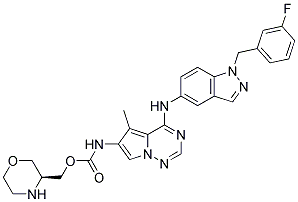
AC480 (BMS-599626) HER2 inhibitor
Cat.No.S1056
Quality Control
| Related Targets | EGFR VEGFR FGFR PDGFR c-Met Src MEK CSF-1R FLT3 c-Kit |
|---|---|
| Other HER2 Inhibitors | Sevabertinib (BAY 2927088) CP-724714 Sapitinib (AZD8931) Mubritinib (TAK 165) Tyrphostin AG 879 HER2-Inhibitor-1 Zongertinib (BI 1810631) TAS0728 IAM1363 |
Solubility
|
In vitro |
DMSO
: 113 mg/mL
(212.98 mM)
Ethanol : 20 mg/mL Water : Insoluble |
Molarity Calculator
|
In vivo |
|||||
In vivo Formulation Calculator (Clear solution)
Step 1: Enter information below (Recommended: An additional animal making an allowance for loss during the experiment)
Step 2: Enter the in vivo formulation (This is only the calculator, not formulation. Please contact us first if there is no in vivo formulation at the solubility Section.)
Calculation results:
Working concentration: mg/ml;
Method for preparing DMSO master liquid: mg drug pre-dissolved in μL DMSO ( Master liquid concentration mg/mL, Please contact us first if the concentration exceeds the DMSO solubility of the batch of drug. )
Method for preparing in vivo formulation: Take μL DMSO master liquid, next addμL PEG300, mix and clarify, next addμL Tween 80, mix and clarify, next add μL ddH2O, mix and clarify.
Method for preparing in vivo formulation: Take μL DMSO master liquid, next add μL Corn oil, mix and clarify.
Note: 1. Please make sure the liquid is clear before adding the next solvent.
2. Be sure to add the solvent(s) in order. You must ensure that the solution obtained, in the previous addition, is a clear solution before proceeding to add the next solvent. Physical methods such
as vortex, ultrasound or hot water bath can be used to aid dissolving.
Chemical Information, Storage & Stability
| Molecular Weight | 530.55 | Formula | C27H27FN8O3 |
Storage (From the date of receipt) | |
|---|---|---|---|---|---|
| CAS No. | 714971-09-2 | Download SDF | Storage of Stock Solutions |
|
|
| Synonyms | N/A | SMILES | CC1=C2C(=NC=NN2C=C1NC(=O)OCC3COCCN3)NC4=CC5=C(C=C4)N(N=C5)CC6=CC(=CC=C6)F | ||
Read more about storage stability stock solution CAS number SMILES
Mechanism of Action
| Targets/IC50/Ki |
HER1
20 nM
HER2
30 nM
HER4
190 nM
|
|---|---|
| In vitro |
AC480 (BMS-599626) is identified as an ATP-competitive inhibitor for HER1 and as an ATP-noncompetitive inhibitor for HER2 with Ki of 2 nM and 5 nM, respectively. It also inhibits the related receptor HER4, but with reduced potency with IC50 of 190 nM. This compound inhibits the proliferation of tumor cells expressing high levels of HER1 and/or HER2, including Sal2, BT474, N87, KPL-4, HCC202, HCC1954, HCC1419, AU565, ZR-75-30, MDA-MB-175, GEO, and PC9 cells with IC50 of 0.24 μM, 0.31 μM, 0.45 μM, 0.38μM, 0.94 μM, 0.34 μM, 0.75 μM, 0.63 μM, 0.51 μM, 0.84 μM, 0.90 μM and 0.34 μM, respectively. While the proliferation of the ovarian tumor cell line A2780 and MRC5 fibroblasts, neither of which expresses HER1 or HER2, are not inhibited significant by it. A recent study shows that it significantly enhances the radiosensitivity of HN-5 cells expressing both EGFR and Her2 cell, by promoting cycle redistribution and inhibiting DNA repair.
|
| Kinase Assay |
Protein kinase assays
|
|
The entire cytoplasmic sequences of HER1, HER2, and HER4 are expressed as recombinant proteins in Sf9 insect cells. HER1 and HER4 are expressed as fusion proteins with glutathione-S-transferase and are purified by affinity chromatography on glutathione-S-Sepharose. HER2 is subcloned into the pBlueBac4 vector and expressed as an untagged protein using an internal methionine codon (M687) for translation initiation. The truncated HER2 protein is isolated by chromatography on a column of DEAE-Sepharose equilibrated in a buffer that contains 0.1 M NaCl, and the recombinant protein is eluted with a buffer containing 0.3 M NaCl. For the HER kinase assays, reaction volumes are 50 μL and contains 10 ng of glutathione-S-transferase fusion protein or 150 ng of partially purified HER2. The mixtures also contains 1.5 μM poly(Glu/Tyr) (4:1), 1 μM ATP, 0.15 μCi [γ-33P]ATP, 50 mM Tris-HCl (pH 7.7), 2 mM DTT, 0.1 mg/mL bovine serum albumin, and 10 mM MnCl2. Reactions are allowed to proceed at 27°C for 1 hour and are terminated by the addition of 10 μL of a stop buffer (2.5 mg/mL bovine serum albumin and 0.3 M EDTA), followed by a 108-μL mixture of 3.5 mM ATP and 5% trichloroacetic acid. Acid-insoluble proteins are recovered on GF/C Unifilter plates with a Filtermate harvester. Incorporation of radioactive phosphate into the poly(Glu/Tyr) substrate is determined by liquid scintillation counting. Percent inhibition of kinase activity is determined by nonlinear regression analyses and data are reported as the inhibitory concentration required to achieve 50% inhibition relative to control reactions (IC50). Data are the averages of triplicate determinations. All other tyrosine kinases are also assayed using poly(Glu/Tyr) as a substrate. Kinetics of HER1 and HER2 inhibition are determined in reaction mixtures that contains varying concentrations of ATP and AC480 (BMS-599626).
|
|
| In vivo |
AC480 (BMS-599626) yields a potent antitumor activity in a human breast tumor KPL-4 xenograft at its maximum tolerated dose of 180 mg/kg, and also has similar antitumor activity in other HER2 amplified xenograft models, as well as other HER1-overexpressing xenograft models. In vivo, oral administration of this compound results in a dose-dependent inhibition of Sal2 tumor growth at doses ranging from 60 mg/kg to 240 mg/kg.
|
References |
|
Clinical Trial Information
(data from https://clinicaltrials.gov, updated on 2024-05-22)
| NCT Number | Recruitment | Conditions | Sponsor/Collaborators | Start Date | Phases |
|---|---|---|---|---|---|
| NCT01245543 | Withdrawn | Solid Tumors |
Daiichi Sankyo |
2010-11 | Phase 1 |
| NCT00979173 | Completed | Glioma |
Annick Desjardins|Ambit Biosciences Corporation|Duke University |
2009-11 | Phase 1 |
| NCT00093730 | Completed | Unspecified Adult Solid Tumor Protocol Specific |
Jonsson Comprehensive Cancer Center|National Cancer Institute (NCI) |
2004-08 | Phase 1 |
| NCT00095537 | Completed | Cancer|Metastases |
Bristol-Myers Squibb |
2004-03 | Phase 1 |
Read more about Clinical Trials
Tech Support
Tel: +1-832-582-8158 Ext:3
If you have any other enquiries, please leave a message.
Signaling Pathway Map

Products are for research use only. Not for human use. We do not sell to patients.
©Copyright 2013 Selleck Chemicals. All Rights Reserved.