
-
 Argentina
-
 Australia
-
 Austria
-
 Belgium
-
 Brazil
-
 Canada
-
 China
China
-
 Czech Republic
-
 Denmark
-
 Finland
-
 France
-
 Germany
-
 Greece
-
 Hong Kong
-
 Hungary
-
 Iceland
-
 India
India
-
 Ireland
-
 Israel
-
 Italy
Italy
-
 Japan
Japan
-
 Korea
Korea
-
 Luxembourg
-
 Malaysia
-
 Netherlands
-
 New Zealand
-
 Norway
-
 Poland
-
 Portugal
-
 Qatar
Qatar
-
 Romania
-
 Saudi Arabia
-
 Singapore
-
 Spain
Spain
-
 Sweden
-
 Switzerland
-
 Taiwan
-
 Turkey
-
 United Kingdom
-
 United States
research use only
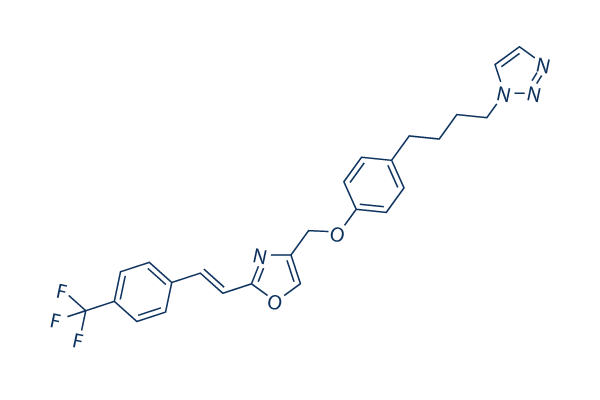
Mubritinib (TAK 165) HER2 inhibitor
Cat.No.S2216
Quality Control
| Related Targets | EGFR VEGFR FGFR PDGFR c-Met Src MEK CSF-1R FLT3 c-Kit |
|---|---|
| Other HER2 Inhibitors | Sevabertinib (BAY 2927088) CP-724714 Sapitinib (AZD8931) AC480 (BMS-599626) Tyrphostin AG 879 HER2-Inhibitor-1 Zongertinib (BI 1810631) TAS0728 IAM1363 |
Solubility
|
In vitro |
DMSO
: 13 mg/mL
(27.74 mM)
Water : Insoluble Ethanol : Insoluble |
Molarity Calculator
|
In vivo |
|||||
In vivo Formulation Calculator (Clear solution)
Step 1: Enter information below (Recommended: An additional animal making an allowance for loss during the experiment)
Step 2: Enter the in vivo formulation (This is only the calculator, not formulation. Please contact us first if there is no in vivo formulation at the solubility Section.)
Calculation results:
Working concentration: mg/ml;
Method for preparing DMSO master liquid: mg drug pre-dissolved in μL DMSO ( Master liquid concentration mg/mL, Please contact us first if the concentration exceeds the DMSO solubility of the batch of drug. )
Method for preparing in vivo formulation: Take μL DMSO master liquid, next addμL PEG300, mix and clarify, next addμL Tween 80, mix and clarify, next add μL ddH2O, mix and clarify.
Method for preparing in vivo formulation: Take μL DMSO master liquid, next add μL Corn oil, mix and clarify.
Note: 1. Please make sure the liquid is clear before adding the next solvent.
2. Be sure to add the solvent(s) in order. You must ensure that the solution obtained, in the previous addition, is a clear solution before proceeding to add the next solvent. Physical methods such
as vortex, ultrasound or hot water bath can be used to aid dissolving.
Chemical Information, Storage & Stability
| Molecular Weight | 468.47 | Formula | C25H23F3N4O2 |
Storage (From the date of receipt) | |
|---|---|---|---|---|---|
| CAS No. | 366017-09-6 | Download SDF | Storage of Stock Solutions |
|
|
| Synonyms | N/A | SMILES | C1=CC(=CC=C1CCCCN2C=CN=N2)OCC3=COC(=N3)C=CC4=CC=C(C=C4)C(F)(F)F | ||
Read more about storage stability stock solution CAS number SMILES
Mechanism of Action
| Targets/IC50/Ki |
HER2/ErbB2
(BT-474 cells) 6.0 nM
|
|---|---|
| In vitro |
Mubritinib (TAK 165) displays > 4000-fold selectivity over other tyrosine kinases, such as EGFR, FGFR, PDGFR, Jak1, Src and Blk. It even at low concentration of 0.1 μM significantly blocks HER2 phosphorylation, leading to the downregulation of PI3K-Akt and MAPK pathway in cell line BT474 with high level of HER2. This compound not only exhibits highly potent antiproliferative effect in ErbB2-overexpressing cancer cell line BT474 with an IC50 of 5 nM, but also displays marked antiproliferative effects in cell lines with HER2 expressed weakly with IC50 of 53 nM, 90 nM and 91 nM for LNCaP, LN-REC4 and T24, respectively. It displays no inhibitory activities against PC-3 cells with HER2 expressed very faintly with IC50 of 4.62 μM, as well as EGFR-overexpressing HT1376 and ACHN cell lines with IC50 of >25 μM. |
| Kinase Assay |
Inhibition of HER2/erbB2 tyrosine kinase activity
|
|
BT-474 cells are seeded on 24-well plates and cultured overnight. Mubritinib (TAK 165) is then added at various concentrations. After incubation for 2 hours, the cells are harvested directly into sodium dodecyl sulfate (SDS)-sample buffer (200 μL). Aliquots containing equal amounts of total cell extract are run on 7.5% to 15% gradient SDS–polyacrylamide gel electrophoresis (PAGE). Following electrophoresis, proteins are transferred onto a polyvinylidene fluoride (PVDF) membrane, for western blot analysis using a relevant primary antibody. Detection of protein is accomplished by an enhanced chemiluminescent (ECL) detection method. The extent of tyrosine phosphorylation of HER2/erbB2 is measured by the LAS-1000 plus lumino-image analyser. The concentration of this compound that inhibits HER2/erbB2 phosphorylation by 50% (IC50) is calculated from a dose–response curve generated by least-squares linear regression of the response using SAS software.
|
|
| In vivo |
Mubritinib (TAK 165) significantly inhibits LN-REC4 xenograft with treatment/control tumor volume ratio of 26.5%. Although ineffective to inhibit the growth of UMUC-3 and ACHN cells in vitro (IC50s of 1.812 and >25 μM, respectively), oral administration of this compound (10 or 20 mg/kg per day) significantly inhibits the growth of UMUC-3 and ACHN xenografts with treatment/control tumor volume ratio of 22.9% and 26%, respectively, as compared with 20 mg/kg which is ineffective to UMUC-3 tumor growth. |
References |
Applications
| Methods | Biomarkers | Images | PMID |
|---|---|---|---|
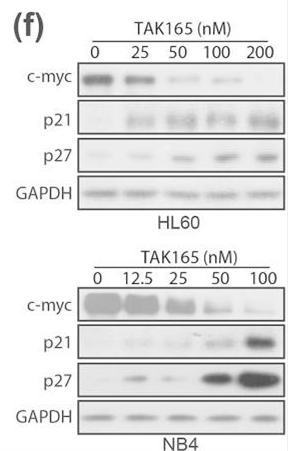
| Western blot | c-myc / p21 / p27 pERK / ERK / pAKT / AKT / p-STAT3 / STAT3 / pHER2 / HER2 |
|
27074819 |
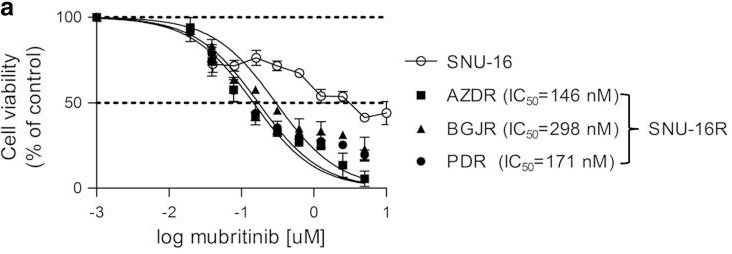
| Growth inhibition assay | Cell viability |
|
25407459 |
Clinical Trial Information
(data from https://clinicaltrials.gov, updated on 2024-05-22)
| NCT Number | Recruitment | Conditions | Sponsor/Collaborators | Start Date | Phases |
|---|---|---|---|---|---|
| NCT00034281 | Completed | Breast Neoplasm|Pancreatic Neoplasm|Lung Neoplasm|Ovarian Neoplasm|Renal Neoplasm |
Takeda |
2002-06 | Phase 1 |
Read more about Clinical Trials
Tech Support
Tel: +1-832-582-8158 Ext:3
If you have any other enquiries, please leave a message.
Signaling Pathway Map

Products are for research use only. Not for human use. We do not sell to patients.
©Copyright 2013 Selleck Chemicals. All Rights Reserved.