
-
 Argentina
-
 Australia
-
 Austria
-
 Belgium
-
 Brazil
-
 Canada
-
 China
China
-
 Czech Republic
-
 Denmark
-
 Finland
-
 France
-
 Germany
-
 Greece
-
 Hong Kong
-
 Hungary
-
 Iceland
-
 India
India
-
 Ireland
-
 Israel
-
 Italy
Italy
-
 Japan
Japan
-
 Korea
Korea
-
 Luxembourg
-
 Malaysia
-
 Netherlands
-
 New Zealand
-
 Norway
-
 Poland
-
 Qatar
Qatar
-
 Romania
-
 Saudi Arabia
-
 Singapore
-
 Spain
Spain
-
 Sweden
-
 Switzerland
-
 Taiwan
-
 Turkey
-
 United Kingdom
-
 United States
research use only
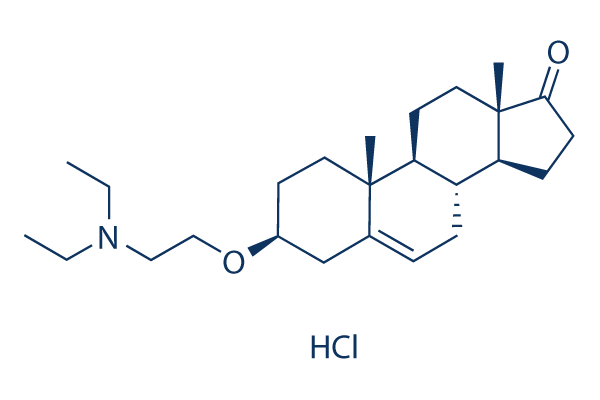
U-18666A Cholesterol Transport Inhibitor
Cat.No.S9669
Quality Control
| Related Targets | PD-1/PD-L1 CXCR STING AhR Immunology & Inflammation related CD markers Interleukins Anti-infection Antioxidant COX |
|---|---|
| Other Antiviral Inhibitors | Moroxydine HCl Aloperine GS-441524 NGI-1 Harringtonine Oleanolic Acid LL-37 acetate Aloin B Lanatoside C Lapachol |
Solubility
|
In vitro |
DMSO
: 85 mg/mL
(200.44 mM)
Ethanol : 85 mg/mL Water : 43 mg/mL |
Molarity Calculator
|
In vivo |
|||||
In vivo Formulation Calculator (Clear solution)
Step 1: Enter information below (Recommended: An additional animal making an allowance for loss during the experiment)
Step 2: Enter the in vivo formulation (This is only the calculator, not formulation. Please contact us first if there is no in vivo formulation at the solubility Section.)
Calculation results:
Working concentration: mg/ml;
Method for preparing DMSO master liquid: mg drug pre-dissolved in μL DMSO ( Master liquid concentration mg/mL, Please contact us first if the concentration exceeds the DMSO solubility of the batch of drug. )
Method for preparing in vivo formulation: Take μL DMSO master liquid, next addμL PEG300, mix and clarify, next addμL Tween 80, mix and clarify, next add μL ddH2O, mix and clarify.
Method for preparing in vivo formulation: Take μL DMSO master liquid, next add μL Corn oil, mix and clarify.
Note: 1. Please make sure the liquid is clear before adding the next solvent.
2. Be sure to add the solvent(s) in order. You must ensure that the solution obtained, in the previous addition, is a clear solution before proceeding to add the next solvent. Physical methods such
as vortex, ultrasound or hot water bath can be used to aid dissolving.
Chemical Information, Storage & Stability
| Molecular Weight | 424.06 | Formula | C25H42ClNO2 |
Storage (From the date of receipt) | 3 years -20°C powder |
|---|---|---|---|---|---|
| CAS No. | 3039-71-2 | -- | Storage of Stock Solutions |
|
|
| Synonyms | U18 | SMILES | CCN(CC)CCOC1CCC2(C3CCC4(C(C3CC=C2C1)CCC4=O)C)C.Cl | ||
Read more about storage stability stock solution CAS number SMILES
Mechanism of Action
| In vitro |
Viral particles are trapped in the Lamp-1 positive late endosome/lysosome compartment when cells are treated with U18666A. In addition, viral replication is also affected by this compound treatment. An additive anti-viral effect is found when C75, a fatty acid synthase inhibitor, is used in combination with this chemical, suggesting the role of cholesterol and fatty acid in DENV. |
|---|---|
| In vivo |
When U18666A is administered to cats experimentally infected with type I FIPV, the development of FIP may be suppressed compared with the control group. However, the number of animals with FIP is too low to establish anti-viral effect of this compound in cats. Two of the five control cats administered PBS alone develops FIP. Four of the five cats administered this chemical develops no signs of FIP. One cat that temporarily developed fever, has no other clinical symptoms, and no gross lesion is noted on an autopsy after the end of the experiment. The FIPV gene is detected intermittently in feces and saliva regardless of the development of FIP or administration of this compound. |
References |
|
Tech Support
Tel: +1-832-582-8158 Ext:3
If you have any other enquiries, please leave a message.

Products are for research use only. Not for human use. We do not sell to patients.
©Copyright 2013 Selleck Chemicals. All Rights Reserved.