
-
 Argentina
-
 Australia
-
 Austria
-
 Belgium
-
 Brazil
-
 Canada
-
 China
China
-
 Czech Republic
-
 Denmark
-
 Finland
-
 France
-
 Germany
-
 Greece
-
 Hong Kong
-
 Hungary
-
 Iceland
-
 India
India
-
 Ireland
-
 Israel
-
 Italy
Italy
-
 Japan
Japan
-
 Korea
Korea
-
 Luxembourg
-
 Malaysia
-
 Netherlands
-
 New Zealand
-
 Norway
-
 Poland
-
 Portugal
-
 Qatar
Qatar
-
 Romania
-
 Saudi Arabia
-
 Singapore
-
 Spain
Spain
-
 Sweden
-
 Switzerland
-
 Taiwan
-
 Turkey
-
 United Kingdom
-
 United States
research use only
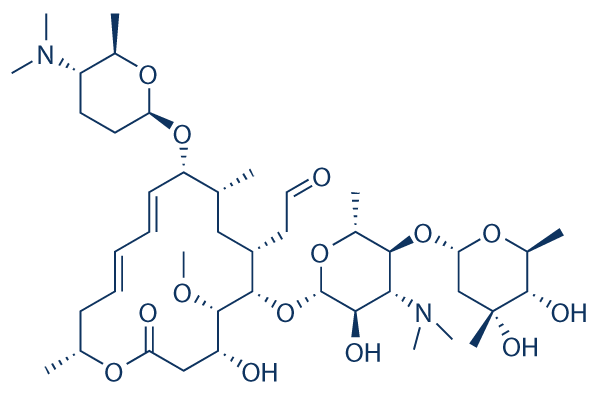
Spiramycin Antibiotics chemical
Cat.No.S4082
Quality Control
| Related Targets | Integrase Bacterial Anti-infection Fungal Antiviral COVID-19 Parasite Reverse Transcriptase HIV HCV Protease |
|---|---|
| Other Antibiotics Inhibitors | Puromycin G418 Sulfate (Geneticin) Nanchangmycin Sitafloxacin Hydrate Trovafloxacin Mesylate Nadifloxacin G-418 Gamithromycin Thiamphenicol Fusidine |
Solubility
|
In vitro |
DMSO
: 100 mg/mL
(118.61 mM)
Ethanol : 100 mg/mL Water : Insoluble |
Molarity Calculator
|
In vivo |
|||||
In vivo Formulation Calculator (Clear solution)
Step 1: Enter information below (Recommended: An additional animal making an allowance for loss during the experiment)
Step 2: Enter the in vivo formulation (This is only the calculator, not formulation. Please contact us first if there is no in vivo formulation at the solubility Section.)
Calculation results:
Working concentration: mg/ml;
Method for preparing DMSO master liquid: mg drug pre-dissolved in μL DMSO ( Master liquid concentration mg/mL, Please contact us first if the concentration exceeds the DMSO solubility of the batch of drug. )
Method for preparing in vivo formulation: Take μL DMSO master liquid, next addμL PEG300, mix and clarify, next addμL Tween 80, mix and clarify, next add μL ddH2O, mix and clarify.
Method for preparing in vivo formulation: Take μL DMSO master liquid, next add μL Corn oil, mix and clarify.
Note: 1. Please make sure the liquid is clear before adding the next solvent.
2. Be sure to add the solvent(s) in order. You must ensure that the solution obtained, in the previous addition, is a clear solution before proceeding to add the next solvent. Physical methods such
as vortex, ultrasound or hot water bath can be used to aid dissolving.
Chemical Information, Storage & Stability
| Molecular Weight | 843.05 | Formula | C43H74N2O14 |
Storage (From the date of receipt) | |
|---|---|---|---|---|---|
| CAS No. | 8025-81-8 | Download SDF | Storage of Stock Solutions |
|
|
| Synonyms | Formacidine | SMILES | CC1CC=CC=CC(C(CC(C(C(C(CC(=O)O1)O)OC)OC2C(C(C(C(O2)C)OC3CC(C(C(O3)C)O)(C)O)N(C)C)O)CC=O)C)OC4CCC(C(O4)C)N(C)C | ||
Read more about storage stability stock solution CAS number SMILES
Mechanism of Action
| In vitro |
Spiramycin reduces the hygromycin A protections of nucleotides in 23 S rRNA. This compound, a 16-membered macrolide, inhibits translocation by binding to bacterial 50S ribosomal subunits with an apparent 1:1 stoichiometry. It acts primarily by stimulating the dissociation of peptidyl-tRNA from ribosomes during translocation. This antibiotic at doses sufficient to inhibit protein synthesis in wild-type cells but not sufficient to kill either mutant or wild-type cells at the permissive temperature (30 degrees C). It inhibits protein synthesis by stimulating the dissociation of peptidyl-tRNA from ribosomes. This agent shows dose-related inhibition of the proliferative response of PHA and PWM stimulated human mononuclear leucocytes (MNL). It also induces a decrease in tritiated uridine (3H-UdR) uptake, which suggests that this compound interferes with an early event in the cell cycle. This chemical and, to a lesser extent, erythromycin increases total IL-6 production without affecting IL-1 alpha, IL-1 beta, or tumor necrosis factor alpha production in human monocytes stimulated with lipopolysaccharide. It shows good antimicrobial activity against species of Prevotella, Eubacterium, Peptostreptococcus, Bacteroides and Porphyromonas, and the effect is enhanced by the addition of Metronidazole.
|
References |
|
|---|
Tech Support
Tel: +1-832-582-8158 Ext:3
If you have any other enquiries, please leave a message.

Products are for research use only. Not for human use. We do not sell to patients.
©Copyright 2013 Selleck Chemicals. All Rights Reserved.