
-
 Argentina
-
 Australia
-
 Austria
-
 Belgium
-
 Brazil
-
 Canada
-
 China
China
-
 Czech Republic
-
 Denmark
-
 Finland
-
 France
-
 Germany
-
 Greece
-
 Hong Kong
-
 Hungary
-
 Iceland
-
 India
India
-
 Ireland
-
 Israel
-
 Italy
Italy
-
 Japan
Japan
-
 Korea
Korea
-
 Luxembourg
-
 Malaysia
-
 Netherlands
-
 New Zealand
-
 Norway
-
 Poland
-
 Qatar
Qatar
-
 Romania
-
 Saudi Arabia
-
 Singapore
-
 Spain
Spain
-
 Sweden
-
 Switzerland
-
 Taiwan
-
 Turkey
-
 United Kingdom
-
 United States
research use only
(+)-Borneol GABA Receptor modulator
Cat.No.S3959
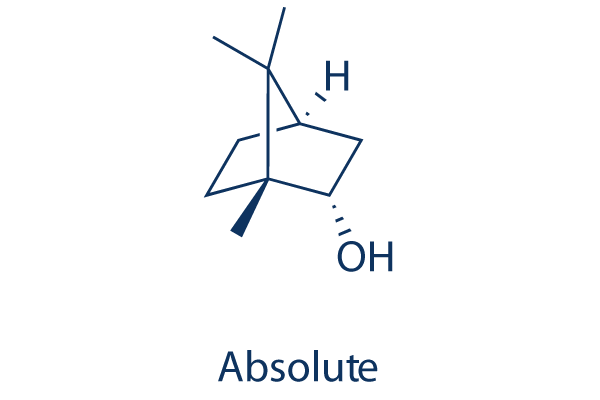
Chemical Structure
Molecular Weight: 154.25
Quality Control
| Related Targets | Adrenergic Receptor AChR 5-HT Receptor COX Calcium Channel Histamine Receptor Dopamine Receptor TRP Channel Cholinesterase (ChE) GluR |
|---|---|
| Other GABA Receptor Inhibitors | Dihydromyricetin CGP52432 Pentylenetetrazol 4-Aminobutyric acid (GABA) Ginkgolide A Oxiracetam Emamectin Benzoate Fluralaner (-)-Borneol SR95531 |
Solubility
|
In vitro |
DMSO
: 30 mg/mL
(194.48 mM)
|
Molarity Calculator
|
In vivo |
|||||
In vivo Formulation Calculator (Clear solution)
Step 1: Enter information below (Recommended: An additional animal making an allowance for loss during the experiment)
Step 2: Enter the in vivo formulation (This is only the calculator, not formulation. Please contact us first if there is no in vivo formulation at the solubility Section.)
Calculation results:
Working concentration: mg/ml;
Method for preparing DMSO master liquid: mg drug pre-dissolved in μL DMSO ( Master liquid concentration mg/mL, Please contact us first if the concentration exceeds the DMSO solubility of the batch of drug. )
Method for preparing in vivo formulation: Take μL DMSO master liquid, next addμL PEG300, mix and clarify, next addμL Tween 80, mix and clarify, next add μL ddH2O, mix and clarify.
Method for preparing in vivo formulation: Take μL DMSO master liquid, next add μL Corn oil, mix and clarify.
Note: 1. Please make sure the liquid is clear before adding the next solvent.
2. Be sure to add the solvent(s) in order. You must ensure that the solution obtained, in the previous addition, is a clear solution before proceeding to add the next solvent. Physical methods such
as vortex, ultrasound or hot water bath can be used to aid dissolving.
Chemical Information, Storage & Stability
| Molecular Weight | 154.25 | Formula | C10H18O |
Storage (From the date of receipt) | |
|---|---|---|---|---|---|
| CAS No. | 464-43-7 | -- | Storage of Stock Solutions |
|
|
| Synonyms | N/A | Smiles | CC1(C2CCC1(C(C2)O)C)C | ||
Mechanism of Action
| In vitro |
(+)-borneol significantly inhibits the expression of iNOS and TNF-α in a dose-dependent manner in the LPS-stimulated BV-2 cells. Aβ-induced cell cytotoxicity is inhibited by 100 μM of (−) and (+) borneol treatment. Treatment of borneol significantly decreases ROS generation. The expression of HO-1 and nuclear translocation of Nrf2 are increased by Aβ treatment. This nuclear translocation of Nrf2 is further increased by administration of borneol. Compared with the Aβ treated group, the (+) borneol treated group significantly increases Bcl-2 expression with decreased expression of Bax. Thus, Borneol protects SH-SY5Y cells against Aβ-induced toxicity, exerts an antioxidative effect and suppresses apoptosis.
|
|---|---|
| In vivo |
In the rat model of permanent cerebral ischemia, (+)-borneol (1.0 mg/kg) significantly ameliorates infarct size and neurological scoresvia reducing the expression of inducible nitric oxide synthase (iNOS) and tumor necrosis factor-alpha (TNF-α) in a dose dependent manner. Notably, (+)-borneol shows long-term effects on the improvement of sensorimotor functions in the photothrombotic model of stroke, which decreases the number of foot faults in the grid-walking task and forelimb asymmetry scores in the cylinder task, at least in part through reducing loss of dendritic spines in the length, brunch number and density. (+)-Borneol obviously loosens the intercellular tight junction in the blood-brain barrier (BBB) and enhances the distribution of drugs in the brain tissue, as it could increase number and volume of pinocytotic vesicles in BBB cells and then promotes the transportation of substance by cell pinocytosis. It contributes to neuroprotection and reduces pro-inflammatory cytokine expression and promotes functional recovery from permanent stroke with a long-term effect in the acute phase of focal permanent cerebral ischemia.
|
References |
|
Tech Support
Tel: +1-832-582-8158 Ext:3
If you have any other enquiries, please leave a message.
Signaling Pathway Map

Products are for research use only. Not for human use. We do not sell to patients.
©Copyright 2013 Selleck Chemicals. All Rights Reserved.