
-
 Argentina
-
 Australia
-
 Austria
-
 Belgium
-
 Brazil
-
 Canada
-
 China
China
-
 Czech Republic
-
 Denmark
-
 Finland
-
 France
-
 Germany
-
 Greece
-
 Hong Kong
-
 Hungary
-
 Iceland
-
 India
India
-
 Ireland
-
 Israel
-
 Italy
Italy
-
 Japan
Japan
-
 Korea
Korea
-
 Luxembourg
-
 Malaysia
-
 Netherlands
-
 New Zealand
-
 Norway
-
 Poland
-
 Portugal
-
 Qatar
Qatar
-
 Romania
-
 Saudi Arabia
-
 Singapore
-
 Spain
Spain
-
 Sweden
-
 Switzerland
-
 Taiwan
-
 Turkey
-
 United Kingdom
-
 United States
research use only
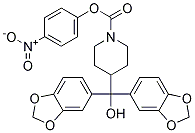
JZL184 Lipase inhibitor
Cat.No.S4904
Quality Control
| Related Targets | Dehydrogenase HSP Transferase P450 (e.g. CYP17) PDE phosphatase PPAR Vitamin Carbohydrate Metabolism Mitochondrial Metabolism |
|---|---|
| Other Lipase Inhibitors | Tanshinone IIA Atglistatin Schaftoside Pristimerin ABX-1431 XEN445 JW642 Ibrolipim Pancreatin URB602 |
Cell Culture, Treatment & Working Concentration
| Cell Lines | Assay Type | Concentration | Incubation Time | Formulation | Activity Description | PMID |
|---|---|---|---|---|---|---|
| COS7 cells | Function assay | Inhibition of human MAGL expressed in monkey COS7 cells, IC50=0.002 μM | ||||
| COS7 cells | Function assay | Inhibition of human MAGL expressed in COS7 cells using endogenous 2-AG substrate, IC50=0.002 μM | ||||
| Click to View More Cell Line Experimental Data | ||||||
Solubility
|
In vitro |
DMSO
: 5.5 mg/mL
(10.56 mM)
Warmed with 60°C water bath;
Ultrasonicated;
Water : Insoluble Ethanol : Insoluble |
Molarity Calculator
|
In vivo |
|||||
In vivo Formulation Calculator (Clear solution)
Step 1: Enter information below (Recommended: An additional animal making an allowance for loss during the experiment)
Step 2: Enter the in vivo formulation (This is only the calculator, not formulation. Please contact us first if there is no in vivo formulation at the solubility Section.)
Calculation results:
Working concentration: mg/ml;
Method for preparing DMSO master liquid: mg drug pre-dissolved in μL DMSO ( Master liquid concentration mg/mL, Please contact us first if the concentration exceeds the DMSO solubility of the batch of drug. )
Method for preparing in vivo formulation: Take μL DMSO master liquid, next addμL PEG300, mix and clarify, next addμL Tween 80, mix and clarify, next add μL ddH2O, mix and clarify.
Method for preparing in vivo formulation: Take μL DMSO master liquid, next add μL Corn oil, mix and clarify.
Note: 1. Please make sure the liquid is clear before adding the next solvent.
2. Be sure to add the solvent(s) in order. You must ensure that the solution obtained, in the previous addition, is a clear solution before proceeding to add the next solvent. Physical methods such
as vortex, ultrasound or hot water bath can be used to aid dissolving.
Chemical Information, Storage & Stability
| Molecular Weight | 520.49 | Formula | C27H24N2O9 |
Storage (From the date of receipt) | |
|---|---|---|---|---|---|
| CAS No. | 1101854-58-3 | Download SDF | Storage of Stock Solutions |
|
|
| Synonyms | N/A | SMILES | C1CN(CCC1C(C2=CC3=C(C=C2)OCO3)(C4=CC5=C(C=C4)OCO5)O)C(=O)OC6=CC=C(C=C6)[N+](=O)[O-] | ||
Read more about storage stability stock solution CAS number SMILES
Mechanism of Action
| Targets/IC50/Ki |
MAGL
8 nM
|
|---|---|
| In vitro |
JZL184 is a useful tool for studying the effects of endogenous 2-AG signaling. This compound displays time-dependent inhibition of MAGL and exhibits >300-fold selectivity for MAGL over FAAH in vitro. It does not interact with CB1 or CB2 receptors and does not inhibit the 2-AG biosynthetic enzymes diacylglycerol lipase-αand diacylglycerol lipase-β, or the arachidonic acid–mobilizing enzyme cytosolic phospholipase A2 group IVA.
|
| Kinase Assay |
activity-based protein profiling (ABPP)
|
|
Mouse brains are Dounce-homogenized in PBS, pH7.5, followed by a low-speed spin (1,400×, 5 min) to remove debris. The supernatant is then subjected to centrifugation (64,000×, 45 min) to provide the cytosolic fraction in the supernatant and the membrane fraction as a pellet. The pellet is washed and resuspended in PBS buffer by sonication. Total protein concentration in each fraction is determined using a protein assay kit. Samples are stored at -80 °C until use. Mouse brain membrane proteomes, are diluted to 1 mg/mL in PBS and pre-incubated with varying concentrations of this compound (1 nM to 10 mM) for 30 min at 37 °C before the addition of FP-rhodamine at a final concentration of 2 mM in a 50 mL total reaction volume. After 30 min at 25 °C, the reactions are quenched with 4×SDS-PAGE loading buffer, boiled for 5 min at 90 °C, subjected to SDS-PAGE and visualized in-gel using a flatbed fluorescence s
|
|
| In vivo |
JZL184 produced a rapid and sustained blockade of brain 2-AG hydrolase activity in mice, resulting in eight-fold elevations in endogenous 2-AG levels that are maintained for at least 8 h. This compound-treated mice showed a wide array of CB1-dependent behavioral effects, including analgesia, hypomotility and hypothermia, that suggest a broad role for 2-AG–mediated endocannabinoid signaling throughout the mammalian nervous system.
|
References |
|
Tech Support
Tel: +1-832-582-8158 Ext:3
If you have any other enquiries, please leave a message.

Products are for research use only. Not for human use. We do not sell to patients.
©Copyright 2013 Selleck Chemicals. All Rights Reserved.