
-
 Argentina
-
 Australia
-
 Austria
-
 Belgium
-
 Brazil
-
 Canada
-
 China
China
-
 Czech Republic
-
 Denmark
-
 Finland
-
 France
-
 Germany
-
 Greece
-
 Hong Kong
-
 Hungary
-
 Iceland
-
 India
India
-
 Ireland
-
 Israel
-
 Italy
Italy
-
 Japan
Japan
-
 Korea
Korea
-
 Luxembourg
-
 Malaysia
-
 Netherlands
-
 New Zealand
-
 Norway
-
 Poland
-
 Qatar
Qatar
-
 Romania
-
 Saudi Arabia
-
 Singapore
-
 Spain
Spain
-
 Sweden
-
 Switzerland
-
 Taiwan
-
 Turkey
-
 United Kingdom
-
 United States
research use only
Darapladib (SB-480848) Lp-PLA2 Inhibitor
Cat.No.S7520
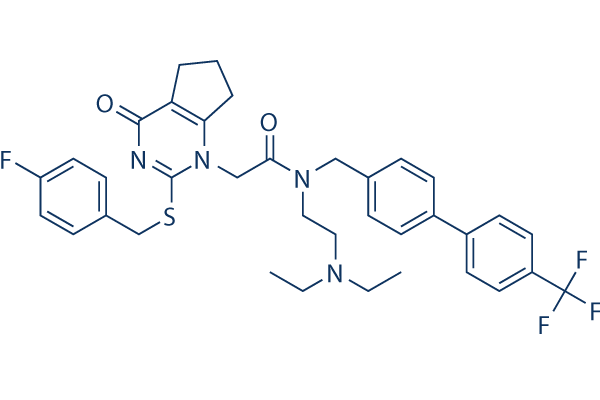
Chemical Structure
Molecular Weight: 666.77
Quality Control
| Related Targets | Dehydrogenase HSP Transferase P450 (e.g. CYP17) PDE phosphatase PPAR Vitamin Carbohydrate Metabolism Mitochondrial Metabolism |
|---|---|
| Other Phospholipase Inhibitors | Varespladib (LY315920) GW4869 U-73122 Tanshinone I (E/Z)-Polydatin Quinacrine 2HCl Melittin Trigonelline FIPI ML348 |
Cell Culture, Treatment & Working Concentration
| Cell Lines | Assay Type | Concentration | Incubation Time | Formulation | Activity Description | PMID |
|---|---|---|---|---|---|---|
| KB-8-5-11 | qHTS assay | P-glycoprotein substrates identified in KB-8-5-11 adenocarcinoma cell line, qHTS therapeutic library screen | 31515284 | |||
| KB-3-1 | qHTS assay | P-glycoprotein substrates identified in KB-3-1 adenocarcinoma cell line, qHTS therapeutic library screen | 31515284 | |||
| Click to View More Cell Line Experimental Data | ||||||
Solubility
|
In vitro |
DMSO
: 100 mg/mL
(149.97 mM)
Ethanol : 100 mg/mL Water : Insoluble |
Molarity Calculator
|
In vivo |
|||||
In vivo Formulation Calculator (Clear solution)
Step 1: Enter information below (Recommended: An additional animal making an allowance for loss during the experiment)
Step 2: Enter the in vivo formulation (This is only the calculator, not formulation. Please contact us first if there is no in vivo formulation at the solubility Section.)
Calculation results:
Working concentration: mg/ml;
Method for preparing DMSO master liquid: mg drug pre-dissolved in μL DMSO ( Master liquid concentration mg/mL, Please contact us first if the concentration exceeds the DMSO solubility of the batch of drug. )
Method for preparing in vivo formulation: Take μL DMSO master liquid, next addμL PEG300, mix and clarify, next addμL Tween 80, mix and clarify, next add μL ddH2O, mix and clarify.
Method for preparing in vivo formulation: Take μL DMSO master liquid, next add μL Corn oil, mix and clarify.
Note: 1. Please make sure the liquid is clear before adding the next solvent.
2. Be sure to add the solvent(s) in order. You must ensure that the solution obtained, in the previous addition, is a clear solution before proceeding to add the next solvent. Physical methods such
as vortex, ultrasound or hot water bath can be used to aid dissolving.
Chemical Information, Storage & Stability
| Molecular Weight | 666.77 | Formula | C36H38F4N4O2S |
Storage (From the date of receipt) | |
|---|---|---|---|---|---|
| CAS No. | 356057-34-6 | Download SDF | Storage of Stock Solutions |
|
|
| Synonyms | SB-480848 | Smiles | CCN(CC)CCN(CC1=CC=C(C=C1)C2=CC=C(C=C2)C(F)(F)F)C(=O)CN3C4=C(CCC4)C(=O)N=C3SCC5=CC=C(C=C5)F | ||
Mechanism of Action
| Targets/IC50/Ki |
Lp-PLA2
(Cell-free assay) 0.25 nM
|
|---|---|
| In vitro |
During the copper catalysed oxidation of human LDL, Darapladib prevents the production of lyso-PtdCho with IC50 of 4 nM and subsequent monocyte chemotaxis with IC50 of 4 nM. |
| In vivo |
In the WHHL rabbits, Darapladib (30 mg/kg p.o.) exhibits excellent inhibition of Lp-PLA2 within the atherosclerotic plaque by 95%. This compound, as an inhibitor of Lp-PLA2, reduces development of advanced coronary atherosclerosis in diabetic and hypercholesterolemic (DMHC) pigs. In DMHC pigs, this compound reduces the amount of IgG-immunopositive material that leaked into the brain and also the density of Aβ42-containing neurons. |
References |
|
Clinical Trial Information
(data from https://clinicaltrials.gov, updated on 2024-05-22)
| NCT Number | Recruitment | Conditions | Sponsor/Collaborators | Start Date | Phases |
|---|---|---|---|---|---|
| NCT02000804 | Completed | Atherosclerosis |
GlaxoSmithKline |
October 23 2013 | Phase 1 |
| NCT01873339 | Completed | Atherosclerosis |
GlaxoSmithKline |
June 19 2013 | Phase 1 |
| NCT01852565 | Completed | Atherosclerosis |
GlaxoSmithKline |
May 14 2013 | Phase 1 |
| NCT01751074 | Completed | Atherosclerosis |
GlaxoSmithKline |
December 17 2012 | Phase 1 |
| NCT01711723 | Completed | Atherosclerosis |
GlaxoSmithKline |
October 29 2012 | Phase 1 |
| NCT01154114 | Completed | Atherosclerosis |
GlaxoSmithKline |
July 1 2010 | Phase 1 |
Tech Support
Tel: +1-832-582-8158 Ext:3
If you have any other enquiries, please leave a message.
Signaling Pathway Map

Products are for research use only. Not for human use. We do not sell to patients.
©Copyright 2013 Selleck Chemicals. All Rights Reserved.