
-
 Argentina
-
 Australia
-
 Austria
-
 Belgium
-
 Brazil
-
 Canada
-
 China
China
-
 Czech Republic
-
 Denmark
-
 Finland
-
 France
-
 Germany
-
 Greece
-
 Hong Kong
-
 Hungary
-
 Iceland
-
 India
India
-
 Ireland
-
 Israel
-
 Italy
Italy
-
 Japan
Japan
-
 Korea
Korea
-
 Luxembourg
-
 Malaysia
-
 Netherlands
-
 New Zealand
-
 Norway
-
 Poland
-
 Qatar
Qatar
-
 Romania
-
 Saudi Arabia
-
 Singapore
-
 Spain
Spain
-
 Sweden
-
 Switzerland
-
 Taiwan
-
 Turkey
-
 United Kingdom
-
 United States
research use only
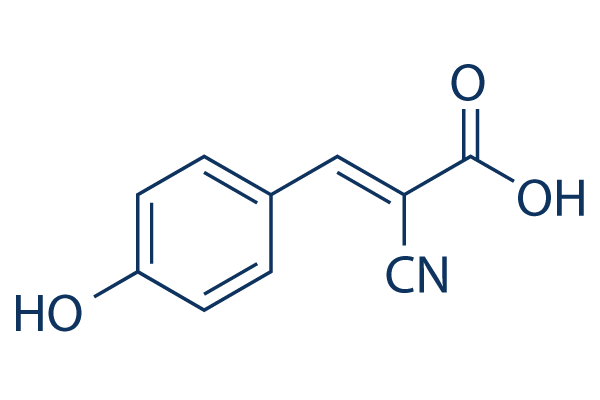
α-cyano-4-hydroxycinnamic acid(α-CHCA) MCT inhibitor
Cat.No.S8612
Quality Control
| Related Targets | CFTR CRM1 CD markers AChR Calcium Channel Sodium Channel Potassium Channel GABA Receptor TRP Channel ATPase |
|---|---|
| Other MCT Inhibitors | AZD3965 VB124 BAY-8002 AR-C155858 Syrosingopine (SU 3118) AZD0095 MCT-IN-1 MSC-4381 7ACC2 |
Solubility
|
In vitro |
DMSO
: 38 mg/mL
(200.87 mM)
Ethanol : 38 mg/mL Water : Insoluble |
Molarity Calculator
|
In vivo |
|||||
In vivo Formulation Calculator (Clear solution)
Step 1: Enter information below (Recommended: An additional animal making an allowance for loss during the experiment)
Step 2: Enter the in vivo formulation (This is only the calculator, not formulation. Please contact us first if there is no in vivo formulation at the solubility Section.)
Calculation results:
Working concentration: mg/ml;
Method for preparing DMSO master liquid: mg drug pre-dissolved in μL DMSO ( Master liquid concentration mg/mL, Please contact us first if the concentration exceeds the DMSO solubility of the batch of drug. )
Method for preparing in vivo formulation: Take μL DMSO master liquid, next addμL PEG300, mix and clarify, next addμL Tween 80, mix and clarify, next add μL ddH2O, mix and clarify.
Method for preparing in vivo formulation: Take μL DMSO master liquid, next add μL Corn oil, mix and clarify.
Note: 1. Please make sure the liquid is clear before adding the next solvent.
2. Be sure to add the solvent(s) in order. You must ensure that the solution obtained, in the previous addition, is a clear solution before proceeding to add the next solvent. Physical methods such
as vortex, ultrasound or hot water bath can be used to aid dissolving.
Chemical Information, Storage & Stability
| Molecular Weight | 189.17 | Formula | C10H7NO3 |
Storage (From the date of receipt) | |
|---|---|---|---|---|---|
| CAS No. | 28166-41-8 | Download SDF | Storage of Stock Solutions |
|
|
| Synonyms | N/A | SMILES | C1=CC(=CC=C1C=C(C#N)C(=O)O)O | ||
Read more about storage stability stock solution CAS number SMILES
Mechanism of Action
| Targets/IC50/Ki |
MCT
|
|---|---|
| In vitro |
Most glioma cell lines are sensitive to CHC, with the exception of SW1088 and SW1783 cells, which show lower sensitivity. The effect of CHC on U251 and SW1088 total cell biomass appears to be related to lactate transport activity. Accordingly, U251 cells presents higher levels of MCT1 and CD147 at the plasma membrane than did SW1088, and consequently, CHC decreases glucose consumption and lactate production in U251, but not in SW1088 cells. In the sensitive U251 cells, CHC is able to inhibit cell proliferation and induce cell death, having a cytotoxic effect; however, in the less sensitive SW1088 cells, CHC only inhibits cell proliferation but did not induce cell death, having only a cytostatic effect. CHC does not enter the cell because its inhibitory effect is dependent on interactions with membrane proteins accessible from the outside of the cell. CHC can inhibit different MCT isoforms. However, they have different sensitivities. In this context, in addition to MCT1, CHC could also inhibit MCT4 activity; however, the latter should happen at much higher concentrations, because MCT4 has much lower affinity for CHC (Ki values are 5-10 times higher than for MCT1; 50-100 mM). Transport by MCT1, 2, and 4 is competitively inhibited by CHC whereas transport by MCT3 is insensitive to this inhibitor. CHC is also a small-molecule inhibitor of lactate transport.
|
| In vivo |
CHC effects in the normal brain tissue are minimal and do not have a significant impact in the neuron-astrocyte lactate shuttle.
|
References |
|
Tech Support
Tel: +1-832-582-8158 Ext:3
If you have any other enquiries, please leave a message.

Products are for research use only. Not for human use. We do not sell to patients.
©Copyright 2013 Selleck Chemicals. All Rights Reserved.