
-
 Argentina
-
 Australia
-
 Austria
-
 Belgium
-
 Brazil
-
 Canada
-
 China
China
-
 Czech Republic
-
 Denmark
-
 Finland
-
 France
-
 Germany
-
 Greece
-
 Hong Kong
-
 Hungary
-
 Iceland
-
 India
India
-
 Ireland
-
 Israel
-
 Italy
Italy
-
 Japan
Japan
-
 Korea
Korea
-
 Luxembourg
-
 Malaysia
-
 Netherlands
-
 New Zealand
-
 Norway
-
 Poland
-
 Portugal
-
 Qatar
Qatar
-
 Romania
-
 Saudi Arabia
-
 Singapore
-
 Spain
Spain
-
 Sweden
-
 Switzerland
-
 Taiwan
-
 Turkey
-
 United Kingdom
-
 United States
research use only
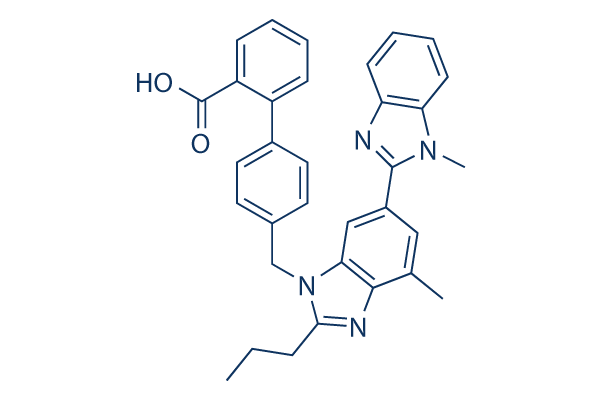
Telmisartan Angiotensin Receptor antagonist
Cat.No.S1738
Quality Control
| Related Targets | CXCR Hedgehog/Smoothened PKA Adrenergic Receptor AChR 5-HT Receptor Histamine Receptor Dopamine Receptor Ras KRas |
|---|---|
| Other Angiotensin Receptor Inhibitors | PD123319 ML221 A-779 Fimasartan Olodanrigan (EMA401) Buloxibutid AVE 0991 |
Cell Culture, Treatment & Working Concentration
| Cell Lines | Assay Type | Concentration | Incubation Time | Formulation | Activity Description | PMID |
|---|---|---|---|---|---|---|
| CHO cells | Function assay | Antagonist activity at human AT1 receptor expressed in CHO cells measured after overnight incubation by luciferase reporter gene assay, IC50=0.002 μM | ||||
| HepG2 cells | Function assay | Inhibition of liver stage Plasmodium berghei infection in HepG2 cells, IC50=0.025 μM | ||||
| CV1 cells | Function assay | Agonist activity at human PPARgamma expressed in african green monkey CV1 cells by Gal4 transactivation assay, EC50=2.02 μM | ||||
| HEK293 cells | Function assay | Inhibition of human MATE1-mediated ASP+ uptake expressed in HEK293 cells after 1.5 mins by fluorescence assay, IC50=17.9 μM | ||||
| Click to View More Cell Line Experimental Data | ||||||
Solubility
|
In vitro |
DMSO
: 15 mg/mL
(29.14 mM)
Water : Insoluble Ethanol : Insoluble |
Molarity Calculator
|
In vivo |
|||||
In vivo Formulation Calculator (Clear solution)
Step 1: Enter information below (Recommended: An additional animal making an allowance for loss during the experiment)
Step 2: Enter the in vivo formulation (This is only the calculator, not formulation. Please contact us first if there is no in vivo formulation at the solubility Section.)
Calculation results:
Working concentration: mg/ml;
Method for preparing DMSO master liquid: mg drug pre-dissolved in μL DMSO ( Master liquid concentration mg/mL, Please contact us first if the concentration exceeds the DMSO solubility of the batch of drug. )
Method for preparing in vivo formulation: Take μL DMSO master liquid, next addμL PEG300, mix and clarify, next addμL Tween 80, mix and clarify, next add μL ddH2O, mix and clarify.
Method for preparing in vivo formulation: Take μL DMSO master liquid, next add μL Corn oil, mix and clarify.
Note: 1. Please make sure the liquid is clear before adding the next solvent.
2. Be sure to add the solvent(s) in order. You must ensure that the solution obtained, in the previous addition, is a clear solution before proceeding to add the next solvent. Physical methods such
as vortex, ultrasound or hot water bath can be used to aid dissolving.
Chemical Information, Storage & Stability
| Molecular Weight | 514.62 | Formula | C33H30N4O2 |
Storage (From the date of receipt) | |
|---|---|---|---|---|---|
| CAS No. | 144701-48-4 | Download SDF | Storage of Stock Solutions |
|
|
| Synonyms | BIBR 277 | SMILES | CCCC1=NC2=C(N1CC3=CC=C(C=C3)C4=CC=CC=C4C(=O)O)C=C(C=C2C)C5=NC6=CC=CC=C6N5C | ||
Read more about storage stability stock solution CAS number SMILES
Mechanism of Action
| Targets/IC50/Ki |
angiotensin II receptor
|
|---|---|
| In vitro |
Telmisartan functions as a moderately potent (EC50=4.5 μM), selective PPARγ partial agonist, activating the receptor to 25% to 30% of the maximum level achieved by the full agonists pioglitazone and rosiglitazone. This compound induces adipocyte differentiation of 3T3-L1 cells. It causes a 60% to 70% decrease in the expression of ACC2 in murine muscle myotubes. This chemical, but not candesartan, another ARB, downregulates RAGE mRNA levels in a dose-dependent manner. It decreases basal as well as AGE-induced RAGE protein expression in Hep3B cells. This compound dose-dependently inhibits AGE-induced ROS generation and subsequent CRP gene and protein induction in Hep3B cells. It effectively facilitates differentiation of 3T3-L1 preadipocytes. This chemical causes a dose-dependent increase in mRNA levels for PPARgamma target genes such as aP2 and adiponectin in both differentiating adipocytes and fully differentiated adipocytes. It attenuates 11beta-hydroxysteroid dehydrogenase type 1 mRNA level in differentiated adipocytes.
|
| In vivo |
Telmisartan promotes increases in caloric expenditure and protects against dietary-induced weight gain in rats fed with a high-fat, high-carbohydrate diet. This compound reduces the accumulation of visceral fat and decreases adipocyte size to a much greater extent than valsartan and is also associated with a significant reduction in hepatic triglyceride levels in rats fed with a high-fat, high-carbohydrate diet.
|
References |
|
Applications
| Methods | Biomarkers | Images | PMID |
|---|---|---|---|
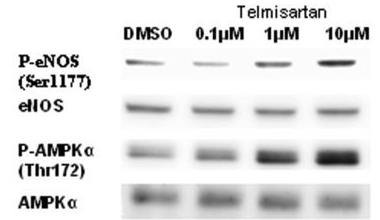
| Western blot | p-eNOS / eNOS / p-AMPKα / AMPKα p-CREB / CREB / p-p38 MAPK / p38 MAPK Cyclin D1 / CDK4 / CDK6 / CDK2 / Cylcin E / E2F2 |
|
24827148 |
Clinical Trial Information
(data from https://clinicaltrials.gov, updated on 2025-10-03)
| NCT Number | Recruitment | Conditions | Sponsor/Collaborators | Start Date | Phases |
|---|---|---|---|---|---|
| NCT07207057 | RECRUITING | Parkinsons Disease (PD) |
University College, London |
2025-09-12 | PHASE3 |
| NCT07568574 | ENROLLING_BY_INVITATION | Safety and Impact of Medically Supervised Performance Enhancing Substance Usage in Healthy Elite Athletes |
Enhanced Emirates Limited |
2026-03-12 | |
| NCT07588932 | RECRUITING | Stroke |
Spaulding Rehabilitation Hospital |
2026-05-18 | EARLY_PHASE1 |
| NCT06815497 | RECRUITING | Ovarian Cancer |
Tyler J Curiel |
2026-01-21 | PHASE2 |
| NCT06168487 | RECRUITING | Prostate Cancer |
Tyler J Curiel |
2024-04-22 | PHASE1 |
| NCT07784608 | NOT_YET_RECRUITING | Drug-drug Interactions |
Huons Co., Ltd. |
2026-09 | PHASE1 |
Read more about Clinical Trials
Tech Support
Tel: +1-832-582-8158 Ext:3
If you have any other enquiries, please leave a message.

Products are for research use only. Not for human use. We do not sell to patients.
©Copyright 2013 Selleck Chemicals. All Rights Reserved.