
-
 Argentina
-
 Australia
-
 Austria
-
 Belgium
-
 Brazil
-
 Canada
-
 China
China
-
 Czech Republic
-
 Denmark
-
 Finland
-
 France
-
 Germany
-
 Greece
-
 Hong Kong
-
 Hungary
-
 Iceland
-
 India
India
-
 Ireland
-
 Israel
-
 Italy
Italy
-
 Japan
Japan
-
 Korea
Korea
-
 Luxembourg
-
 Malaysia
-
 Netherlands
-
 New Zealand
-
 Norway
-
 Poland
-
 Qatar
Qatar
-
 Romania
-
 Saudi Arabia
-
 Singapore
-
 Spain
Spain
-
 Sweden
-
 Switzerland
-
 Taiwan
-
 Turkey
-
 United Kingdom
-
 United States
research use only
ML221 Angiotensin Receptor antagonist
Cat.No.S8695
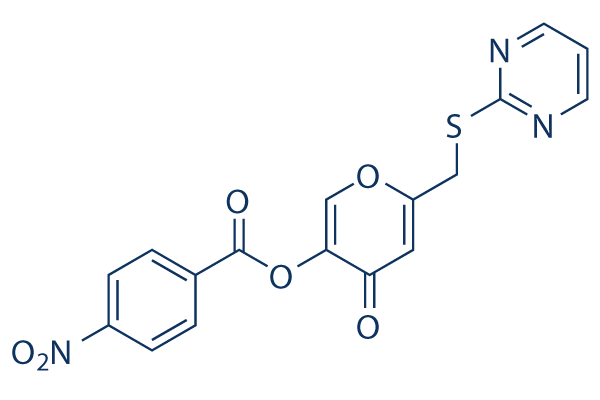
Chemical Structure
Molecular Weight: 385.35
Quality Control
| Related Targets | CXCR Hedgehog/Smoothened PKA Adrenergic Receptor AChR 5-HT Receptor Histamine Receptor Dopamine Receptor Ras KRas |
|---|---|
| Other Angiotensin Receptor Inhibitors | PD123319 A-779 Fimasartan Olodanrigan (EMA401) Buloxibutid AVE 0991 |
Solubility
|
In vitro |
DMSO
: 9 mg/mL
(23.35 mM)
Water : Insoluble Ethanol : Insoluble |
Molarity Calculator
|
In vivo |
|||||
In vivo Formulation Calculator (Clear solution)
Step 1: Enter information below (Recommended: An additional animal making an allowance for loss during the experiment)
Step 2: Enter the in vivo formulation (This is only the calculator, not formulation. Please contact us first if there is no in vivo formulation at the solubility Section.)
Calculation results:
Working concentration: mg/ml;
Method for preparing DMSO master liquid: mg drug pre-dissolved in μL DMSO ( Master liquid concentration mg/mL, Please contact us first if the concentration exceeds the DMSO solubility of the batch of drug. )
Method for preparing in vivo formulation: Take μL DMSO master liquid, next addμL PEG300, mix and clarify, next addμL Tween 80, mix and clarify, next add μL ddH2O, mix and clarify.
Method for preparing in vivo formulation: Take μL DMSO master liquid, next add μL Corn oil, mix and clarify.
Note: 1. Please make sure the liquid is clear before adding the next solvent.
2. Be sure to add the solvent(s) in order. You must ensure that the solution obtained, in the previous addition, is a clear solution before proceeding to add the next solvent. Physical methods such
as vortex, ultrasound or hot water bath can be used to aid dissolving.
Chemical Information, Storage & Stability
| Molecular Weight | 385.35 | Formula | C17H11N3O6S |
Storage (From the date of receipt) | |
|---|---|---|---|---|---|
| CAS No. | 877636-42-5 | -- | Storage of Stock Solutions |
|
|
| Synonyms | N/A | Smiles | C1=CN=C(N=C1)SCC2=CC(=O)C(=CO2)OC(=O)C3=CC=C(C=C3)[N+](=O)[O-] | ||
Mechanism of Action
| Targets/IC50/Ki |
apelin receptor
(β-arrestin assay) 1.75 μM
|
|---|---|
| In vitro |
In a PAMPA permeability assay, ML221 exhibits moderate permeability. It displays moderate plasma and poor microsomal stability, as it is rapidly metabolized in both human and mouse liver homogenates (4.2% and 4.9% remaining at 60 min). It shows no toxicity (>50 μM) toward human hepatocytes. This compound displays limited cross reactivity against a range of GPCRs. It inhibits endothelial cell proliferation by blocking apelin-APJ signaling without affecting the expression of VEGF and VEGFR2.
|
| In vivo |
Intraperitoneal administration of ML221 inhibits pathological angiogenesis but enhances the recovery of normal vessels into the ischemic regions in the retina of the OIR model mice. A single application of this compound alleviates mechanical allodynia and heat hyperalgesia 7 days following chronic constriction injury (CCI), in a dose‑dependent manner. Intraspinal delivery of this chemical, at the onset of and in fully‑established neuropathic pain, persistently attenuates CCI‑induced pain hypersensitivity, indicating that the apelin‑APJ system is involved in initiating and maintaining pain. Intrathecal ML221 downregulates phosphorylated extracellular signal‑related kinase (ERK) in the rat spinal cord dorsal horn, suggesting that the effect of apelin on neuropathic pain may be mediated via ERK signaling.
|
Tech Support
Tel: +1-832-582-8158 Ext:3
If you have any other enquiries, please leave a message.

Products are for research use only. Not for human use. We do not sell to patients.
©Copyright 2013 Selleck Chemicals. All Rights Reserved.