
-
 Australia
-
 Austria
-
 Belgium
-
 Brazil
-
 Canada
-
 China
China
-
 Czech Republic
-
 Denmark
-
 Finland
-
 France
-
 Germany
-
 Greece
-
 Hong Kong
-
 Hungary
-
 Iceland
-
 India
India
-
 Ireland
-
 Israel
-
 Italy
Italy
-
 Japan
Japan
-
 Korea
Korea
-
 Luxembourg
-
 Malaysia
-
 Netherlands
-
 New Zealand
-
 Norway
-
 Poland
-
 Qatar
Qatar
-
 Romania
-
 Saudi Arabia
-
 Singapore
-
 Spain
Spain
-
 Sweden
-
 Switzerland
-
 Taiwan
-
 Turkey
-
 United Kingdom
-
 United States
research use only
Nefiracetam GABA Receptor activator
Cat.No.S1969
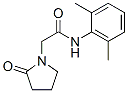
Chemical Structure
Molecular Weight: 246.3
Quality Control
| Related Targets | Adrenergic Receptor AChR 5-HT Receptor COX Calcium Channel Histamine Receptor Dopamine Receptor TRP Channel Cholinesterase (ChE) GluR |
|---|---|
| Other GABA Receptor Inhibitors | Dihydromyricetin CGP52432 Pentylenetetrazol 4-Aminobutyric acid (GABA) (+)-Borneol Ginkgolide A Oxiracetam Emamectin Benzoate Fluralaner (-)-Borneol |
Solubility
|
In vitro |
DMSO
: 49 mg/mL
(198.94 mM)
Ethanol : 49 mg/mL Water : 3 mg/mL |
Molarity Calculator
|
In vivo |
|||||
In vivo Formulation Calculator (Clear solution)
Step 1: Enter information below (Recommended: An additional animal making an allowance for loss during the experiment)
Step 2: Enter the in vivo formulation (This is only the calculator, not formulation. Please contact us first if there is no in vivo formulation at the solubility Section.)
Calculation results:
Working concentration: mg/ml;
Method for preparing DMSO master liquid: mg drug pre-dissolved in μL DMSO ( Master liquid concentration mg/mL, Please contact us first if the concentration exceeds the DMSO solubility of the batch of drug. )
Method for preparing in vivo formulation: Take μL DMSO master liquid, next addμL PEG300, mix and clarify, next addμL Tween 80, mix and clarify, next add μL ddH2O, mix and clarify.
Method for preparing in vivo formulation: Take μL DMSO master liquid, next add μL Corn oil, mix and clarify.
Note: 1. Please make sure the liquid is clear before adding the next solvent.
2. Be sure to add the solvent(s) in order. You must ensure that the solution obtained, in the previous addition, is a clear solution before proceeding to add the next solvent. Physical methods such
as vortex, ultrasound or hot water bath can be used to aid dissolving.
Chemical Information, Storage & Stability
| Molecular Weight | 246.3 | Formula | C14H18N2O2 |
Storage (From the date of receipt) | |
|---|---|---|---|---|---|
| CAS No. | 77191-36-7 | Download SDF | Storage of Stock Solutions |
|
|
| Synonyms | DZL 221 | Smiles | CC1=C(C(=CC=C1)C)NC(=O)CN2CCCC2=O | ||
Mechanism of Action
| Targets/IC50/Ki |
GABA receptor
|
|---|---|
| In vitro |
Nefiracetam at a concentration of 1 μM increases a long-lasting component of calcium channel currents two-fold without affecting a transient component. This compound induces a short-term depression of ACh-evoked currents at submicromolar concentrations (0.01–0.1 μM) and a long-term enhancement of the currents at micromolar concentrations (1–10 μM). It interacts with PKA and PKC pathways, which may explain a cellular mechanism for the action of cognition-enhancing agents. Lower (submicromolar) concentrations of the nootropic reduces ACh-evoked currents to 30% (0.01 μM) and 38% (0.1 μM) of control after a 10-minute treatment. In primary cultures of rat hippocampal neurons, this compound increases the rate of nicotine-sensitive miniature excitatory postsynaptic currents. It induces a long-lasting facilitation of synaptic transmission in both the CA1 area and the dentate gyrus of rat hippocampal slices, and the facilitation is inhibited by α-bungarotoxin and mecamylamine. This chemical enhances activity of nicotinic ACh receptors by interacting with a PKC pathway, thereby increasing glutamate release from presynaptic terminals, and then leading to a sustained facilitation of hippocampal neurotransmission.
|
| Kinase Assay |
Assay of glutamate released
|
|
Hippocampal slices (400 μM) are prepared from the guinea pig brain using standard techniques. A slice is fixed on a pair of silver wire electrodes (10 Hz, 5 V, 0.1 ms in duration) at 1-minutes intervals for 10 minutes and submerged in 1 mL standard artificial cerebrospinal fluid (ACSF) (in mM: 125 mM NaCl, 5 mM KCl, 1.24 mM KH2PO4, 1.3 mM MgSO4, 2 mM CaCl2, 26 mM NaHCO3, and 10 mM glucose) oxygenated with 95% O2 and 5% CO2 at 36 °C in the presence and absence of tetrodotoxin (TTX) (0.5 μM). In a different set of experiments, electrical stimulation is applied to slices treated with this compound (1 μM) in the presence and absence of α-bungarotoxin (50 nM) or mecamylamine (3 μM). A 100 μL aliquot of the medium filtered with millipore filters (0.45 μM) is injected onto the cation-exchanger column of the autoanalyser to separate amino acids and the amount of glutamate released is calculated using known amino acid standard concentrations.
|
|
| In vivo |
Nefiracetam administered orally inhibits Ro 5-4864-induced convulsions in EL mice. This compound also efficiently inhibits Ro 5-4864-induced convulsions in DDY mice at doses higher than 10 mg/kg. It administered daily 1 hour before each training session facilitates the acquisition process of the avoidance response.
|
References |
|
Tech Support
Tel: +1-832-582-8158 Ext:3
If you have any other enquiries, please leave a message.
Signaling Pathway Map

Products are for research use only. Not for human use. We do not sell to patients.
©Copyright 2013 Selleck Chemicals. All Rights Reserved.