
-
 Argentina
-
 Australia
-
 Austria
-
 Belgium
-
 Brazil
-
 Canada
-
 China
China
-
 Czech Republic
-
 Denmark
-
 Finland
-
 France
-
 Germany
-
 Greece
-
 Hong Kong
-
 Hungary
-
 Iceland
-
 India
India
-
 Ireland
-
 Israel
-
 Italy
Italy
-
 Japan
Japan
-
 Korea
Korea
-
 Luxembourg
-
 Malaysia
-
 Netherlands
-
 New Zealand
-
 Norway
-
 Poland
-
 Portugal
-
 Qatar
Qatar
-
 Romania
-
 Saudi Arabia
-
 Singapore
-
 Spain
Spain
-
 Sweden
-
 Switzerland
-
 Taiwan
-
 Turkey
-
 United Kingdom
-
 United States
research use only
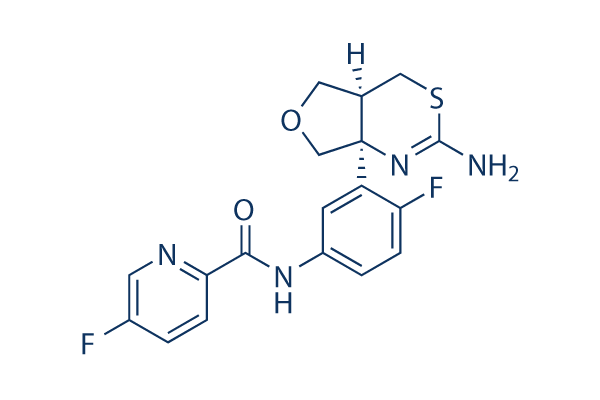
LY2886721 BACE inhibitor
Cat.No.S2156
Quality Control
Solubility
|
In vitro |
DMSO
: 35 mg/mL
(89.64 mM)
Water : Insoluble Ethanol : Insoluble |
Molarity Calculator
|
In vivo |
|||||
In vivo Formulation Calculator (Clear solution)
Step 1: Enter information below (Recommended: An additional animal making an allowance for loss during the experiment)
Step 2: Enter the in vivo formulation (This is only the calculator, not formulation. Please contact us first if there is no in vivo formulation at the solubility Section.)
Calculation results:
Working concentration: mg/ml;
Method for preparing DMSO master liquid: mg drug pre-dissolved in μL DMSO ( Master liquid concentration mg/mL, Please contact us first if the concentration exceeds the DMSO solubility of the batch of drug. )
Method for preparing in vivo formulation: Take μL DMSO master liquid, next addμL PEG300, mix and clarify, next addμL Tween 80, mix and clarify, next add μL ddH2O, mix and clarify.
Method for preparing in vivo formulation: Take μL DMSO master liquid, next add μL Corn oil, mix and clarify.
Note: 1. Please make sure the liquid is clear before adding the next solvent.
2. Be sure to add the solvent(s) in order. You must ensure that the solution obtained, in the previous addition, is a clear solution before proceeding to add the next solvent. Physical methods such
as vortex, ultrasound or hot water bath can be used to aid dissolving.
Chemical Information, Storage & Stability
| Molecular Weight | 390.41 | Formula | C18H16F2N4O2S |
Storage (From the date of receipt) | |
|---|---|---|---|---|---|
| CAS No. | 1262036-50-9 | Download SDF | Storage of Stock Solutions |
|
|
| Synonyms | N/A | SMILES | C1C2CSC(=NC2(CO1)C3=C(C=CC(=C3)NC(=O)C4=NC=C(C=C4)F)F)N | ||
Read more about storage stability stock solution CAS number SMILES
Mechanism of Action
| Targets/IC50/Ki |
BACE2
(Cell-free assay) 10.2 nM
BACE1
(Cell-free assay) 20.3 nM
|
|---|---|
| In vitro |
LY2886721 is an oral, small molecule of β-site amyloid protein cleaving enzyme (BACE) inhibitor with the potential to inhibit the synthesis of β-amyloid and thereby to slow the clinical progression of AD. This compound can also targetγ-secretase to nhibit the synthesis of β-amyloid. It inhibits recombinant hBACE1 with an IC50 of 20.3 nM. In cellular assays, this chemical inhibits Abeta with an IC50 of 18.7 nM and 10.7 nM, HEK293Swe and PDAPP neuronal culture, respectively. It has high selectivity against key off-target proteases, which efficiently translates in vitro activity into robust in vivo amyloid β lowering in nonclinical animal models. Assessment of its activity against hBACE2 demonstrates an IC50 of 10.2 nM. Assessment of the compound's activity against cathepsin D, pepsin, renin, or other important aspartyl proteases shows essentially no inhibition (IC50 >100,000 nM), suggesting that activity against these common aspartyl proteases is unlikely to be significant.
|
| In vivo |
Oral administration of LY2886721 to PDAPP mice produces dose-dependent reductions in brain Abeta, C99 and sAPPbeta. Brain Abeta levels are decreased ∼20%-65% relative to vehicle-treated groups three hours after a 3-30 mg/kg dose of this compound. Brain C99 and sAPPb levels also are reduced in a dose-dependent manner consistent with BACE1 inhibition in vivo. The pharmacodynamic responses to this chemical persists out to 9 hours post dose in brains of PDAPP mice. Pharmacodynamic studies in beagle dog reveal robust and sustained reductions in plasma Abeta following 1 mg/kg dosing. Central effects of BACE1 inhibition in dog are manifested by a 50% reduction in CSF Abeta at 9 hours after a 0.5 mg/kg dose. The geometric mean terminal elimination t1/2 is determined to be 17.2 h (range 8.19-36.3 h). The geometric mean apparent oral clearance is 34.8 L/h (38% CV) and the apparent volume of distribution during the terminal phase was 863 L (56% CV) across dose levels. This compound is freely permeable across the blood-brain barrier.
|
References |
|
Clinical Trial Information
(data from https://clinicaltrials.gov, updated on 2018-05-18)
| NCT Number | Recruitment | Conditions | Sponsor/Collaborators | Start Date | Phases |
|---|---|---|---|---|---|
| NCT01561430 | TERMINATED | Alzheimer's Disease |
Eli Lilly and Company |
2012-03 | PHASE1; PHASE2 |
| NCT01775904 | COMPLETED | Healthy Volunteers |
Eli Lilly and Company |
2013-02 | PHASE1 |
| NCT01807026 | COMPLETED | Alzheimer Disease; Healthy Volunteers |
Eli Lilly and Company |
2013-03 | PHASE1 |
| NCT01807026 | Completed | Alzheimer Disease|Healthy Volunteers |
Eli Lilly and Company |
2013-03 | Phase 1 |
| NCT01534273 | COMPLETED | Healthy Volunteers |
Eli Lilly and Company |
2012-02 | PHASE1 |
| NCT01534273 | Completed | Healthy Volunteers |
Eli Lilly and Company |
2012-02 | Phase 1 |
Read more about Clinical Trials
Tech Support
Tel: +1-832-582-8158 Ext:3
If you have any other enquiries, please leave a message.
Signaling Pathway Map

Products are for research use only. Not for human use. We do not sell to patients.
©Copyright 2013 Selleck Chemicals. All Rights Reserved.