
-
 Argentina
-
 Australia
-
 Austria
-
 Belgium
-
 Brazil
-
 Canada
-
 China
China
-
 Czech Republic
-
 Denmark
-
 Finland
-
 France
-
 Germany
-
 Greece
-
 Hong Kong
-
 Hungary
-
 Iceland
-
 India
India
-
 Ireland
-
 Israel
-
 Italy
Italy
-
 Japan
Japan
-
 Korea
Korea
-
 Luxembourg
-
 Malaysia
-
 Netherlands
-
 New Zealand
-
 Norway
-
 Poland
-
 Qatar
Qatar
-
 Romania
-
 Saudi Arabia
-
 Singapore
-
 Spain
Spain
-
 Sweden
-
 Switzerland
-
 Taiwan
-
 Turkey
-
 United Kingdom
-
 United States
research use only
(20S)-Protopanaxadiol P-gp inhibitor
Cat.No.S4746
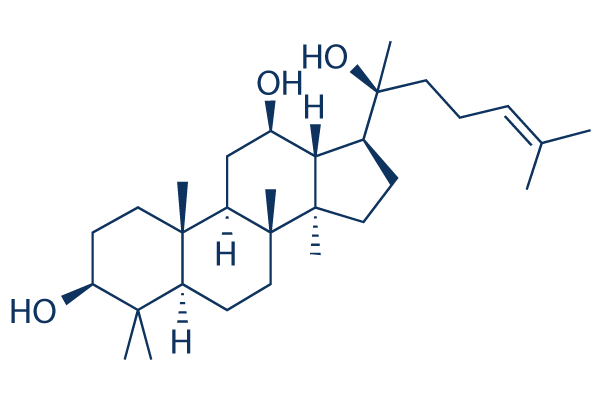
Chemical Structure
Molecular Weight: 460.73
Quality Control
Cell Culture, Treatment & Working Concentration
| Cell Lines | Assay Type | Concentration | Incubation Time | Formulation | Activity Description | PMID |
|---|---|---|---|---|---|---|
| SF188 cells | Cytotoxicity assay | 24 h | Cytotoxicity against human SF188 cells after 24 hrs | |||
| U87MG cells | Cytotoxicity assay | 24 h | Cytotoxicity against human U87MG cells after 24 hrs | |||
| U87MG cells | Function assay | 2 h | Increase in superoxide anion level in human U87MG cells after 2 hrs | |||
| U87MG cells | Function assay | 43.4 μM | 4 h | Induction of autophagy in human U87MG cells by MDC staining at 43.4 uM after 4 hrs | ||
| U87 cell | Cytotoxicity assay | 72 h | Cytotoxicity against human U87 cells after 72 hrs by MTT assay | |||
| Hep3B cells | Cytotoxicity assay | 72 h | Cytotoxicity against human Hep3B cells after 72 hrs by MTT assay | |||
| MDA-MB-231 cells | Function assay | 2.5-5.8 μM | 24 h | Induction of apoptosis in human MDA-MB-231 cells assessed as increase in expression of cleaved PARP at 2.5 to 5.8 uM after 24 hrs by SDS-polyactylamide gel electrophoresis | ||
| LLC-PK1 | Cytotoxicity assay | 4 h | Cytotoxicity against pig LLC-PK1 cells after 4 hrs by MTT assay | |||
| MDA-MB-231 cells | Proliferation assay | 4 h | Antiproliferative activity against human MDA-MB-231 cells after 4 hrs by MTT assay | |||
| COLO205 cells | Cytotoxicity assay | 72 h | Cytotoxicity against human COLO205 cells after 72 hrs by MTT assay | |||
| HL60 cells | Cytotoxicity assay | 72 h | Cytotoxicity against human HL60 cells after 72 hrs by MTT assay | |||
| HepG2 cells | Cytotoxicity assay | 72 h | Cytotoxicity against human HepG2 cells after 72 hrs by MTT assay | |||
| MCF7 cells | Cytotoxicity assay | 72 h | Cytotoxicity against human MCF7 cells after 72 hrs by MTT assay | |||
| SF188 cells | Function assay | 108.4 μM | 4 h | Induction of autophagy in human SF188 cells by MDC staining at 108.4 uM after 4 hrs | ||
| SF188 cells | Function assay | 108.4 μM | Activation of caspase 3 in human SF188 cells at 108.4 uM | |||
| SF188 cells | Function assay | 2 h | Increase in superoxide anion level in human SF188 cells after 2 hrs | |||
| SF188 cells | Function assay | 108.4 μM | Activation of caspase 7 in human SF188 cells at 108.4 uM | |||
| SF188 cells | Function assay | 43.4 μM | 4 h | Induction of autophagy in human SF188 cells by MDC staining at 43.4 uM after 4 hrs | ||
| HepG2 cells | Cytotoxicity assay | 48 h | Cytotoxicity against human HepG2 cells after 48 hrs by MTT assay | |||
| HL60 cells | Cytotoxicity assay | 48 h | Cytotoxicity against human HL60 cells after 48 hrs by MTT assay | |||
| Click to View More Cell Line Experimental Data | ||||||
Solubility
|
In vitro |
DMSO
: 92 mg/mL
(199.68 mM)
Ethanol : 33 mg/mL Water : Insoluble |
Molarity Calculator
|
In vivo |
|||||
In vivo Formulation Calculator (Clear solution)
Step 1: Enter information below (Recommended: An additional animal making an allowance for loss during the experiment)
Step 2: Enter the in vivo formulation (This is only the calculator, not formulation. Please contact us first if there is no in vivo formulation at the solubility Section.)
Calculation results:
Working concentration: mg/ml;
Method for preparing DMSO master liquid: mg drug pre-dissolved in μL DMSO ( Master liquid concentration mg/mL, Please contact us first if the concentration exceeds the DMSO solubility of the batch of drug. )
Method for preparing in vivo formulation: Take μL DMSO master liquid, next addμL PEG300, mix and clarify, next addμL Tween 80, mix and clarify, next add μL ddH2O, mix and clarify.
Method for preparing in vivo formulation: Take μL DMSO master liquid, next add μL Corn oil, mix and clarify.
Note: 1. Please make sure the liquid is clear before adding the next solvent.
2. Be sure to add the solvent(s) in order. You must ensure that the solution obtained, in the previous addition, is a clear solution before proceeding to add the next solvent. Physical methods such
as vortex, ultrasound or hot water bath can be used to aid dissolving.
Chemical Information, Storage & Stability
| Molecular Weight | 460.73 | Formula | C30H52O3 |
Storage (From the date of receipt) | |
|---|---|---|---|---|---|
| CAS No. | 30636-90-9 | Download SDF | Storage of Stock Solutions |
|
|
| Synonyms | 20-Epiprotopanaxadiol | Smiles | CC(=CCCC(C)(C1CCC2(C1C(CC3C2(CCC4C3(CCC(C4(C)C)O)C)C)O)C)O)C | ||
Mechanism of Action
| In vitro |
Concentrations causing growth inhibition of 50% of cells (LC50) for the compounds PPD is 23 μg/ml, for Int-407 cells. The the LC50 for PPD is determined to be 24 μg/ml in Caco-2 cells. In the Int-407 cell line, PPD produces great percentage of sub-G1 (apoptotic) cells(The Int-407 cell line is a human embryonic nonmalignant cell line originating from fetal tissue of approximately 2 months gestation, whereas Caco-2 is a human colon adenocarcinoma cell line). This response is attributed to differences in individual ginsenoside glycosylation and, thus, the hydrophobic-hydrophilic balance . Incubation with PPD also significantly reduces the viability of U251-MG and U87-MG cells in a dose- and time-dependent manner. The cytotoxic effect of PPD is accompanied by reduced expression of cell adhesion proteins, including N-cadherin and integrin β1, which leads to reduced phosphorylation of focal adhesion kinase. Furthermore, incubation with PPD reduces the expression of cyclin D1 and subsequently induces cell-cycle arrest at the G1 phase. |
|---|---|
| In vivo |
Treatment with PPD(20(S)-Protopanaxadiol) and PPT(20(S)-Protopanaxatriol) prior to immobilization stress increase the time spent in open arms and open arm entries in the elevated plus-maze (EPM) test. Treatment with PPD potently suppresses immobilization stress-induced serum levels of corticosterone and interleukin (IL)-6 by the enzyme-linked immunosorbent assay. PPD and PPT may exhibit the anxiolytic effect via γ-aminobutyrateA (GABAA) receptor(s) and serotonergic receptor(s), respectively, and PPD may have an anti-inflammatory effect that is more potent than that of PPT. |
References |
|
Tech Support
Tel: +1-832-582-8158 Ext:3
If you have any other enquiries, please leave a message.
Signaling Pathway Map

Products are for research use only. Not for human use. We do not sell to patients.
©Copyright 2013 Selleck Chemicals. All Rights Reserved.