
-
 Argentina
-
 Australia
-
 Austria
-
 Belgium
-
 Brazil
-
 Canada
-
 China
China
-
 Czech Republic
-
 Denmark
-
 Finland
-
 France
-
 Germany
-
 Greece
-
 Hong Kong
-
 Hungary
-
 Iceland
-
 India
India
-
 Ireland
-
 Israel
-
 Italy
Italy
-
 Japan
Japan
-
 Korea
Korea
-
 Luxembourg
-
 Malaysia
-
 Netherlands
-
 New Zealand
-
 Norway
-
 Poland
-
 Portugal
-
 Qatar
Qatar
-
 Romania
-
 Saudi Arabia
-
 Singapore
-
 Spain
Spain
-
 Sweden
-
 Switzerland
-
 Taiwan
-
 Turkey
-
 United Kingdom
-
 United States
research use only
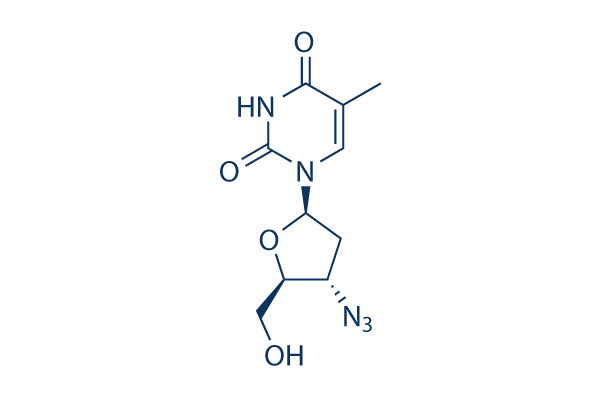
Zidovudine Reverse Transcriptase inhibitor
Cat.No.S2579
Quality Control
| Related Targets | Integrase Bacterial Antibiotics Anti-infection Fungal Antiviral COVID-19 Parasite HIV HCV Protease |
|---|---|
| Other Reverse Transcriptase Inhibitors | Dapivirine (TMC120) Fangchinoline 3'-Fluoro-3'-deoxythymidine (Alovudine) Salicylanilide Bifendate Ulonivirine Islatravir Lersivirine (UK-453061) 4-Chloro-2-(trifluoroacetyl)aniline hydrochloride |
Cell Culture, Treatment & Working Concentration
| Cell Lines | Assay Type | Concentration | Incubation Time | Formulation | Activity Description | PMID |
|---|---|---|---|---|---|---|
| human C8166 cells | Function assay | Antiviral activity against Human immunodeficiency virus 1 infected in human C8166 cells assessed as inhibition of virus-induced cytopathic effect, EC50=4e-06 μM | ||||
| PBMC | Function assay | 1 μM | Antiviral activity against HIV1 TEKI replication in PBMC at 1 uM, IC50=0.00014 μM | |||
| human H9 cells | Function assay | 6 days | Antiviral activity against Human immunodeficiency virus 1 3B infected in human H9 cells infected with 6.25 uL of virus stock assessed as expression of p24 antigen after 6 days postinfection by ELISA, IC50=0.3 nM | |||
| AA5 cells | Function assay | Antiviral activity against of Human immunodeficiency virus 1 3B infected in AA5 cells infected with 1.56 uL of virus stock assessed as inhibition of viral Reverse transcriptase by [3H]TTP incorporation assay, IC50=0.3 nM | ||||
| CEM cells | Function assay | Concentration of the drug resulting in 50% reduction of the viral cytopathic effect against HIV-1 replication in CEM cells, EC50=0.32 nM | ||||
| MT4 cells | Function assay | 4 days | Antiviral activity against HIV1 3B assessed as inhibition of virus-induced cytopathogenicity in MT4 cells after 4 days by MTT assay, EC50=0.7 nM | |||
| human MT2 cells | Function assay | 1 h | Antiviral activity against HIV1 subtype B-3B infected in 1 hr-pretreated human MT2 cells assessed as inhibition of multicycle replication measured on day 5 postinfection by RT SPA, EC50=1.2 nM | |||
| C8166 cells | Function assay | Inhibition of HIV1-3B replication in C8166 cells, EC50=1.9 nM | ||||
| CEM-SS cell | Function assay | Inhibitory activity against the HIV-1-induced cytopathic effect in CEM-SS cell line, IC50=0.002 μM | ||||
| PBLs | Function assay | Antiviral activity against subtype isolate G strain in PBLs (peripheral blood lymphocytes), IC50=0.002 μM | ||||
| human lymphocyte CEM/0 cell line | Function assay | Anti HIV-1 activity in human lymphocyte CEM/0 cell line, EC50=0.003 μM | ||||
| Jurkat cell | Function assay | Inhibitory concentration against HIV-1 infected Jurkat cell lines, IC50=0.01 μM | ||||
| human H9 cells | Cytotoxicity assay | 6 days | Cytotoxicity against human H9 cells after 6 days by MTT assay, EC50=0.01 μM | |||
| C3H/3T3 cells | Function assay | Concentration of compound required to inhibit HIV-1 induced cytopathogenicity of MSV-induced transformation of C3H/3T3 cells by 50%, EC50=0.02 μM | ||||
| U937 cells | Function assay | Effective concentration required for antiviral activity against Macrophage cell line of U937 cells of Human by XTT assay, EC50=0.03 μM | ||||
| Click to View More Cell Line Experimental Data | ||||||
Solubility
|
In vitro |
DMSO
: 53 mg/mL
(198.32 mM)
Ethanol : 53 mg/mL Water : 26 mg/mL |
Molarity Calculator
|
In vivo |
|||||
In vivo Formulation Calculator (Clear solution)
Step 1: Enter information below (Recommended: An additional animal making an allowance for loss during the experiment)
Step 2: Enter the in vivo formulation (This is only the calculator, not formulation. Please contact us first if there is no in vivo formulation at the solubility Section.)
Calculation results:
Working concentration: mg/ml;
Method for preparing DMSO master liquid: mg drug pre-dissolved in μL DMSO ( Master liquid concentration mg/mL, Please contact us first if the concentration exceeds the DMSO solubility of the batch of drug. )
Method for preparing in vivo formulation: Take μL DMSO master liquid, next addμL PEG300, mix and clarify, next addμL Tween 80, mix and clarify, next add μL ddH2O, mix and clarify.
Method for preparing in vivo formulation: Take μL DMSO master liquid, next add μL Corn oil, mix and clarify.
Note: 1. Please make sure the liquid is clear before adding the next solvent.
2. Be sure to add the solvent(s) in order. You must ensure that the solution obtained, in the previous addition, is a clear solution before proceeding to add the next solvent. Physical methods such
as vortex, ultrasound or hot water bath can be used to aid dissolving.
Chemical Information, Storage & Stability
| Molecular Weight | 267.24 | Formula | C10H13N5O4 |
Storage (From the date of receipt) | |
|---|---|---|---|---|---|
| CAS No. | 30516-87-1 | Download SDF | Storage of Stock Solutions |
|
|
| Synonyms | Azidothymidine, NSC 602670 | SMILES | CC1=CN(C(=O)NC1=O)C2CC(C(O2)CO)N=[N+]=[N-] | ||
Read more about storage stability stock solution CAS number SMILES
Mechanism of Action
| Targets/IC50/Ki |
Reverse transcriptase
|
|---|---|
| In vitro |
Zidovudine pretreatment has potent anti-HIV-1 activity in the newly infected T and monocytic cells but not in chronically infected cells. Inhibition of reverse transcription by this compound decreases p24 antigen levels modestly, decreased HIV-1 gag by 19-fold, and inhibits detection of 2-LTR HIV-1 DNA. This compound and dideoxynucleosides deplete wild-type mitochondrial DNA levels and increase deletedmitochondrial DNA levels in cultured Kearns-Sayre syndrome fibroblasts. This chemical (AZT, 0.1-50 mM) has a concentration dependent suppressive effect on the growth of granulocyte-monocyte colony forming unit (CFU-GM) derived colonies. This compound exposure also induces a concentration dependent suppressive effect (35-90%) on GM-CSF receptor type alpha (GM-CSFR alpha) gene expression. It causes a much lower decrease (15-22%) on the IL-3 receptor type alpha (IL-3R alpha) message level, and has an insignificant effect on glyceraldehyde 3-phosphate dehydrogenase (GAPDH) and c-myc message levels. This chemical causes a concentration-dependent inhibition in the levels of the mRNA of Epo receptors and c-fos, whereas the level of c-myc mRNA is unaffected. It also inhibits protein kinase C (PKC) activity in a concentration- and time-dependent manner, causing 50% inhibition at 10 mM within 3 hours. This compound-induced down-regulation of Epo receptors and c-fos expression coupled with inhibition of Epo receptor-mediated signal transduction through PKC are significant contributory factors to AZT-induced erythroid toxicity. This compound could decrease the HDR efficiency. It decrease CRISPR-mediated sequence-specific genome knockin events while increases knockout efficiency . |
References |
|
Clinical Trial Information
(data from https://clinicaltrials.gov, updated on 2026-08-25)
| NCT Number | Recruitment | Conditions | Sponsor/Collaborators | Start Date | Phases |
|---|---|---|---|---|---|
| NCT01419561 | RECRUITING | KSHV Inflammatory Cytokine Syndrome (KICS); KSHV; HHV-8 |
National Cancer Institute (NCI) |
2011-09-08 | PHASE2 |
| NCT00092222 | ACTIVE_NOT_RECRUITING | Lymphoproliferative Disorder; HHV-8; Malignancy; HIV |
National Cancer Institute (NCI) |
2004-10-28 | PHASE2 |
| NCT02737046 | COMPLETED | Adult T-cell Leukemia-Lymphoma; ATLL |
University of Miami |
2016-12-12 | PHASE2 |
| NCT04731103 | COMPLETED | Aicardi-Goutières Syndrome |
University of Edinburgh |
2022-08-24 | PHASE2 |
| NCT00799864 | COMPLETED | HIV-1 |
Janssen Sciences Ireland UC |
2011-01 | PHASE2 |
| NCT03088410 | COMPLETED | HIV; Insulin Sensitivity; Diabetes Mellitus |
Ann & Robert H Lurie Children's Hospital of Chicago |
2016-08-22 | PHASE4 |
Read more about Clinical Trials
Tech Support
Tel: +1-832-582-8158 Ext:3
If you have any other enquiries, please leave a message.
Frequently Asked Questions
Question 1:
Do you happen to have any information regarding its half-life?
Answer:
Its half-life in human is available (http://www.rxlist.com/retrovir-drug/clinical-pharmacology.htm), about 0.5-3 hours in adult subjects.
Signaling Pathway Map

Products are for research use only. Not for human use. We do not sell to patients.
©Copyright 2013 Selleck Chemicals. All Rights Reserved.