
-
 Argentina
-
 Australia
-
 Austria
-
 Belgium
-
 Brazil
-
 Canada
-
 China
China
-
 Czech Republic
-
 Denmark
-
 Finland
-
 France
-
 Germany
-
 Greece
-
 Hong Kong
-
 Hungary
-
 Iceland
-
 India
India
-
 Ireland
-
 Israel
-
 Italy
Italy
-
 Japan
Japan
-
 Korea
Korea
-
 Luxembourg
-
 Malaysia
-
 Netherlands
-
 New Zealand
-
 Norway
-
 Poland
-
 Portugal
-
 Qatar
Qatar
-
 Romania
-
 Saudi Arabia
-
 Singapore
-
 Spain
Spain
-
 Sweden
-
 Switzerland
-
 Taiwan
-
 Turkey
-
 United Kingdom
-
 United States
research use only
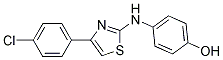
SKI II SPHK inhibitor
Cat.No.S7176
Quality Control
| Related Targets | PD-1/PD-L1 CXCR STING AhR Immunology & Inflammation related CD markers Interleukins Anti-infection Antioxidant COX |
|---|---|
| Other SPHK Inhibitors | Opaganib (ABC294640) PF-543 hydrochloride Defensamide (MHP) K6PC-5 SKI-V SKI-178 |
Solubility
|
In vitro |
DMSO
: 61 mg/mL
(201.46 mM)
Ethanol : 8 mg/mL Water : Insoluble |
Molarity Calculator
|
In vivo |
|||||
In vivo Formulation Calculator (Clear solution)
Step 1: Enter information below (Recommended: An additional animal making an allowance for loss during the experiment)
Step 2: Enter the in vivo formulation (This is only the calculator, not formulation. Please contact us first if there is no in vivo formulation at the solubility Section.)
Calculation results:
Working concentration: mg/ml;
Method for preparing DMSO master liquid: mg drug pre-dissolved in μL DMSO ( Master liquid concentration mg/mL, Please contact us first if the concentration exceeds the DMSO solubility of the batch of drug. )
Method for preparing in vivo formulation: Take μL DMSO master liquid, next addμL PEG300, mix and clarify, next addμL Tween 80, mix and clarify, next add μL ddH2O, mix and clarify.
Method for preparing in vivo formulation: Take μL DMSO master liquid, next add μL Corn oil, mix and clarify.
Note: 1. Please make sure the liquid is clear before adding the next solvent.
2. Be sure to add the solvent(s) in order. You must ensure that the solution obtained, in the previous addition, is a clear solution before proceeding to add the next solvent. Physical methods such
as vortex, ultrasound or hot water bath can be used to aid dissolving.
Chemical Information, Storage & Stability
| Molecular Weight | 302.78 | Formula | C15H11ClN2OS |
Storage (From the date of receipt) | |
|---|---|---|---|---|---|
| CAS No. | 312636-16-1 | Download SDF | Storage of Stock Solutions |
|
|
| Synonyms | SphK-I2 | SMILES | C1=CC(=CC=C1C2=CSC(=N2)NC3=CC=C(C=C3)O)Cl | ||
Read more about storage stability stock solution CAS number SMILES
Mechanism of Action
| Targets/IC50/Ki |
Sphingosine Kinase
0.5 μM
|
|---|---|
| In vitro |
SKI II potently inhibits endogenous SK activities in the breast cancer cell line MDA-MB-231. This compound demonstrates significantly antiproliferative effects in human cancer cell lines including T-24, MCF-7, MCF-7/VP, NCI/ADR with IC50 of 4.6 μM , 1.2 μM, 0.9 μM and 1.3 μM, respectively. It also induces apoptosis of T24 cells consistent with the hypothesized consequence of reducing S1P levels. As demonstrated previously in MDA-MB-231 cells, this chemical decreases S1P formation in JC cells in a concentration-dependent manner, with IC50 of 12 μM. |
| Kinase Assay |
SK Assay
|
|
A medium-throughput assay suitable for screening for inhibitors of recombinant human SK has been established. Briefly, 5 μg of purified GST-SK fusion protein are combined with 12 nM sphingosine, which contains a 100-fold dilution of [3-3H]sphingosine (20 Ci/mmol), 1 mM ATP, 1 mM magnesium chloride, and 200 μL of assay buffer [20 mM Tris HCl (pH 7.4), 20% glycerol, 1 mM beta-mercaptoethanol, 1 mM EDTA, 20 mM zinc chloride, 1 mM sodium orthovanadate, 15 mM sodium fluoride, and 0.5 mM 4-deoxypyridoxine]. Assays are run for 30 min at 25°C with shaking and contains either 1% DMSO or 5 g/mL test compound, which corresponds to concentrations of 10–25 μM. The reactions are terminated with 50 μL of concentrated ammonium hydroxide, followed by extraction of the assay mixture with chloroform:methanol (2:1). The aqueous portion is transferred to scintillation vials and radioactivity is quantified as a measure of [3H]]S1P formation using a Beckman LS 3801 Scintillation Counter. The intra-assay coefficient of variation is ~10%, whereas interassay variation is ~20%.
|
|
| In vivo |
SKI II (50 mg/kg) after intraperitoneal or oral administration significantly decreases tumor growth a syngeneic Balb/c mouse solid tumor model that uses JC mammary adenocarcinoma cells relative to control groups with no overt toxicity or weight loss. This compound (50 mg/kg ip) ameliorates antigen-induced bronchial smooth muscle hyperresponsiveness in mice by endogenously inhibiting generation of S1P. |
References |
|
Tech Support
Tel: +1-832-582-8158 Ext:3
If you have any other enquiries, please leave a message.

Products are for research use only. Not for human use. We do not sell to patients.
©Copyright 2013 Selleck Chemicals. All Rights Reserved.