
-
 Argentina
-
 Australia
-
 Austria
-
 Belgium
-
 Brazil
-
 Canada
-
 China
China
-
 Czech Republic
-
 Denmark
-
 Finland
-
 France
-
 Germany
-
 Greece
-
 Hong Kong
-
 Hungary
-
 Iceland
-
 India
India
-
 Ireland
-
 Israel
-
 Italy
Italy
-
 Japan
Japan
-
 Korea
Korea
-
 Luxembourg
-
 Malaysia
-
 Netherlands
-
 New Zealand
-
 Norway
-
 Poland
-
 Portugal
-
 Qatar
Qatar
-
 Romania
-
 Saudi Arabia
-
 Singapore
-
 Spain
Spain
-
 Sweden
-
 Switzerland
-
 Taiwan
-
 Turkey
-
 United Kingdom
-
 United States
research use only
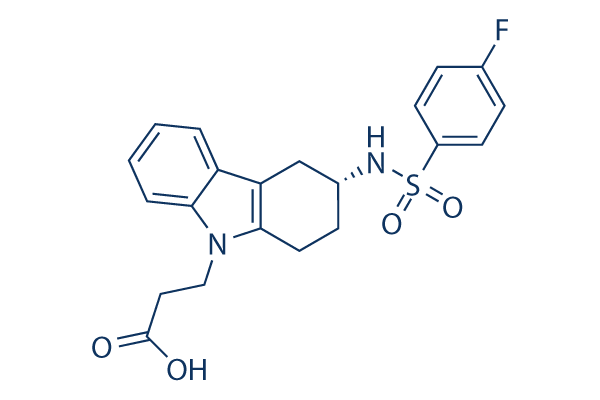
Ramatroban Prostaglandin Receptor antagonist
Cat.No.S5286
Quality Control
| Related Targets | Dehydrogenase HSP Transferase P450 (e.g. CYP17) PDE phosphatase PPAR Vitamin Carbohydrate Metabolism Mitochondrial Metabolism |
|---|---|
| Other Prostaglandin Receptor Inhibitors | PF-04418948 E7046 (ER-886406) TG4-155 RO1138452 Ethamsylate Grapiprant (CJ-023,423) Timapiprant Sodium Seratrodast(AA-2414) BI-671800 Setipiprant (ACT-129968) |
Solubility
|
In vitro |
DMSO
: 83 mg/mL
(199.29 mM)
Ethanol : 83 mg/mL Water : Insoluble |
Molarity Calculator
|
In vivo |
|||||
In vivo Formulation Calculator (Clear solution)
Step 1: Enter information below (Recommended: An additional animal making an allowance for loss during the experiment)
Step 2: Enter the in vivo formulation (This is only the calculator, not formulation. Please contact us first if there is no in vivo formulation at the solubility Section.)
Calculation results:
Working concentration: mg/ml;
Method for preparing DMSO master liquid: mg drug pre-dissolved in μL DMSO ( Master liquid concentration mg/mL, Please contact us first if the concentration exceeds the DMSO solubility of the batch of drug. )
Method for preparing in vivo formulation: Take μL DMSO master liquid, next addμL PEG300, mix and clarify, next addμL Tween 80, mix and clarify, next add μL ddH2O, mix and clarify.
Method for preparing in vivo formulation: Take μL DMSO master liquid, next add μL Corn oil, mix and clarify.
Note: 1. Please make sure the liquid is clear before adding the next solvent.
2. Be sure to add the solvent(s) in order. You must ensure that the solution obtained, in the previous addition, is a clear solution before proceeding to add the next solvent. Physical methods such
as vortex, ultrasound or hot water bath can be used to aid dissolving.
Chemical Information, Storage & Stability
| Molecular Weight | 416.47 | Formula | C21H21FN2O4S |
Storage (From the date of receipt) | |
|---|---|---|---|---|---|
| CAS No. | 116649-85-5 | -- | Storage of Stock Solutions |
|
|
| Synonyms | BAY u 3405 | SMILES | C1CC2=C(CC1NS(=O)(=O)C3=CC=C(C=C3)F)C4=CC=CC=C4N2CCC(=O)O | ||
Read more about storage stability stock solution CAS number SMILES
Mechanism of Action
| Targets/IC50/Ki |
TxA2 receptor
|
|---|---|
| In vitro |
Ramatroban can block the PGD2 receptor, chemoattractant receptor-homologous molecule expressed on Th2 cells (CRTh2). This compound can suppress the expression of monocyte chemoattractant protein-1 (MCP-1) and adhesion molecules in endothelial cells and prevent exacerbation of inflammation by blocking these responses. It has inhibitory effects on platelet aggregation and vascular smooth muscle contraction. This chemical significantly inhibited binding of [3H]PGD2 to CRTh2 with an IC50 value of 100 nM. It also inhibited, in a concentration-dependent manner, PGD2-induced Ca2+ mobilization in CRTh2 transfectants with an IC50 = 30 nM and suppressed migration of human eosinophils induced by PGD2 with an IC50 = 170 nM.
|
| In vivo |
In hypercholesterolemic rabbits, ramatroban prevents macrophage infiltration through MCP-1 downregulation and neointimal formation after balloon injury and attenuates vascular response to acetylcholine. The pharmacokinetic parameters after single oral administration of 75 mg of this compound were studied in fasting healthy adult volunteers: relative bioavailability of its tablets (as compared with aqueous solution) was 80.3%. The pharmacokinetics of this chemical at doses ranging from 25 to 150 mg was found to be linear. When a single dose of 50 mg of this agent was given orally to healthy volunteers postprandially, the AUC was 88.8% of that obtained in fasting state. A low total body clearance of this substance is shown in elderly subjects; After oral administration of [14C]-labeled material to male rats, maximum concentrations of radioactivity were higher in liver, kidneys and adipose tissues than in plasma. Other organs tissues had lower radioactivity levels than plasma. Radioactivity levels in most organs tissues declined in parallel with the decrease in the plasma radioactivity. In contrast, elimination of the radioactivity from the blood cells was relatively prolonged. Extremely low radioactivity levels were found only in the brain. The ratio of brain-to-plasma levels was as low as 8% at the maximum.
|
References |
Tech Support
Tel: +1-832-582-8158 Ext:3
If you have any other enquiries, please leave a message.

Products are for research use only. Not for human use. We do not sell to patients.
©Copyright 2013 Selleck Chemicals. All Rights Reserved.