
-
 Argentina
-
 Australia
-
 Austria
-
 Belgium
-
 Brazil
-
 Canada
-
 China
China
-
 Czech Republic
-
 Denmark
-
 Finland
-
 France
-
 Germany
-
 Greece
-
 Hong Kong
-
 Hungary
-
 Iceland
-
 India
India
-
 Ireland
-
 Israel
-
 Italy
Italy
-
 Japan
Japan
-
 Korea
Korea
-
 Luxembourg
-
 Malaysia
-
 Netherlands
-
 New Zealand
-
 Norway
-
 Poland
-
 Portugal
-
 Qatar
Qatar
-
 Romania
-
 Saudi Arabia
-
 Singapore
-
 Spain
Spain
-
 Sweden
-
 Switzerland
-
 Taiwan
-
 Turkey
-
 United Kingdom
-
 United States
research use only
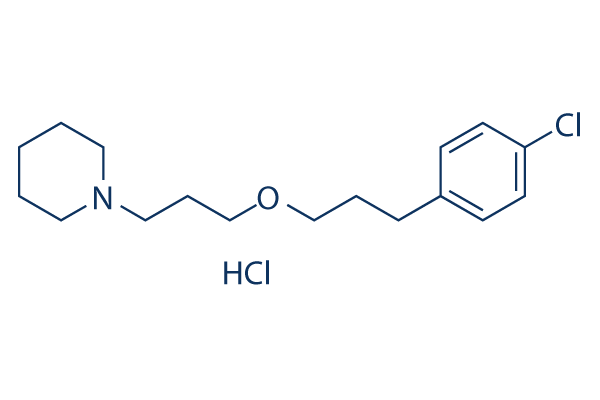
Pitolisant hydrochloride Histamine Receptor antagonist
Cat.No.S5926
Quality Control
| Related Targets | Adrenergic Receptor AChR 5-HT Receptor COX Calcium Channel Dopamine Receptor GABA Receptor TRP Channel Cholinesterase (ChE) GluR |
|---|---|
| Other Histamine Receptor Inhibitors | GSK2879552 Dihydrochloride JNJ-7777120 Mianserin HCl Ebastine Astemizole Ciproxifan Maleate Rupatadine Lafutidine Cloperastine hydrochloride Mizolastine |
Solubility
|
In vitro |
DMSO
: 66 mg/mL
(198.6 mM)
Water : 66 mg/mL Ethanol : 66 mg/mL |
Molarity Calculator
|
In vivo |
|||||
In vivo Formulation Calculator (Clear solution)
Step 1: Enter information below (Recommended: An additional animal making an allowance for loss during the experiment)
Step 2: Enter the in vivo formulation (This is only the calculator, not formulation. Please contact us first if there is no in vivo formulation at the solubility Section.)
Calculation results:
Working concentration: mg/ml;
Method for preparing DMSO master liquid: mg drug pre-dissolved in μL DMSO ( Master liquid concentration mg/mL, Please contact us first if the concentration exceeds the DMSO solubility of the batch of drug. )
Method for preparing in vivo formulation: Take μL DMSO master liquid, next addμL PEG300, mix and clarify, next addμL Tween 80, mix and clarify, next add μL ddH2O, mix and clarify.
Method for preparing in vivo formulation: Take μL DMSO master liquid, next add μL Corn oil, mix and clarify.
Note: 1. Please make sure the liquid is clear before adding the next solvent.
2. Be sure to add the solvent(s) in order. You must ensure that the solution obtained, in the previous addition, is a clear solution before proceeding to add the next solvent. Physical methods such
as vortex, ultrasound or hot water bath can be used to aid dissolving.
Chemical Information, Storage & Stability
| Molecular Weight | 332.31 | Formula | C17H27Cl2NO |
Storage (From the date of receipt) | 3 years -20°C powder |
|---|---|---|---|---|---|
| CAS No. | 903576-44-3 | -- | Storage of Stock Solutions |
|
|
| Synonyms | Tiprolisant hydrochloride, BF-2649 HCl | SMILES | C1CCN(CC1)CCCOCCCC2=CC=C(C=C2)Cl.Cl | ||
Read more about storage stability stock solution CAS number SMILES
Mechanism of Action
| Targets/IC50/Ki |
H3 receptor
0.16 nM(Ki)
|
|---|---|
| In vitro |
Pitolisant shows high selectivity for H3 receptors compared with the other histamine receptor subtypes (H1, H2, and H4 subtypes) and shows a lack of interaction with other human receptors or channels.
|
| In vivo |
In animal experiments, pitolisant increases histaminergic and noradrenergic neuron activity, increases wakefulness at the expense of slow wave and rapid eye movement sleep, has low abuse potential, and has no effect on mechanical or thermal pain thresholds.
|
References |
Clinical Trial Information
(data from https://clinicaltrials.gov, updated on 2024-05-22)
| NCT Number | Recruitment | Conditions | Sponsor/Collaborators | Start Date | Phases |
|---|---|---|---|---|---|
| NCT05458128 | Active not recruiting | Idiopathic Hypersomnia|Excessive Daytime Sleepiness |
Harmony Biosciences LLC |
2022-08-19 | Phase 3 |
| NCT02929342 | Completed | Healthy Volunteers |
Bioprojet |
2016-07 | Phase 1 |
| NCT02611687 | Active not recruiting | Narcolepsy With Cataplexy|Narcolepsy Without Cataplexy |
Bioprojet |
2016-06-06 | Phase 3 |
Read more about Clinical Trials
Tech Support
Tel: +1-832-582-8158 Ext:3
If you have any other enquiries, please leave a message.
Signaling Pathway Map

Products are for research use only. Not for human use. We do not sell to patients.
©Copyright 2013 Selleck Chemicals. All Rights Reserved.