
-
 Argentina
-
 Australia
-
 Austria
-
 Belgium
-
 Brazil
-
 Canada
-
 China
China
-
 Czech Republic
-
 Denmark
-
 Finland
-
 France
-
 Germany
-
 Greece
-
 Hong Kong
-
 Hungary
-
 Iceland
-
 India
India
-
 Ireland
-
 Israel
-
 Italy
Italy
-
 Japan
Japan
-
 Korea
Korea
-
 Luxembourg
-
 Malaysia
-
 Netherlands
-
 New Zealand
-
 Norway
-
 Poland
-
 Portugal
-
 Qatar
Qatar
-
 Romania
-
 Saudi Arabia
-
 Singapore
-
 Spain
Spain
-
 Sweden
-
 Switzerland
-
 Taiwan
-
 Turkey
-
 United Kingdom
-
 United States
research use only
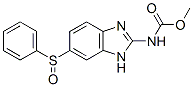
Oxfendazole Parasite inhibitor
Cat.No.S1830
Quality Control
| Related Targets | Integrase Bacterial Antibiotics Anti-infection Fungal Antiviral COVID-19 Reverse Transcriptase HIV HCV Protease |
|---|---|
| Other Parasite Inhibitors | Diminazene Aceturate Oxibendazole (+/-)-nerolidol Emodepside Avermectin B1 Milbemycin Oxime Arteether Eprinomectin Diclazuril Selamectin |
Solubility
|
In vitro |
DMSO
: 10 mg/mL
(31.71 mM)
Water : Insoluble Ethanol : Insoluble |
Molarity Calculator
|
In vivo |
|||||
In vivo Formulation Calculator (Clear solution)
Step 1: Enter information below (Recommended: An additional animal making an allowance for loss during the experiment)
Step 2: Enter the in vivo formulation (This is only the calculator, not formulation. Please contact us first if there is no in vivo formulation at the solubility Section.)
Calculation results:
Working concentration: mg/ml;
Method for preparing DMSO master liquid: mg drug pre-dissolved in μL DMSO ( Master liquid concentration mg/mL, Please contact us first if the concentration exceeds the DMSO solubility of the batch of drug. )
Method for preparing in vivo formulation: Take μL DMSO master liquid, next addμL PEG300, mix and clarify, next addμL Tween 80, mix and clarify, next add μL ddH2O, mix and clarify.
Method for preparing in vivo formulation: Take μL DMSO master liquid, next add μL Corn oil, mix and clarify.
Note: 1. Please make sure the liquid is clear before adding the next solvent.
2. Be sure to add the solvent(s) in order. You must ensure that the solution obtained, in the previous addition, is a clear solution before proceeding to add the next solvent. Physical methods such
as vortex, ultrasound or hot water bath can be used to aid dissolving.
Chemical Information, Storage & Stability
| Molecular Weight | 315.35 | Formula | C15H13N3O3S |
Storage (From the date of receipt) | |
|---|---|---|---|---|---|
| CAS No. | 53716-50-0 | Download SDF | Storage of Stock Solutions |
|
|
| Synonyms | RS-8858,Fenbendazole sulfoxide | SMILES | COC(=O)NC1=NC2=C(N1)C=C(C=C2)S(=O)C3=CC=CC=C3 | ||
Read more about storage stability stock solution CAS number SMILES
Mechanism of Action
| In vivo |
Oxfendazole (OX) induces not only mRNA expression of phase I enzymes Cyp1a1, Cyp1a2, but also Nrf2-regulated phase II enzymes such as Gpx2, Nqo1, Yc2, Akr7a3 and Gstm1 in rats, presumably due to an adaptive response against OX-induced oxidative stress. This compound enhances oxidative DNA damage (as assessed by 8-hydroxydeoxyguanosine; 8-OHdG) and lipid peroxidation (as assessed by thiobarbituric acid-reactive substances; TBARS) in rats. This chemical administered at the therapeutic dose (4.5 mg/kg) and at the highest dose (22.5 mg/kg) increase 1.54- and 2.36-fold the total liver microsomal cytochrome P450 and more particularly the isoenzyme P450IA2 (95% and 184% increases) in rabbit liver. It induces a mutagenic effect in all tested cell types. It exhibits embryotoxicity including teratogenicity. It induces a disturbance in the different biochemical contents of all tested tissues in mice. This compound increases the incidence and multiplicity of altered foci (4.0- and 3.6-fold, respectively) and hepatocellular adenomas (HCAs) (3.0- and 5.5-fold, respectively). This treatment induces 5.2- and 5.6-fold increases in the number of proliferating cell nuclear antigen (PCNA)-positive cells and single-stranded DNA (ssDNA)-positive cells in HCAs compared with the surrounding tissue, respectively. It and its sulphone metabolite attain a significantly higher plasma concentration and remain much longer in plasma compared with fenbendazole (FBZ) and albendazole (ABZ) and their respective metabolites in dogs. |
References |
|
|---|
Clinical Trial Information
(data from https://clinicaltrials.gov, updated on 2024-05-22)
| NCT Number | Recruitment | Conditions | Sponsor/Collaborators | Start Date | Phases |
|---|---|---|---|---|---|
| NCT06367361 | Not yet recruiting | Fascioliasis |
Universidad Peruana Cayetano Heredia|National Institute of Allergy and Infectious Diseases (NIAID) |
2024-07 | Phase 2 |
| NCT04920292 | Completed | Filariasis |
Swiss Tropical & Public Health Institute|Ifakara Health Institute|Drugs for Neglected Diseases |
2022-04-21 | Phase 1 |
| NCT02636803 | Withdrawn | Helminthiasis |
Johns Hopkins Bloomberg School of Public Health|Universidad Peruana Cayetano Heredia |
2019-11 | Phase 2 |
| NCT03035760 | Completed | Helminthic Infection |
National Institute of Allergy and Infectious Diseases (NIAID) |
2017-05-12 | Phase 1 |
| NCT02234570 | Completed | Neurocysticercosis |
National Institute of Allergy and Infectious Diseases (NIAID) |
2014-11-17 | Phase 1 |
Read more about Clinical Trials
Tech Support
Tel: +1-832-582-8158 Ext:3
If you have any other enquiries, please leave a message.

Products are for research use only. Not for human use. We do not sell to patients.
©Copyright 2013 Selleck Chemicals. All Rights Reserved.