
-
 Argentina
-
 Australia
-
 Austria
-
 Belgium
-
 Brazil
-
 Canada
-
 China
China
-
 Czech Republic
-
 Denmark
-
 Finland
-
 France
-
 Germany
-
 Greece
-
 Hong Kong
-
 Hungary
-
 Iceland
-
 India
India
-
 Ireland
-
 Israel
-
 Italy
Italy
-
 Japan
Japan
-
 Korea
Korea
-
 Luxembourg
-
 Malaysia
-
 Netherlands
-
 New Zealand
-
 Norway
-
 Poland
-
 Portugal
-
 Qatar
Qatar
-
 Romania
-
 Saudi Arabia
-
 Singapore
-
 Spain
Spain
-
 Sweden
-
 Switzerland
-
 Taiwan
-
 Turkey
-
 United Kingdom
-
 United States
research use only
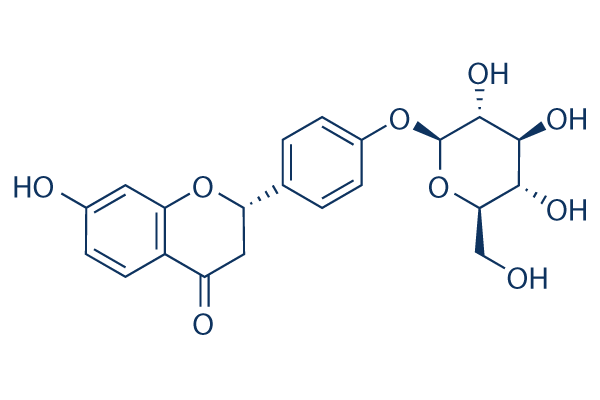
Liquiritin AKR1C inhibitor
Cat.No.S3930
Quality Control
| Related Targets | PD-1/PD-L1 CXCR STING AhR Immunology & Inflammation related CD markers Interleukins Anti-infection Antioxidant COX |
|---|---|
| Other AKR1C Inhibitors | RJG-2051 AKR1C1-IN-1 AKR1C3-IN-1 |
Solubility
|
In vitro |
DMSO
: 100 mg/mL
(239.01 mM)
|
Molarity Calculator
|
In vivo |
|||||
In vivo Formulation Calculator (Clear solution)
Step 1: Enter information below (Recommended: An additional animal making an allowance for loss during the experiment)
Step 2: Enter the in vivo formulation (This is only the calculator, not formulation. Please contact us first if there is no in vivo formulation at the solubility Section.)
Calculation results:
Working concentration: mg/ml;
Method for preparing DMSO master liquid: mg drug pre-dissolved in μL DMSO ( Master liquid concentration mg/mL, Please contact us first if the concentration exceeds the DMSO solubility of the batch of drug. )
Method for preparing in vivo formulation: Take μL DMSO master liquid, next addμL PEG300, mix and clarify, next addμL Tween 80, mix and clarify, next add μL ddH2O, mix and clarify.
Method for preparing in vivo formulation: Take μL DMSO master liquid, next add μL Corn oil, mix and clarify.
Note: 1. Please make sure the liquid is clear before adding the next solvent.
2. Be sure to add the solvent(s) in order. You must ensure that the solution obtained, in the previous addition, is a clear solution before proceeding to add the next solvent. Physical methods such
as vortex, ultrasound or hot water bath can be used to aid dissolving.
Chemical Information, Storage & Stability
| Molecular Weight | 418.39 | Formula | C21H22O9 |
Storage (From the date of receipt) | |
|---|---|---|---|---|---|
| CAS No. | 551-15-5 | Download SDF | Storage of Stock Solutions |
|
|
| Synonyms | Liquiritoside, Liquiritigenin-4'-O-glucoside | SMILES | C1C(OC2=C(C1=O)C=CC(=C2)O)C3=CC=C(C=C3)OC4C(C(C(C(O4)CO)O)O)O | ||
Read more about storage stability stock solution CAS number SMILES
Mechanism of Action
| In vitro |
Liquiritin exerts neuroprotective and neurotrophic effects on primary cultured hippocampal cells. This compound may enhance cell survival by increasing the protein expression level of glucose-6 phosphate dehydrogenase. It potentiates neurite outgrowth induced by nerve growth factor in PC12 cells. It affects particular types of cells such as neurons in the central nervous system. This chemical increases the proliferation of B65 neuroblastoma cells.
|
|---|---|
| In vivo |
Liquiritin at doses of 50-100 mg/kg significantly improves the cognitive ability, restores the abnormal activities of glutathione peroxidase and superoxide dismutase, and decreases the levels of malondialdehyde,8-hydroxy-2′-deoxyguanosine and protein carbonyl in the hippocampus of rats with Alzheimer's disease. This compound can significantly ameliorate Aβ1-42-induced spatial learning and memory impairment by inhibiting oxidative stress and neural apoptosis. It is also frequently used to treat injury or swelling owing to its life-enhancing properties, as well as detoxification in traditional oriental medicine. It exerts significant antidepressant-like effects on the forced swimming and tail suspension tests in mice. It can also produce obvious neuroprotective effects on focal cerebral ischemia/reperfusion induced by middle cerebral artery occlusion. This chemical can protect neurons from Aβ-induced neurotoxicity. This ability probably involves the suppression of oxidative stress and neuron apoptosis in a rat model of Alzheimer disease (AD) induced by subsequent bilateral intrahippocampal (IH) injections of aggregated soluble oligomeric Aβ1-42. It provides beneficial effects on the cognitive impairments observed in an Aβ1-42-induced model of AD. The neuroprotective effects of this compound are closely associated with its effects of inhibiting oxidative stress and neuronal apoptosis.
|
References |
|
Tech Support
Tel: +1-832-582-8158 Ext:3
If you have any other enquiries, please leave a message.

Products are for research use only. Not for human use. We do not sell to patients.
©Copyright 2013 Selleck Chemicals. All Rights Reserved.