
-
 Argentina
-
 Australia
-
 Austria
-
 Belgium
-
 Brazil
-
 Canada
-
 China
China
-
 Czech Republic
-
 Denmark
-
 Finland
-
 France
-
 Germany
-
 Greece
-
 Hong Kong
-
 Hungary
-
 Iceland
-
 India
India
-
 Ireland
-
 Israel
-
 Italy
Italy
-
 Japan
Japan
-
 Korea
Korea
-
 Luxembourg
-
 Malaysia
-
 Netherlands
-
 New Zealand
-
 Norway
-
 Poland
-
 Portugal
-
 Qatar
Qatar
-
 Romania
-
 Saudi Arabia
-
 Singapore
-
 Spain
Spain
-
 Sweden
-
 Switzerland
-
 Taiwan
-
 Turkey
-
 United Kingdom
-
 United States
research use only
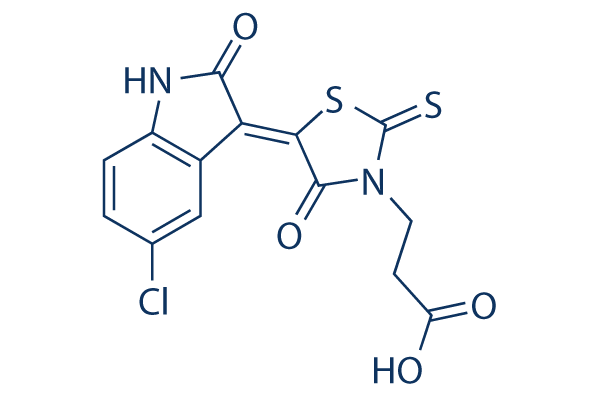
FX1 Bcl-6 inhibitor
Cat.No.S8591
Quality Control
| Related Targets | Bcl-2 Caspase PD-1/PD-L1 Ferroptosis p53 Apoptosis related Synthetic Lethality STAT TNF-alpha Ras |
|---|---|
| Other Bcl-6 Inhibitors | BI-3802 BI-3812 79-6 (CID5721353) BMS-986458 |
Cell Culture, Treatment & Working Concentration
| Cell Lines | Assay Type | Concentration | Incubation Time | Formulation | Activity Description | PMID |
|---|---|---|---|---|---|---|
| TMD8 | Antiproliferative assay | 3 days | Antiproliferative activity against BCL6 dependent human TMD8 cells after 3 days by CellTiter-Glo assay, GI50 = 10 μM. | 28485934 | ||
| SUDHL4 | Antiproliferative assay | 3 days | Antiproliferative activity against BCL6 dependent human SUDHL4 cells after 3 days by CellTiter-Glo assay, GI50 = 10 μM. | 28485934 | ||
| OCI-LY19 | Antiproliferative assay | 3 days | Antiproliferative activity against BCL6 independent human OCI-LY19 cells after 3 days by CellTiter-Glo assay, GI50 = 10 μM. | 28485934 | ||
| OCI-LY10 | Antiproliferative assay | 3 days | Antiproliferative activity against BCL6 dependent human OCI-LY10 cells after 3 days by CellTiter-Glo assay, GI50 = 12.5892 μM. | 28485934 | ||
| SU-DHL-2 | Antiproliferative assay | 3 days | Antiproliferative activity against BCL6 dependent human SU-DHL-2 cells after 3 days by CellTiter-Glo assay, GI50 = 12.5892 μM. | 28485934 | ||
| U2932 | Antiproliferative assay | 3 days | Antiproliferative activity against BCL6 dependent human U2932 cells after 3 days by CellTiter-Glo assay, GI50 = 12.5892 μM. | 28485934 | ||
| KARPAS422 | Antiproliferative assay | 3 days | Antiproliferative activity against BCL6 independent human KARPAS422 cells after 3 days by CellTiter-Glo assay, GI50 = 12.5892 μM. | 28485934 | ||
| OCI-LY1 | Antiproliferative assay | 3 days | Antiproliferative activity against BCL6 dependent human OCI-LY1 cells after 3 days by CellTiter-Glo assay, GI50 = 19.9526 μM. | 28485934 | ||
| OCI-LY3 | Antiproliferative assay | 3 days | Antiproliferative activity against BCL6 dependent human OCI-LY3 cells after 3 days by CellTiter-Glo assay, GI50 = 19.9526 μM. | 28485934 | ||
| AMO1 | Antiproliferative assay | 3 days | Antiproliferative activity against BCL6 dependent human AMO1 cells after 3 days by CellTiter-Glo assay, GI50 = 19.9526 μM. | 28485934 | ||
| Click to View More Cell Line Experimental Data | ||||||
Solubility
|
In vitro |
DMSO
: 20 mg/mL
(54.22 mM)
Water : Insoluble Ethanol : Insoluble |
Molarity Calculator
|
In vivo |
|||||
In vivo Formulation Calculator (Clear solution)
Step 1: Enter information below (Recommended: An additional animal making an allowance for loss during the experiment)
Step 2: Enter the in vivo formulation (This is only the calculator, not formulation. Please contact us first if there is no in vivo formulation at the solubility Section.)
Calculation results:
Working concentration: mg/ml;
Method for preparing DMSO master liquid: mg drug pre-dissolved in μL DMSO ( Master liquid concentration mg/mL, Please contact us first if the concentration exceeds the DMSO solubility of the batch of drug. )
Method for preparing in vivo formulation: Take μL DMSO master liquid, next addμL PEG300, mix and clarify, next addμL Tween 80, mix and clarify, next add μL ddH2O, mix and clarify.
Method for preparing in vivo formulation: Take μL DMSO master liquid, next add μL Corn oil, mix and clarify.
Note: 1. Please make sure the liquid is clear before adding the next solvent.
2. Be sure to add the solvent(s) in order. You must ensure that the solution obtained, in the previous addition, is a clear solution before proceeding to add the next solvent. Physical methods such
as vortex, ultrasound or hot water bath can be used to aid dissolving.
Chemical Information, Storage & Stability
| Molecular Weight | 368.82 | Formula | C14H9ClN2O4S2 |
Storage (From the date of receipt) | |
|---|---|---|---|---|---|
| CAS No. | 1426138-42-2 | Download SDF | Storage of Stock Solutions |
|
|
| Synonyms | N/A | SMILES | C1=CC2=NC(=O)C(=C2C=C1Cl)C3=C(N(C(=S)S3)CCC(=O)O)O | ||
Read more about storage stability stock solution CAS number SMILES
Mechanism of Action
| Features |
Recommend for freshly prepared each time for in vitro experiment
|
|---|---|
| Targets/IC50/Ki |
BCL6 BTB
(Cell-free assay) 35 μM
|
| In vitro |
FX1 disrupted formation of the BCL6 repression complex, reactivated BCL6 target genes, and mimicked the phenotype of mice engineered to express BCL6 with corepressor binding site mutations. This compound suppressed ABC-DLBCL cells in vitro and in vivo, as well as primary human ABC-DLBCL specimens ex vivo. It is specific to BCL6 and binds with a greater affinity than the natural BCL6 ligand SMRT. This chemical almost invariantly induced significant derepression of these genes(BCL6 target genes CASP8, CD69, CXCR4, CDKN1A, and DUSP5) as compared with vehicle in 2 independent DLBCL cell lines. It was more than 100-fold more powerful than the previous generation of BCL6 inhibitors represented by 79-6, and 300-fold more potent than the recently reported binding of the antibiotics rifamycin and rifabutin (KD ~1 mM). |
| In vivo |
Low doses of FX1 induce regression of established tumors in mice bearing DLBCL xenografts. The half-life is estimated to be approximately 12 hours for this compound in SCID mice. No signs of toxicity, inflammation, or infection are evident from H&E-stained sections of lung, gastrointestinal tract, heart, kidney, liver, spleen, and bone marrow of the fixed organs from mice treated with this chemical compared with vehicle. Peripheral blood counts and serum chemistry in FX1-treated mice are also examined and they remain within normal parameters. This compound causes profound and significant suppression of DLBCLs in DLBCL xenografts, and indeed not only prevented growth of the xenografts but in addition causes these tumors to shrink from their initial volume. The maximal effect is already achieved by the lower 25 mg/kg dose. TUNEL and Ki-67 staining shows that this agent also induced more apoptosis and growth arrest than 79-6, respectively. |
References |
Clinical Trial Information
(data from https://clinicaltrials.gov, updated on 2024-05-22)
| NCT Number | Recruitment | Conditions | Sponsor/Collaborators | Start Date | Phases |
|---|---|---|---|---|---|
| NCT02902679 | Completed | Thrombosis|Factor XI|Renal Impairment|ESRD (End-Stage Renal Disease) |
Bristol-Myers Squibb |
2016-11 | Phase 1 |
Read more about Clinical Trials
Tech Support
Tel: +1-832-582-8158 Ext:3
If you have any other enquiries, please leave a message.

Products are for research use only. Not for human use. We do not sell to patients.
©Copyright 2013 Selleck Chemicals. All Rights Reserved.