
-
 Australia
-
 Austria
-
 Belgium
-
 Brazil
-
 Canada
-
 China
China
-
 Czech Republic
-
 Denmark
-
 Finland
-
 France
-
 Germany
-
 Greece
-
 Hong Kong
-
 Hungary
-
 Iceland
-
 India
India
-
 Ireland
-
 Israel
-
 Italy
Italy
-
 Japan
Japan
-
 Korea
Korea
-
 Luxembourg
-
 Malaysia
-
 Netherlands
-
 New Zealand
-
 Norway
-
 Poland
-
 Qatar
Qatar
-
 Romania
-
 Saudi Arabia
-
 Singapore
-
 Spain
Spain
-
 Sweden
-
 Switzerland
-
 Taiwan
-
 Turkey
-
 United Kingdom
-
 United States
research use only
Lomibuvir (VX-222) HCV Protease inhibitor
Cat.No.S1480
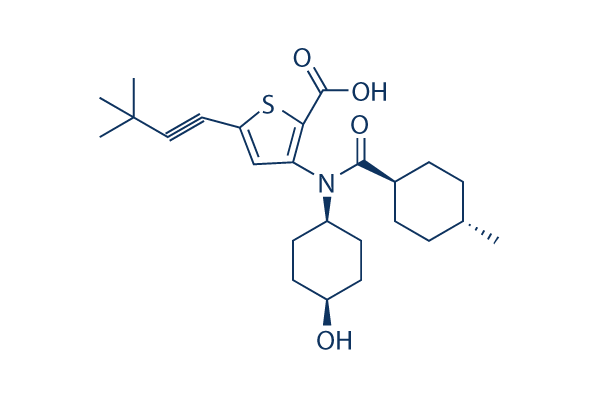
Chemical Structure
Molecular Weight: 445.61
Quality Control
| Related Targets | HDAC Caspase Proteasome Secretase MMP Cysteine Protease Tyrosinase HIV Protease DPP Serine Protease |
|---|---|
| Other HCV Protease Inhibitors | Danoprevir Asunaprevir Tizoxanide PSI-6206 (GS-331007) 2'-C-Methylcytidine Voxilaprevir Tegobuvir Herba taxilli Extract Mecarbinate |
Solubility
|
In vitro |
DMSO
: 89 mg/mL
(199.72 mM)
Ethanol : 89 mg/mL Water : Insoluble |
Molarity Calculator
|
In vivo |
|||||
In vivo Formulation Calculator (Clear solution)
Step 1: Enter information below (Recommended: An additional animal making an allowance for loss during the experiment)
Step 2: Enter the in vivo formulation (This is only the calculator, not formulation. Please contact us first if there is no in vivo formulation at the solubility Section.)
Calculation results:
Working concentration: mg/ml;
Method for preparing DMSO master liquid: mg drug pre-dissolved in μL DMSO ( Master liquid concentration mg/mL, Please contact us first if the concentration exceeds the DMSO solubility of the batch of drug. )
Method for preparing in vivo formulation: Take μL DMSO master liquid, next addμL PEG300, mix and clarify, next addμL Tween 80, mix and clarify, next add μL ddH2O, mix and clarify.
Method for preparing in vivo formulation: Take μL DMSO master liquid, next add μL Corn oil, mix and clarify.
Note: 1. Please make sure the liquid is clear before adding the next solvent.
2. Be sure to add the solvent(s) in order. You must ensure that the solution obtained, in the previous addition, is a clear solution before proceeding to add the next solvent. Physical methods such
as vortex, ultrasound or hot water bath can be used to aid dissolving.
Chemical Information, Storage & Stability
| Molecular Weight | 445.61 | Formula | C25H35NO4S |
Storage (From the date of receipt) | |
|---|---|---|---|---|---|
| CAS No. | 1026785-59-0 | Download SDF | Storage of Stock Solutions |
|
|
| Synonyms | VCH-222 | Smiles | CC1CCC(CC1)C(=O)N(C2CCC(CC2)O)C3=C(SC(=C3)C#CC(C)(C)C)C(=O)O | ||
Mechanism of Action
| Features |
A novel, potent and selective inhibitor of non-nucleoside polymerase, specifically the HCV RNA-dependent RNA polymerase.
|
|---|---|
| Targets/IC50/Ki |
HCV NS5B 1a
0.94 μM
HCV NS5B 1b
1.2 μM
|
| In vitro |
Lomibuvir (VX-222) binds to the thumb II allosteric pocket of the HCV RNA-dependent RNA polymerase. It exhibits non-competitive and selective inhibition in HCV NS5B of genotype 1a and 1b, with IC50 of 0.94 and 1.2 μM, respectively. This compound selectively inhibits the replication of subgenomic HCV genotype 1a and 1b with an EC50 of 22.3 and 11.2 nM, respectively.
Similarly, a recent study shows that it inhibits the 1b/Con1 HCV subgenomic replicon, with an EC50 of 5 nM. VX-222 preferentially inhibits primer-dependent RNA synthesis, showing only a modest or no effect on de novo-initiated RNA synthesis.
|
| Kinase Assay |
Anti-NS5B activity assay
|
|
The inhibitory effect of Lomibuvir (VX-222) on HCV NS5B activity is measured by evaluating the amount of radiolabeled UTP incorporated by the C-terminal ∆21 truncated version of enzyme in a newly synthesized RNA using a homopolymeric RNA template / primer namely poly rA / oligo dT. Quantitative detection of incorporated radioactivity is done using a liquid scintillation counter. The in vitro kinetics of inhibition of HCV NS5B from genotype 1b strain BK by this compound are determined using the C-terminal ∆21 truncated version of NS5B. It (1 to 1.5 μM) is tested in the presence of 10 to 75 μM nonradioactive UTP mixed with 0.89 to 6.70 μCi of [α-33P]-labeled UTP. RNA-dependent-RNA polymerase reactions are allowed to proceed for 18 min at 22 °C.
|
|
| In vivo |
Lomibuvir (VX-222) displays a fine pharmacokinetic profile in rats and dogs, including low total body clearance and excellent oral bioavailability (greater than 30%) with good ADME properties. It is biotransformed by several enzymes (CYP1A1, 2A6, 2B6, 2C8, CYP 3A4, UGT1A3) and is predicted to be actively transported in the liver and excreted mainly intact in bile or as glucuronide adducts.
|
References |
|
Clinical Trial Information
(data from https://clinicaltrials.gov, updated on 2024-05-22)
| NCT Number | Recruitment | Conditions | Sponsor/Collaborators | Start Date | Phases |
|---|---|---|---|---|---|
| NCT00958152 | Completed | Hepatitis C |
Vertex Pharmaceuticals Incorporated |
August 2009 | Phase 1 |
Tech Support
Tel: +1-832-582-8158 Ext:3
If you have any other enquiries, please leave a message.
Signaling Pathway Map

Products are for research use only. Not for human use. We do not sell to patients.
©Copyright 2013 Selleck Chemicals. All Rights Reserved.