
-
 Argentina
-
 Australia
-
 Austria
-
 Belgium
-
 Brazil
-
 Canada
-
 China
China
-
 Czech Republic
-
 Denmark
-
 Finland
-
 France
-
 Germany
-
 Greece
-
 Hong Kong
-
 Hungary
-
 Iceland
-
 India
India
-
 Ireland
-
 Israel
-
 Italy
Italy
-
 Japan
Japan
-
 Korea
Korea
-
 Luxembourg
-
 Malaysia
-
 Netherlands
-
 New Zealand
-
 Norway
-
 Poland
-
 Portugal
-
 Qatar
Qatar
-
 Romania
-
 Saudi Arabia
-
 Singapore
-
 Spain
Spain
-
 Sweden
-
 Switzerland
-
 Taiwan
-
 Turkey
-
 United Kingdom
-
 United States
research use only
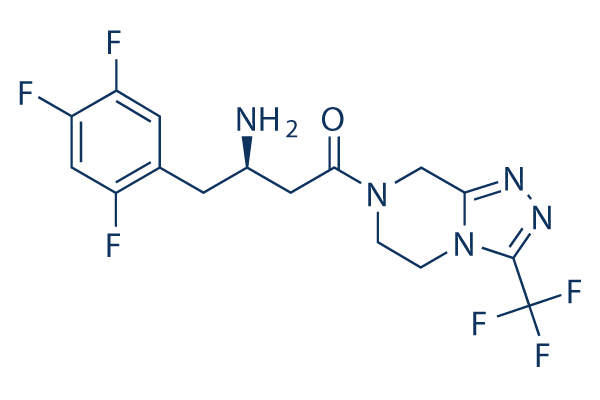
Sitagliptin DPP inhibitor
Cat.No.S5079
Quality Control
Solubility
|
In vitro |
DMSO
: 81 mg/mL
(198.86 mM)
Ethanol : 81 mg/mL Water : 5 mg/mL (Ultrasonic and heating for 10 minutes, at 60℃.) |
Molarity Calculator
|
In vivo |
|||||
In vivo Formulation Calculator (Clear solution)
Step 1: Enter information below (Recommended: An additional animal making an allowance for loss during the experiment)
Step 2: Enter the in vivo formulation (This is only the calculator, not formulation. Please contact us first if there is no in vivo formulation at the solubility Section.)
Calculation results:
Working concentration: mg/ml;
Method for preparing DMSO master liquid: mg drug pre-dissolved in μL DMSO ( Master liquid concentration mg/mL, Please contact us first if the concentration exceeds the DMSO solubility of the batch of drug. )
Method for preparing in vivo formulation: Take μL DMSO master liquid, next addμL PEG300, mix and clarify, next addμL Tween 80, mix and clarify, next add μL ddH2O, mix and clarify.
Method for preparing in vivo formulation: Take μL DMSO master liquid, next add μL Corn oil, mix and clarify.
Note: 1. Please make sure the liquid is clear before adding the next solvent.
2. Be sure to add the solvent(s) in order. You must ensure that the solution obtained, in the previous addition, is a clear solution before proceeding to add the next solvent. Physical methods such
as vortex, ultrasound or hot water bath can be used to aid dissolving.
Chemical Information, Storage & Stability
| Molecular Weight | 407.31 | Formula | C16H15F6N5O |
Storage (From the date of receipt) | |
|---|---|---|---|---|---|
| CAS No. | 486460-32-6 | -- | Storage of Stock Solutions |
|
|
| Synonyms | MK-0431 | SMILES | C1CN2C(=NN=C2C(F)(F)F)CN1C(=O)CC(CC3=CC(=C(C=C3F)F)F)N | ||
Read more about storage stability stock solution CAS number SMILES
Mechanism of Action
| Targets/IC50/Ki |
DPP-4
(Cell-free) 18 nM
|
|---|---|
| In vitro |
Sitagliptin exhibits a > 2600-fold margin of selectivity against DPP8, DPP9, and other members of the dipeptidyl peptidase family (i.e., potency against DPP-4 vs. DPP8/9). This compound reduces in vitro migration of isolated splenic CD4 T-cells through a pathway involving cAMP/PKA/Rac1 activation. It exerts a novel, direct action in order to stimulate GLP-1 secretion by the intestinal L cell through a DPP-4-independent, protein kinase A- and MEK-ERK1/2-dependent pathway. It therefore reduces the effect of autoimmunity on graft survival.
|
| In vivo |
Sitagliptin is well absorbed after oral administration with a bioavailability of 87%. It has an apparent terminal half-life of 10–12 h at doses of 25-100 mg and is excreted mainly (≈ 80%) as unchanged compound by the kidneys. This compound does not interfere with the P450 cytochrome enzymes nor have there been any reported significant drug-drug interactions. It has been shown to inhibit DPP-4 activity by > 90% within 1-2 h of administration. It has a short half-life in mice (1-2 h). Chronic sitagliptin treatment in a non-geneticmouse model of type 2 diabetes elicits significant improvement in glycemic control. The improved glucose homeostasis correlates with restoration of normal islet cell (α and β cells) mass, architecture and insulin secretion capacity in response to glucose stimulation. This compound prolongs islet graft survival in streptozotocin-induced and NOD mice. Administration of this chemical in vivo reduces lymph node and splenic CD4+ T-cell migration, measured in vitro, via incretin- and nonincretin-mediated effects, respectively, and splenic sDPP-IV-responsive CD4+ T-cells and lymph node incretin nonresponsive CD4+ T-cells selectively infiltrated islets of diabetic NOD mice, after tail vein injection. It significantly suppressed epileptogenesis in PTZ (pentylenetetrazole)-induced seizures. This compound counteracted neuronal damage and all biochemical, and histo-chemical alteration induced by PTZ. Oral sitagliptin can promote hippocampal neurogenesis, counteract hippocampal oxidative stress, and prevent the decline in mice cognition.
|
References |
|
Clinical Trial Information
(data from https://clinicaltrials.gov, updated on 2026-02-18)
| NCT Number | Recruitment | Conditions | Sponsor/Collaborators | Start Date | Phases |
|---|---|---|---|---|---|
| NCT06813014 | NOT_YET_RECRUITING | Diabetes |
University of Maryland, Baltimore |
2026-12 | PHASE4 |
| NCT07365592 | RECRUITING | Colorectal Cancer |
Second Affiliated Hospital, Zhejiang University, School of Medicine |
2026-04-09 | PHASE1; PHASE2 |
| NCT07108985 | NOT_YET_RECRUITING | Diabetes Mellitus, Type 2; Hyperglycemia; Insulin Resistance |
Yonsei University |
2025-09 | PHASE4 |
| NCT07541781 | RECRUITING | Glioma; Glioblastoma; Recurrent Glioma; Recurrent Glioblastoma; Grade 4 Malignant Glioma of Brain (Disorder) |
Kailin Yang, MD, PhD |
2026-06-11 | PHASE1 |
| NCT06246799 | RECRUITING | Type 2 Diabetes (Adult Onset) |
The University of Texas Health Science Center at San Antonio |
2024-11-07 | PHASE3 |
| NCT07804381 | NOT_YET_RECRUITING | Parkinson Disease |
Yonsei University |
2026-12-15 | PHASE2 |
Read more about Clinical Trials
Tech Support
Tel: +1-832-582-8158 Ext:3
If you have any other enquiries, please leave a message.
Signaling Pathway Map

Products are for research use only. Not for human use. We do not sell to patients.
©Copyright 2013 Selleck Chemicals. All Rights Reserved.