
-
 Argentina
-
 Australia
-
 Austria
-
 Belgium
-
 Brazil
-
 Canada
-
 China
China
-
 Czech Republic
-
 Denmark
-
 Finland
-
 France
-
 Germany
-
 Greece
-
 Hong Kong
-
 Hungary
-
 Iceland
-
 India
India
-
 Ireland
-
 Israel
-
 Italy
Italy
-
 Japan
Japan
-
 Korea
Korea
-
 Luxembourg
-
 Malaysia
-
 Netherlands
-
 New Zealand
-
 Norway
-
 Poland
-
 Portugal
-
 Qatar
Qatar
-
 Romania
-
 Saudi Arabia
-
 Singapore
-
 Spain
Spain
-
 Sweden
-
 Switzerland
-
 Taiwan
-
 Turkey
-
 United Kingdom
-
 United States
research use only
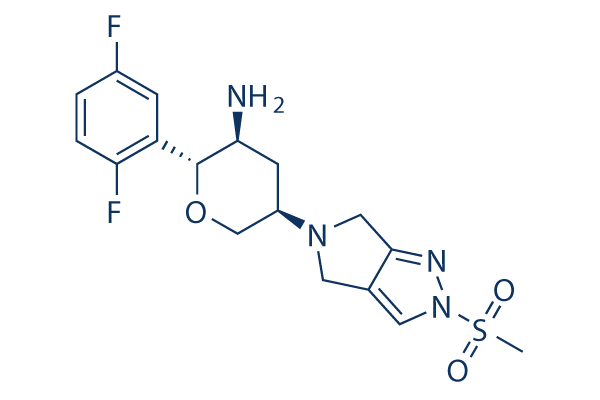
MK-3102 (Omarigliptin) DPP-4 Inhibitor
Cat.No.S8565
Quality Control
Solubility
|
In vitro |
DMSO
: 80 mg/mL
(200.78 mM)
Water : Insoluble Ethanol : Insoluble |
Molarity Calculator
|
In vivo |
|||||
In vivo Formulation Calculator (Clear solution)
Step 1: Enter information below (Recommended: An additional animal making an allowance for loss during the experiment)
Step 2: Enter the in vivo formulation (This is only the calculator, not formulation. Please contact us first if there is no in vivo formulation at the solubility Section.)
Calculation results:
Working concentration: mg/ml;
Method for preparing DMSO master liquid: mg drug pre-dissolved in μL DMSO ( Master liquid concentration mg/mL, Please contact us first if the concentration exceeds the DMSO solubility of the batch of drug. )
Method for preparing in vivo formulation: Take μL DMSO master liquid, next addμL PEG300, mix and clarify, next addμL Tween 80, mix and clarify, next add μL ddH2O, mix and clarify.
Method for preparing in vivo formulation: Take μL DMSO master liquid, next add μL Corn oil, mix and clarify.
Note: 1. Please make sure the liquid is clear before adding the next solvent.
2. Be sure to add the solvent(s) in order. You must ensure that the solution obtained, in the previous addition, is a clear solution before proceeding to add the next solvent. Physical methods such
as vortex, ultrasound or hot water bath can be used to aid dissolving.
Chemical Information, Storage & Stability
| Molecular Weight | 398.43 | Formula | C17H20F2N4O3S |
Storage (From the date of receipt) | |
|---|---|---|---|---|---|
| CAS No. | 1226781-44-7 | Download SDF | Storage of Stock Solutions |
|
|
| Synonyms | N/A | SMILES | CS(=O)(=O)N1C=C2CN(CC2=N1)C3CC(C(OC3)C4=C(C=CC(=C4)F)F)N | ||
Read more about storage stability stock solution CAS number SMILES
Mechanism of Action
| Targets/IC50/Ki |
DPP-4
(Cell-free assay) 1.6 nM
|
|---|---|
| In vitro |
Omarigliptin (MK-3102) is a potent inhibitor of DPP-4 and is highly selective over other proteases tested (IC50 > 67 μmol/L) with weak ion channel activity (IC50 > 30 μmol/L at IKr, Caγ1.2, and Naγ1.5). Additionally, an IC50 > 10 μmol/L was obtained in all assays in an expansive selectivity counterscreen (168 radioligand binding or enzymatic assays). It binds rapidly and competitively to the active site of DPP-4, a process that is reversible and highly selective, and thus leads to increased levels of insulin and decreased levels of glucagon under hyperglycaemic conditions.
|
| In vivo |
In lean mice, when orally administered 1 h prior to dextrose challenge in an oral glucose tolerance test (OGTT), it significantly reduced blood glucose excursion in a dose-dependent manner from 0.01 mg/kg (7% reduction in glucose AUC) to 0.3 mg/kg (51% reduction). the administration of omarigliptin dose-dependently increases plasma concentrations of active GLP-1. The pharmacokinetics of omarigliptin in male Sprague−Dawley rat and beagle dog are characterized by a low plasma clearance (0.9−1.1 mL/min/kg), a volume of distribution at steady state of 0.8−1.3 L/kg, and a long terminal half-life (∼11−22 h). The oral bioavailability of omarigliptin is good in both dogs and rats (∼100%). Omarigliptin is well-tolerated over the duration of the study, with no mortality or physical signs noted. Following the administration of a single oral dose of 25 mg in volunteers, omarigliptin was rapidly absorbed, with peak concentrations (Cmax) of 750 nmol/L reached within 1 h (Tmax). Bioavailability was estimated to be ≥74 %.
|
References |
|
Clinical Trial Information
(data from https://clinicaltrials.gov, updated on 2024-07-16)
| NCT Number | Recruitment | Conditions | Sponsor/Collaborators | Start Date | Phases |
|---|---|---|---|---|---|
| NCT06449235 | UNKNOWN | Type2diabetes |
Bangladesh Institute of Research and Rehabilitation in Diabetes, Endocrine and Metabolic Disorders |
2024-09 | PHASE4 |
| NCT04365907 | UNKNOWN | Healthy Volunteers |
British University In Egypt |
2020-03-11 | |
| NCT02906709 | COMPLETED | Type 2 Diabetes Mellitus |
Merck Sharp & Dohme LLC |
2016-10-17 | PHASE4 |
| NCT03362398 | COMPLETED | Diabetes Mellitus, Type 2 |
British University In Egypt |
2017-11-20 | |
| NCT02906709 | Completed | Type 2 Diabetes Mellitus |
Merck Sharp & Dohme LLC |
2016-10-17 | Phase 4 |
| NCT01703208 | TERMINATED | Type 2 Diabetes Mellitus |
Merck Sharp & Dohme LLC |
2012-10-05 | PHASE3 |
Read more about Clinical Trials
Tech Support
Tel: +1-832-582-8158 Ext:3
If you have any other enquiries, please leave a message.
Signaling Pathway Map

Products are for research use only. Not for human use. We do not sell to patients.
©Copyright 2013 Selleck Chemicals. All Rights Reserved.