
-
 Argentina
-
 Australia
-
 Austria
-
 Belgium
-
 Brazil
-
 Canada
-
 China
China
-
 Czech Republic
-
 Denmark
-
 Finland
-
 France
-
 Germany
-
 Greece
-
 Hong Kong
-
 Hungary
-
 Iceland
-
 India
India
-
 Ireland
-
 Israel
-
 Italy
Italy
-
 Japan
Japan
-
 Korea
Korea
-
 Luxembourg
-
 Malaysia
-
 Netherlands
-
 New Zealand
-
 Norway
-
 Poland
-
 Qatar
Qatar
-
 Romania
-
 Saudi Arabia
-
 Singapore
-
 Spain
Spain
-
 Sweden
-
 Switzerland
-
 Taiwan
-
 Turkey
-
 United Kingdom
-
 United States
Rituximab (anti-CD20)
Synonyms: IDEC-C2B8
Rituximab (anti-CD20) is a chimeric anti-CD20 mAb that binds the CD20 antigen on B cells with a binding affinity of 5 nM, MW: 143.86 KD.
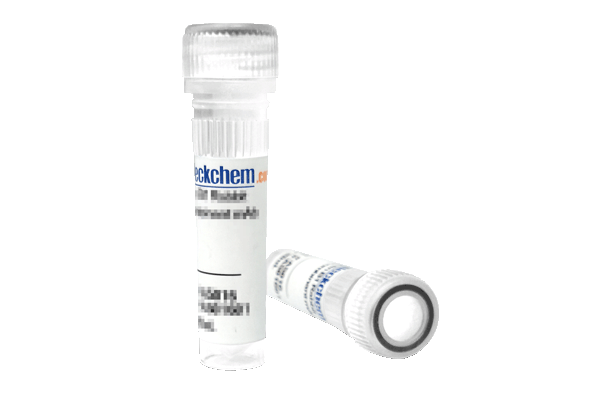
Click to purchase the isotype control of Rituximab (anti-CD20)
16 Citations

17 Nobel Prize winners have used Selleck products
Shimon Sakaguchi
Nature Communications 2025,16, Article number:1325
David Baker
Dev Cell 2023, 58(20):2163-2180.e9.
David Julius
Cell 2017, 185-198.e16
Michael Houghton
Cell Chem Biol, 2020, 27(7):780-792.e5
Charles M. Rice
Cell 2018, 172(3):423-438.e25
Quality Control
| Featured Inhibitors | Y-27632 Dihydrochloride SB431542 CHIR-99021 (Laduviglusib) RMC-7977 RMC-6236 (Daraxonrasib) MRTX1133 MG132 Z-VAD-FMK VT3989 IAG933 |
|---|
Specificity
Mechanism of Action
| Description |
Rituximab (anti-CD20) is a chimeric anti-CD20 mAb that binds the CD20 antigen on B cells with a binding affinity of 5 nM, MW: 143.86 KD.
|
|---|---|
| Features |
Human IgG1
|
| Targets/IC50/Ki |
CD20
|
| In vitro |
Anti-CD20 IgG1 antibody (rituximab), induces strong antibody-dependent cellular cytotoxicity (ADCC) and complement-dependent cytotoxicity (CDC) effects on CD20+ Raji cells with the EC50 at 0.0365 nM and 1.5 nM, respectively. |
| Cell Research |
For ADCC experiments, PBMCs were isolated from healthy human donor blood to serve as effector cells and were plated with target Raji cells at E:T ratio of 50:1 in the presence of indicated concentrations of KPL-404, anti-CD20, or isotype antibodies. Target Raji cells were labeled with calcein-AM for detection of cell lysis prior to experimental set up. Following incubation for 4 hours at 37°C in 5% CO2, supernatants from the experiment were analyzed. For CDC experiments, human complement was plated with calcein-AM labeled target Raji cells in the presence of indicated concentrations of KPL-404, anti-CD20, or isotype antibodies. Following incubation for 4 hours at 37°C in 5% CO2, supernatants from the experiment were analyzed. |
| In vivo |
A number of in vivo tumor models suggest the anti-tumor activity of rituximab is dependent, at least in part, on complement. Rituximab can deplete B cells for several months and, as such, could represent an effective therapy for B cell-mediated autoimmune diseases. Rituximab is now widely used in onco-haematology and is currently in development in several autoimmune diseases. |
| Animal Research |
Objective: To study the mechanisms of follicular lymphoma’s resistance to rituximab |
References |
|
Product Details
| CAS No. | 174722-31-7 |
|---|---|
| Isotype | Human IgG1 |
| Source | CHO cells |
| Sterility | 0.2 μM filtered |
| Formulation | 100 mM Pro-Ac, 20 mM Arg, pH 5.0 |
| Storage (From the date of receipt) |
Store the undiluted solution at 4°C in the dark to avoid freeze-thaw cycles |
Comparison of Clones for
*Literature analysis of various clone (for this target) products available on the market shows that Selleck's selected clones are more frequently applied. (data until September 2024)
Tech Support
Tel: +1-832-582-8158 Ext:3
If you have any other enquiries, please leave a message.
Frequently Asked Questions
Question 1:
How to store the antibody?
Answer:
Store the undiluted solution at 4 °C in the dark. Freezing antibodies can result in a loss of activity caused by the freezing/thawing process. Diluting antibodies to working concentrations and storing at 4°C for more than a day should be avoided. Additionally, make sure to keep the antibody sterile. Under these storage conditions, your antibodies should remain active for up to one year and oftentimes longer.

Products are for research use only. Not for human use. We do not sell to patients.
©Copyright 2013 Selleck Chemicals. All Rights Reserved.