
-
 Argentina
-
 Australia
-
 Austria
-
 Belgium
-
 Brazil
-
 Canada
-
 China
China
-
 Czech Republic
-
 Denmark
-
 Finland
-
 France
-
 Germany
-
 Greece
-
 Hong Kong
-
 Hungary
-
 Iceland
-
 India
India
-
 Ireland
-
 Israel
-
 Italy
Italy
-
 Japan
Japan
-
 Korea
Korea
-
 Luxembourg
-
 Malaysia
-
 Netherlands
-
 New Zealand
-
 Norway
-
 Poland
-
 Portugal
-
 Qatar
Qatar
-
 Romania
-
 Saudi Arabia
-
 Singapore
-
 Spain
Spain
-
 Sweden
-
 Switzerland
-
 Taiwan
-
 Turkey
-
 United Kingdom
-
 United States
research use only
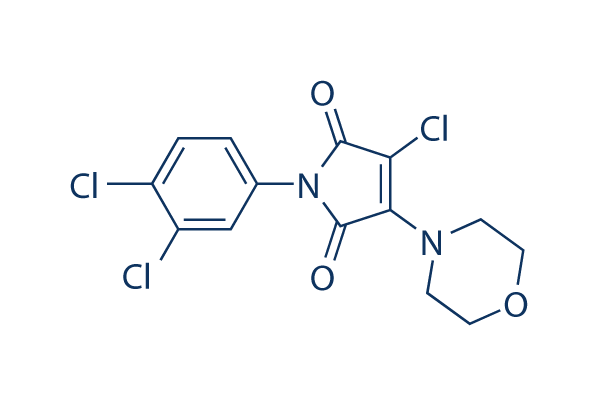
RI-1 RAD51 inhibitor
Cat.No.S8077
Quality Control
| Related Targets | HDAC PARP ATM/ATR DNA-PK WRN DNA/RNA Synthesis Topoisomerase PPAR Sirtuin Casein Kinase |
|---|---|
| Other RAD51 Inhibitors | RAD51 Inhibitor B02 RS-1 RAD51-IN-17 Emzadirib |
Solubility
|
In vitro |
DMSO
: 50 mg/mL
(138.27 mM)
Water : Insoluble Ethanol : Insoluble |
Molarity Calculator
|
In vivo |
|||||
In vivo Formulation Calculator (Clear solution)
Step 1: Enter information below (Recommended: An additional animal making an allowance for loss during the experiment)
Step 2: Enter the in vivo formulation (This is only the calculator, not formulation. Please contact us first if there is no in vivo formulation at the solubility Section.)
Calculation results:
Working concentration: mg/ml;
Method for preparing DMSO master liquid: mg drug pre-dissolved in μL DMSO ( Master liquid concentration mg/mL, Please contact us first if the concentration exceeds the DMSO solubility of the batch of drug. )
Method for preparing in vivo formulation: Take μL DMSO master liquid, next addμL PEG300, mix and clarify, next addμL Tween 80, mix and clarify, next add μL ddH2O, mix and clarify.
Method for preparing in vivo formulation: Take μL DMSO master liquid, next add μL Corn oil, mix and clarify.
Note: 1. Please make sure the liquid is clear before adding the next solvent.
2. Be sure to add the solvent(s) in order. You must ensure that the solution obtained, in the previous addition, is a clear solution before proceeding to add the next solvent. Physical methods such
as vortex, ultrasound or hot water bath can be used to aid dissolving.
Chemical Information, Storage & Stability
| Molecular Weight | 361.61 | Formula | C14H11Cl3N2O3 |
Storage (From the date of receipt) | |
|---|---|---|---|---|---|
| CAS No. | 415713-60-9 | Download SDF | Storage of Stock Solutions |
|
|
| Synonyms | RAD51 inhibitor 1 | SMILES | C1COCCN1C2=C(C(=O)N(C2=O)C3=CC(=C(C=C3)Cl)Cl)Cl | ||
Read more about storage stability stock solution CAS number SMILES
Mechanism of Action
| Features |
A selective recombinant RAD51 protein inhibitor discovered in 2012. Valuable tool for mechanistic studies of DNA repair and potential for use in many cancers.
|
|---|---|
| Targets/IC50/Ki |
RAD51
<30 μM
|
| In vitro |
RI-1 sensitizes cells to DNA damage by directly and specifically disrupting HsRAD51 and inhibiting the ability of RAD51 to form filaments on ssDNA. In addition, this compound alone generates single-agent toxicity in all three cancer cell lines (HeLa, MCF-7 and U2OS) with LD50 values in the 20–40 µM range. It decreases the rejoining of γ-H2AX foci in G2 phase cells and results in a higher level of unrepaired DSBs 6 hours after irradiation.
|
| Kinase Assay |
DNA binding assays
|
|
All reactions are performed in black non-binding polystyrene 384-well plates with reaction volumes of 30–100 μL. Purified DNA strand exchange proteins and chemical compounds are pre-incubated at room temperature for 5 minutes; they are then further incubated at 37°C for 30 min with 100 nM of ssDNA substrate, consisting of a 45-mer poly-dT tagged with Alexa 488 at the 5’ terminus (synthesized and purified by Integrated DNA Technologies). Reactions are performed in 20 mM HEPES pH 7.5, 10 mM MgCl2, 0.25 μM BSA, 2% glycerol, 30 mM NaCl, 4% DMSO and 2 mM ATP. Some conditions included DTT or TCEP (tris(2-carboxyethyl)phosphine) as indicated. DNA binding is measured as a function of fluorescence polarization (FP) with a Safire2 plate reader, using the following settings: excitation 470±5nm, emission 530±5nm, 10 reads/well, Z height and G factor auto-calibrated from control wells. Displayed error bars represent standard deviation. For experiments involving a titration of protein concentrations, data are fit to an equation that accounts for the cooperative nature by which recombinase proteins bind DNA. For experiments involving a titration of this compound, protein concentrations are selected to give an ∼80% saturation of the FP signal in the absence of this chemical.
|
References |
|
Clinical Trial Information
(data from https://clinicaltrials.gov, updated on 2026-08-06)
| NCT Number | Recruitment | Conditions | Sponsor/Collaborators | Start Date | Phases |
|---|---|---|---|---|---|
| NCT06776783 | RECRUITING | Respiratory Distress Syndrome; Pre-term Infants |
Aerogen Pharma Limited |
2025-09-24 | PHASE3 |
Read more about Clinical Trials
Tech Support
Tel: +1-832-582-8158 Ext:3
If you have any other enquiries, please leave a message.

Products are for research use only. Not for human use. We do not sell to patients.
©Copyright 2013 Selleck Chemicals. All Rights Reserved.