
-
 Argentina
-
 Australia
-
 Austria
-
 Belgium
-
 Brazil
-
 Canada
-
 China
China
-
 Czech Republic
-
 Denmark
-
 Finland
-
 France
-
 Germany
-
 Greece
-
 Hong Kong
-
 Hungary
-
 Iceland
-
 India
India
-
 Ireland
-
 Israel
-
 Italy
Italy
-
 Japan
Japan
-
 Korea
Korea
-
 Luxembourg
-
 Malaysia
-
 Netherlands
-
 New Zealand
-
 Norway
-
 Poland
-
 Portugal
-
 Qatar
Qatar
-
 Romania
-
 Saudi Arabia
-
 Singapore
-
 Spain
Spain
-
 Sweden
-
 Switzerland
-
 Taiwan
-
 Turkey
-
 United Kingdom
-
 United States
research use only
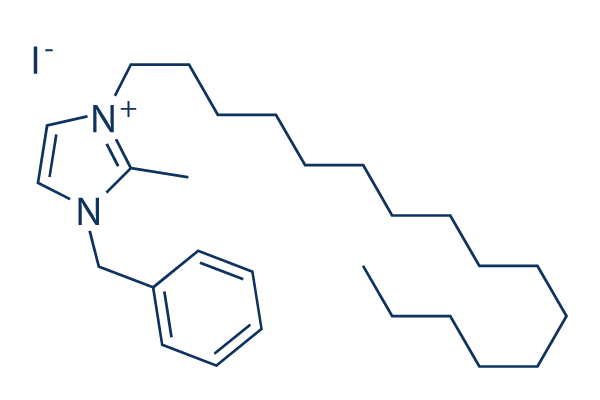
NH125 CaMK inhibitor
Cat.No.S7436
Quality Control
| Related Targets | Adrenergic Receptor AChR 5-HT Receptor COX Calcium Channel Histamine Receptor Dopamine Receptor GABA Receptor TRP Channel Cholinesterase (ChE) |
|---|---|
| Other CaMK Inhibitors | KN-93 Phosphate KN-93 STO-609 KN-62 KN-92 phosphate KN-93 hydrochloride |
Solubility
|
In vitro |
DMSO
: 100 mg/mL
(190.63 mM)
Ethanol : 100 mg/mL Water : Insoluble |
Molarity Calculator
|
In vivo |
|||||
In vivo Formulation Calculator (Clear solution)
Step 1: Enter information below (Recommended: An additional animal making an allowance for loss during the experiment)
Step 2: Enter the in vivo formulation (This is only the calculator, not formulation. Please contact us first if there is no in vivo formulation at the solubility Section.)
Calculation results:
Working concentration: mg/ml;
Method for preparing DMSO master liquid: mg drug pre-dissolved in μL DMSO ( Master liquid concentration mg/mL, Please contact us first if the concentration exceeds the DMSO solubility of the batch of drug. )
Method for preparing in vivo formulation: Take μL DMSO master liquid, next addμL PEG300, mix and clarify, next addμL Tween 80, mix and clarify, next add μL ddH2O, mix and clarify.
Method for preparing in vivo formulation: Take μL DMSO master liquid, next add μL Corn oil, mix and clarify.
Note: 1. Please make sure the liquid is clear before adding the next solvent.
2. Be sure to add the solvent(s) in order. You must ensure that the solution obtained, in the previous addition, is a clear solution before proceeding to add the next solvent. Physical methods such
as vortex, ultrasound or hot water bath can be used to aid dissolving.
Chemical Information, Storage & Stability
| Molecular Weight | 524.56 | Formula | C27H45IN2 |
Storage (From the date of receipt) | |
|---|---|---|---|---|---|
| CAS No. | 278603-08-0 | Download SDF | Storage of Stock Solutions |
|
|
| Synonyms | N/A | SMILES | CCCCCCCCCCCCCCCCN1C=C[N+](=C1C)CC2=CC=CC=C2.[I-] | ||
Read more about storage stability stock solution CAS number SMILES
Mechanism of Action
| Targets/IC50/Ki |
eEF-2 kinase
60 nM
|
|---|---|
| In vitro |
In C6 glioma cells, NH125 decreases the cellular content of phospho-eEF-2 without affecting total content eEF-2 content, and blocks cell cycle transit at the G1-S boundary. This compound potently inhibits cell viability of 10 cancer cells with IC50 ranging from 0.7 to 4.8 μM. It effectively inhibits histidine protein kinases, including Envz, PhoQ, BvgS, EvgS, and thus produces potent anti-bacteria activities on oxacillin-resistant Staphylococcus aureus (ORSA), vancomycin-resistant Enterococcus faecalis (VRE), penicillin-resistant Streptococcus pneumoniae (PRS), and other Gram-positive and Gram-negative bacteria. EEF2K inhibition by this chemical renders tumor cells more sensitive to curcumin and velcade, which possess ER stress-inducing action.
|
| Kinase Assay |
eEF-2 Kinase Assay
|
|
eEF-2 kinase activity is measured by two methods: (a) a filter-based assay; and (b) by immunoblotting using antiphospho-eEF2 antibody. For both of these, reactions are carried out in 20 μl of total volume containing 50 mM HEPES (pH 7.5), 10 mM MgCl2, 1.5 mM CaCl2, 100 μg/ml calmodulin, 2 μM His-tagged eEF-2 and 400 nM GST-eEF-2 kinase, and ATP mixture [50 μM ATP with 1μCi (γ-33P)ATP]. The kinase mixture without ATP is prepared on ice and then preincubated for 15 min at room temperature. Kinase reactions are started by adding ATP and allowed to progress at 30°C for 30 min. For the filter-based assay, the reaction is terminated by adding 20 μl of cold 1.5% phosphoric acid, and 5 μl of the reaction are applied to P81 Whatman phosphocellulose paper. The paper is washed three times in 500 ml of 0.5% phosphoric acid and once with 200 ml of acetone. The paper is then air-dried and immersed in 10 ml of scintillation mixture. Radioactivity is counted using a Beckton-Dickinson liquid scintillation counter. For immunoblotting, the reactions are stopped by addition of 20 μl of 3× Lamelli buffer [190 mM Tris (pH 6.8), 6% SDS, 30% glycerol, 15% 2-mercaptoethanol, and 0.003% bromphenol blue dye]. Samples are boiled for 5 min and resolved by 7% SDS-PAGE and processed for Western blotting as described below. Conditions for both assays are chosen to ensure linearity of the reaction with respect to time of incubation and concentration of enzyme.
|
|
| In vivo |
NH125 reduces blood pressure in SHR and ROS production, induction of inflammatory molecules, and hypertrophy in SHR superior mesenteric artery.
|
References |
|
Tech Support
Tel: +1-832-582-8158 Ext:3
If you have any other enquiries, please leave a message.

Products are for research use only. Not for human use. We do not sell to patients.
©Copyright 2013 Selleck Chemicals. All Rights Reserved.