
-
 Argentina
-
 Australia
-
 Austria
-
 Belgium
-
 Brazil
-
 Canada
-
 China
China
-
 Czech Republic
-
 Denmark
-
 Finland
-
 France
-
 Germany
-
 Greece
-
 Hong Kong
-
 Hungary
-
 Iceland
-
 India
India
-
 Ireland
-
 Israel
-
 Italy
Italy
-
 Japan
Japan
-
 Korea
Korea
-
 Luxembourg
-
 Malaysia
-
 Netherlands
-
 New Zealand
-
 Norway
-
 Poland
-
 Portugal
-
 Qatar
Qatar
-
 Romania
-
 Saudi Arabia
-
 Singapore
-
 Spain
Spain
-
 Sweden
-
 Switzerland
-
 Taiwan
-
 Turkey
-
 United Kingdom
-
 United States
research use only
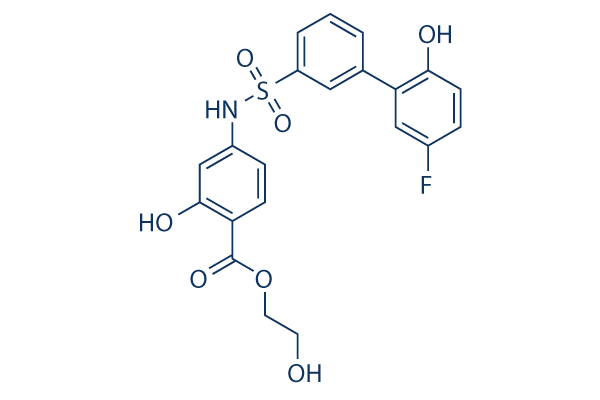
KAN0438757 PFKFB inhibitor
Cat.No.S0400
Quality Control
| Related Targets | CDK HSP PD-1/PD-L1 ROCK Wee1 DNA/RNA Synthesis Microtubule Associated Ras KRas Aurora Kinase |
|---|---|
| Other PFKFB Inhibitors | PFK-015 3PO PFK158 |
Solubility
|
In vitro |
DMSO
: 7 mg/mL
(15.64 mM)
Water : Insoluble Ethanol : Insoluble |
Molarity Calculator
|
In vivo |
|||||
In vivo Formulation Calculator (Clear solution)
Step 1: Enter information below (Recommended: An additional animal making an allowance for loss during the experiment)
Step 2: Enter the in vivo formulation (This is only the calculator, not formulation. Please contact us first if there is no in vivo formulation at the solubility Section.)
Calculation results:
Working concentration: mg/ml;
Method for preparing DMSO master liquid: mg drug pre-dissolved in μL DMSO ( Master liquid concentration mg/mL, Please contact us first if the concentration exceeds the DMSO solubility of the batch of drug. )
Method for preparing in vivo formulation: Take μL DMSO master liquid, next addμL PEG300, mix and clarify, next addμL Tween 80, mix and clarify, next add μL ddH2O, mix and clarify.
Method for preparing in vivo formulation: Take μL DMSO master liquid, next add μL Corn oil, mix and clarify.
Note: 1. Please make sure the liquid is clear before adding the next solvent.
2. Be sure to add the solvent(s) in order. You must ensure that the solution obtained, in the previous addition, is a clear solution before proceeding to add the next solvent. Physical methods such
as vortex, ultrasound or hot water bath can be used to aid dissolving.
Chemical Information, Storage & Stability
| Molecular Weight | 447.43 | Formula | C21H18FNO7S |
Storage (From the date of receipt) | 3 years -20°C powder |
|---|---|---|---|---|---|
| CAS No. | 1451255-59-6 | -- | Storage of Stock Solutions |
|
|
| Synonyms | N/A | SMILES | C1=CC(=CC(=C1)S(=O)(=O)NC2=CC(=C(C=C2)C(=O)OCCO)O)C3=C(C=CC(=C3)F)O | ||
Read more about storage stability stock solution CAS number SMILES
Mechanism of Action
| Targets/IC50/Ki |
PFKFB3
(Cell-free assay) 0.19 μM
PFKFB4
(Cell-free assay) 3.6 μM
|
|---|---|
| In vitro |
A PFKFB3 inhibitor, KAN0438757, which selectively inhibits proliferation of transformed cells while sparing non-transformed cells. Inhibition of PFKFB3 enzymatic activity by this compound impairs IR-induced recruitment of ribonucleotide reductase (RNR) M2 and deoxynucleotide incorporation upon DNA repair. |
| Kinase Assay |
ADP-GloTM Kinase Assay
|
|
First, after the kinase reaction, an equal volume of ADP-GloTM Reagent was added to terminate the kinase reaction and deplete the remaining ATP. Second, the Kinase Detection Reagent was added to simultaneously convert ADP to ATP and allow the newly synthesized ATP to be measured using a luciferase/luciferin reaction. The light generated was measured. The assay was performed in white 384-well plates by consecutive additions of a test compound solution, enzyme solution and substrate. Controls in the absence of inhibitor, 100 nM of an in-house inhibitor, and 49.5 µM of an in-house inhibitor were included in the plate. The final concentrations of all reagents per well were 50 mM Tris HCl at pH 8.0, 10 mM MgCl2, 5 mM NaPi at pH 8.0, 81.48 nM PFKFB3 or 145 nM PFKFB4, 8 µM ATP, 100 µM F6P (acid treated and then neutralized to remove any contaminating F-2,6-P2), 0.005% Tween-20 and 1 mM dithiothreitol. Enzyme, compounds, and controls were pre-incubated at room temperature for 15 min before the addition of substrate solution. The enzymatic reaction was allowed to proceed for 20 min and the reaction was terminated by the addition of ADP-GloTM Reagent (10 µL) to all wells followed by 40 min incubation at room temperature. After addition of Kinase Detection Reagent (20 µL) to all wells, the plate was incubated for 30 min at room temperature, followed by measurement. All plates were centrifuged after each addition.
|
|
| In vivo |
In vivo administration of KAN0438757 in mice is well tolerated and does not trigger major systemic or toxic alterations. |
References |
|
Tech Support
Tel: +1-832-582-8158 Ext:3
If you have any other enquiries, please leave a message.

Products are for research use only. Not for human use. We do not sell to patients.
©Copyright 2013 Selleck Chemicals. All Rights Reserved.