
-
 Argentina
-
 Australia
-
 Austria
-
 Belgium
-
 Brazil
-
 Canada
-
 China
China
-
 Czech Republic
-
 Denmark
-
 Finland
-
 France
-
 Germany
-
 Greece
-
 Hong Kong
-
 Hungary
-
 Iceland
-
 India
India
-
 Ireland
-
 Israel
-
 Italy
Italy
-
 Japan
Japan
-
 Korea
Korea
-
 Luxembourg
-
 Malaysia
-
 Netherlands
-
 New Zealand
-
 Norway
-
 Poland
-
 Portugal
-
 Qatar
Qatar
-
 Romania
-
 Saudi Arabia
-
 Singapore
-
 Spain
Spain
-
 Sweden
-
 Switzerland
-
 Taiwan
-
 Turkey
-
 United Kingdom
-
 United States
research use only
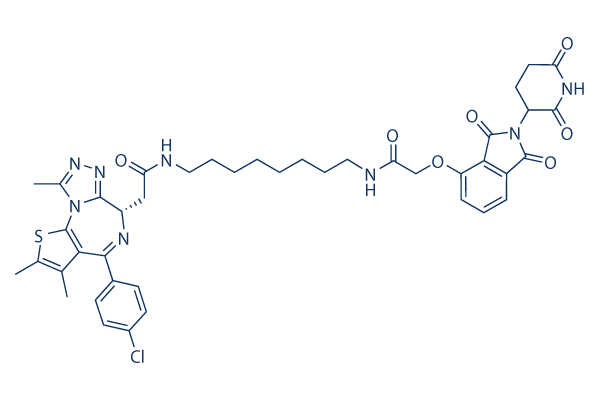
dBET6 BET PROTAC Degrader
Cat.No.S8762
Quality Control
Cell Culture, Treatment & Working Concentration
| Cell Lines | Assay Type | Concentration | Incubation Time | Formulation | Activity Description | PMID |
|---|---|---|---|---|---|---|
| Vero E6 | Function assay | 48 h | IC50 for antiviral activity against SARS-CoV-2 in the Vero E6 cell line at 48 h by immunofluorescence-based assay (detecting the viral NP protein in the nucleus of the Vero E6 cells), IC50=3.17687 µM. | 32353859 | ||
| Click to View More Cell Line Experimental Data | ||||||
Solubility
|
In vitro |
DMSO
: 100 mg/mL
(118.85 mM)
Ethanol : 50 mg/mL Water : Insoluble |
Molarity Calculator
|
In vivo |
|||||
In vivo Formulation Calculator (Clear solution)
Step 1: Enter information below (Recommended: An additional animal making an allowance for loss during the experiment)
Step 2: Enter the in vivo formulation (This is only the calculator, not formulation. Please contact us first if there is no in vivo formulation at the solubility Section.)
Calculation results:
Working concentration: mg/ml;
Method for preparing DMSO master liquid: mg drug pre-dissolved in μL DMSO ( Master liquid concentration mg/mL, Please contact us first if the concentration exceeds the DMSO solubility of the batch of drug. )
Method for preparing in vivo formulation: Take μL DMSO master liquid, next addμL PEG300, mix and clarify, next addμL Tween 80, mix and clarify, next add μL ddH2O, mix and clarify.
Method for preparing in vivo formulation: Take μL DMSO master liquid, next add μL Corn oil, mix and clarify.
Note: 1. Please make sure the liquid is clear before adding the next solvent.
2. Be sure to add the solvent(s) in order. You must ensure that the solution obtained, in the previous addition, is a clear solution before proceeding to add the next solvent. Physical methods such
as vortex, ultrasound or hot water bath can be used to aid dissolving.
Chemical Information, Storage & Stability
| Molecular Weight | 841.37 | Formula | C42H45ClN8O7S |
Storage (From the date of receipt) | 3 years -20°C powder |
|---|---|---|---|---|---|
| CAS No. | 1950634-92-0 | -- | Storage of Stock Solutions |
|
|
| Synonyms | N/A | SMILES | CC1=C(SC2=C1C(=NC(C3=NN=C(N32)C)CC(=O)NCCCCCCCCNC(=O)COC4=CC=CC5=C4C(=O)N(C5=O)C6CCC(=O)NC6=O)C7=CC=C(C=C7)Cl)C | ||
Read more about storage stability stock solution CAS number SMILES
Mechanism of Action
| Targets/IC50/Ki |
BRD4
14 nM
|
|---|---|
| In vitro |
dBET6 is a highly cell-permeable degrader of BET bromodomains. It is potent in most cancer cell lines. This compound features highly increased cellular potency with evident degradation in the sub-nanomolar range. Treatment with 100 nM of this chemical leads to degradation of BRD4 after 1 hr, prompting subsequent downregulation of c-MYC and induction of apoptosis. It disrupts global productive transcription elongation. Its treatment leads to a widespread decrease in steady-state mRNA levels, but observed an incommensurate impact on expression of members of the core regulatory circuitry of leukemogenic transcription factors. The collapse of the core transcriptional machinery prompted by BET degradation precedes a robust apoptotic response, of apparent translational significance. |
| In vivo |
dBET6 is well tolerated. Upon treatment with this compound, a significant reduction of leukemic burden is observed in a disseminated mouse model of T-ALL. Moreover, mice treated with this chemical (7.5 mg/kg BID) exhibits a significant survival benefit compared to mice treated with vehicle control or JQ1 (20 mg/kg QD). |
References |
Applications
| Methods | Biomarkers | Images | PMID |
|---|---|---|---|
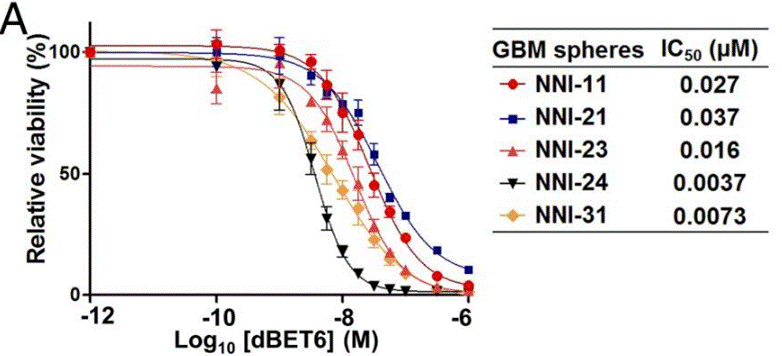
| Growth inhibition assay | Cell viability |
|
29764999 |
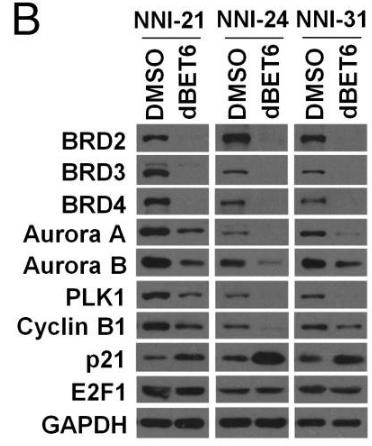
| Western blot | BRD2 / BRD3 / BRD4 / Aurora A / Aurora B / PLK1 / Cyclin B1 / p21 / E2F1 p-RNA-Pol2 S2 / p-RNA-Pol2 S5 / RNA-Pol2 |
|
29764999 |
Tech Support
Tel: +1-832-582-8158 Ext:3
If you have any other enquiries, please leave a message.

Products are for research use only. Not for human use. We do not sell to patients.
©Copyright 2013 Selleck Chemicals. All Rights Reserved.