
-
 Argentina
-
 Australia
-
 Austria
-
 Belgium
-
 Brazil
-
 Canada
-
 China
China
-
 Czech Republic
-
 Denmark
-
 Finland
-
 France
-
 Germany
-
 Greece
-
 Hong Kong
-
 Hungary
-
 Iceland
-
 India
India
-
 Ireland
-
 Israel
-
 Italy
Italy
-
 Japan
Japan
-
 Korea
Korea
-
 Luxembourg
-
 Malaysia
-
 Netherlands
-
 New Zealand
-
 Norway
-
 Poland
-
 Portugal
-
 Qatar
Qatar
-
 Romania
-
 Saudi Arabia
-
 Singapore
-
 Spain
Spain
-
 Sweden
-
 Switzerland
-
 Taiwan
-
 Turkey
-
 United Kingdom
-
 United States
research use only
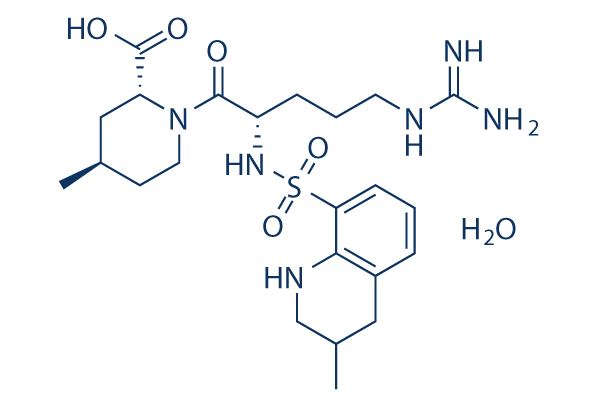
Argatroban Monohydrate Thrombin inhibitor
Cat.No.S5074
Quality Control
| Related Targets | HDAC Caspase Proteasome Secretase MMP HCV Protease Cysteine Protease Tyrosinase HIV Protease DPP |
|---|---|
| Featured Inhibitors | Y-27632 Dihydrochloride SB431542 CHIR-99021 (Laduviglusib) RMC-7977 RMC-6236 (Daraxonrasib) MRTX1133 MG132 Z-VAD-FMK VT3989 IAG933 |
Solubility
|
In vitro |
DMSO
: 100 mg/mL
(189.87 mM)
Ethanol : 40 mg/mL Water : Insoluble |
Molarity Calculator
|
In vivo |
|||||
In vivo Formulation Calculator (Clear solution)
Step 1: Enter information below (Recommended: An additional animal making an allowance for loss during the experiment)
Step 2: Enter the in vivo formulation (This is only the calculator, not formulation. Please contact us first if there is no in vivo formulation at the solubility Section.)
Calculation results:
Working concentration: mg/ml;
Method for preparing DMSO master liquid: mg drug pre-dissolved in μL DMSO ( Master liquid concentration mg/mL, Please contact us first if the concentration exceeds the DMSO solubility of the batch of drug. )
Method for preparing in vivo formulation: Take μL DMSO master liquid, next addμL PEG300, mix and clarify, next addμL Tween 80, mix and clarify, next add μL ddH2O, mix and clarify.
Method for preparing in vivo formulation: Take μL DMSO master liquid, next add μL Corn oil, mix and clarify.
Note: 1. Please make sure the liquid is clear before adding the next solvent.
2. Be sure to add the solvent(s) in order. You must ensure that the solution obtained, in the previous addition, is a clear solution before proceeding to add the next solvent. Physical methods such
as vortex, ultrasound or hot water bath can be used to aid dissolving.
Chemical Information, Storage & Stability
| Molecular Weight | 526.65 | Formula | C23H36N6O5S.H2O |
Storage (From the date of receipt) | |
|---|---|---|---|---|---|
| CAS No. | 141396-28-3 | -- | Storage of Stock Solutions |
|
|
| Synonyms | Argatroban hydrate, Argipidine,MCI-9038 Monohydrate | SMILES | CC1CCN(C(C1)C(=O)O)C(=O)C(CCCN=C(N)N)NS(=O)(=O)C2=CC=CC3=C2NCC(C3)C.O | ||
Read more about storage stability stock solution CAS number SMILES
Mechanism of Action
| Targets/IC50/Ki |
thrombin
|
|---|---|
| In vitro |
Argatroban is highly selective for thrombin and has little or no effect on related serine proteases (trypsin, factor Xa, plasmin, and kallikrein). Argatroban is effective against free, fibrin-bound and clot-bound thrombin with comparable half-maximal inhibitory concentrations (IC50), and argatroban is also effective in inhibiting platelet aggregation and thromboxane generation in the presence of both free and clot-bound thrombin. Argatroban binds thrombin and inhibits its activity without the requirement of coenzymes, unlike antithrombin III or heparin cofactor II. Argatroban decreases bone metastasis of B16 mouse melanoma cells by inactivating thrombin activity. Moreover, argatroban has potential to inhibit PAR-2 activation by interfering with the thrombogenic cycle. It does not have toxic effect for tumor cells. |
| In vivo |
Within a clinically relevant dose range (from 1–3 μg/kg/min in prevention or treatment of thrombotic events in HIT to up to 25 μg/kg/min in PCI in HIT patients), argatroban exhibits linear pharmacokinetic behavior, and steady state levels are attained within 1 hour after the start of an infusion. The elimination half-life of argatroban in healthy subjects is about 45 minutes, with a corresponding decline in its anticoagulant effects which reach their pretreatment level within 2–4 hours after cessation of an infusion. Argatroban lacks major drug–drug interactions with CYP3A4/5 inhibitors such as erythromycin or with acetaminophen, warfarin, and digoxin. However, in patients with hepatic impairment, area under the concentration versus time curve (AUC), maximum concentration, and half-life of argatroban were increased approximately 2- to 3-fold, and clearance was one-fourth that of healthy volunteers. The increase in plasma concentrations in these patients coincided with increased pharmacodynamic effects. |
References |
|
Tech Support
Tel: +1-832-582-8158 Ext:3
If you have any other enquiries, please leave a message.

Products are for research use only. Not for human use. We do not sell to patients.
©Copyright 2013 Selleck Chemicals. All Rights Reserved.