
-
 Argentina
-
 Australia
-
 Austria
-
 Belgium
-
 Brazil
-
 Canada
-
 China
China
-
 Czech Republic
-
 Denmark
-
 Finland
-
 France
-
 Germany
-
 Greece
-
 Hong Kong
-
 Hungary
-
 Iceland
-
 India
India
-
 Ireland
-
 Israel
-
 Italy
Italy
-
 Japan
Japan
-
 Korea
Korea
-
 Luxembourg
-
 Malaysia
-
 Netherlands
-
 New Zealand
-
 Norway
-
 Poland
-
 Qatar
Qatar
-
 Romania
-
 Saudi Arabia
-
 Singapore
-
 Spain
Spain
-
 Sweden
-
 Switzerland
-
 Taiwan
-
 Turkey
-
 United Kingdom
-
 United States
research use only
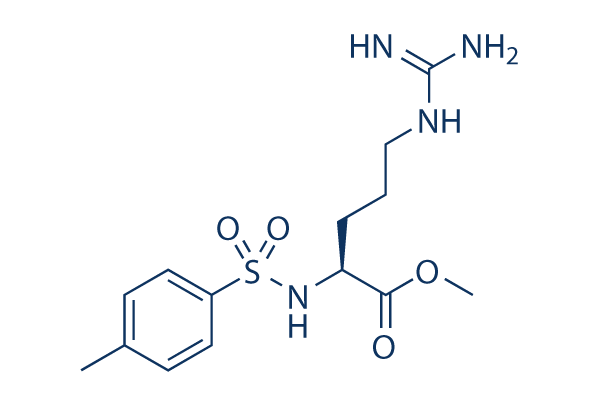
TAME APC inhibitor
Cat.No.S2225
Quality Control
| Related Targets | CDK HSP PD-1/PD-L1 ROCK Wee1 DNA/RNA Synthesis Microtubule Associated Ras KRas Aurora Kinase |
|---|---|
| Featured Inhibitors | Y-27632 Dihydrochloride SB431542 CHIR-99021 (Laduviglusib) RMC-7977 RMC-6236 (Daraxonrasib) MRTX1133 MG132 Z-VAD-FMK VT3989 IAG933 |
Solubility
|
In vitro |
DMSO
: 69 mg/mL
(201.51 mM)
Water : 69 mg/mL Ethanol : 3 mg/mL |
Molarity Calculator
|
In vivo |
|||||
In vivo Formulation Calculator (Clear solution)
Step 1: Enter information below (Recommended: An additional animal making an allowance for loss during the experiment)
Step 2: Enter the in vivo formulation (This is only the calculator, not formulation. Please contact us first if there is no in vivo formulation at the solubility Section.)
Calculation results:
Working concentration: mg/ml;
Method for preparing DMSO master liquid: mg drug pre-dissolved in μL DMSO ( Master liquid concentration mg/mL, Please contact us first if the concentration exceeds the DMSO solubility of the batch of drug. )
Method for preparing in vivo formulation: Take μL DMSO master liquid, next addμL PEG300, mix and clarify, next addμL Tween 80, mix and clarify, next add μL ddH2O, mix and clarify.
Method for preparing in vivo formulation: Take μL DMSO master liquid, next add μL Corn oil, mix and clarify.
Note: 1. Please make sure the liquid is clear before adding the next solvent.
2. Be sure to add the solvent(s) in order. You must ensure that the solution obtained, in the previous addition, is a clear solution before proceeding to add the next solvent. Physical methods such
as vortex, ultrasound or hot water bath can be used to aid dissolving.
Chemical Information, Storage & Stability
| Molecular Weight | 342.41 | Formula | C14H22N4O4S |
Storage (From the date of receipt) | |
|---|---|---|---|---|---|
| CAS No. | 901-47-3 | Download SDF | Storage of Stock Solutions |
|
|
| Synonyms | N/A | SMILES | CC1=CC=C(C=C1)S(=O)(=O)NC(CCCN=C(N)N)C(=O)OC | ||
Read more about storage stability stock solution CAS number SMILES
Mechanism of Action
| Targets/IC50/Ki |
APC
|
|---|---|
| In vitro |
TAME inhibits cyclin proteolysis in mitotic Xenopus egg extract with IC50 of 12 µM. This compound at concentration of 1-200 μM arrests interphase extract treated with recombinant cyclin B1/Cdc2 complex in mitosis, with stable cyclin B1 and phosphorylated Cdc27. It at concentration of 200 μM dramaticly inhibits the ubiquitin ligase activity of the Anaphase-Promoting Complex (APC), accompanied by reduced binding of Cdh1 to APC. This chemical addition to interphase extract reduces Cdc20 association with the APC in a dose-dependent manner partly by binding directly to APC, and the contribution motif is the C-terminal isoleucine-arginine (IR) tail on APC. It is hydrolysed by trypsin with Km of 0.328 mM. This compound accelerates the ATP hydrolysis process about 12-fold. It interacts with β and γ phosphate and the adenine ring of ATP by the guanidinium group and the aromatic ring. This chemical at concentration of 50 mM inhibits nutrient-induced germination and pressure-induced germination at 600 MPa in Bacillus subtilis. It induces a concentration dependent contractile response on ileal strips with EC50 of 4.3 x 10³ M.
|
References |
|
Clinical Trial Information
(data from https://clinicaltrials.gov, updated on 2025-04-08)
| NCT Number | Recruitment | Conditions | Sponsor/Collaborators | Start Date | Phases |
|---|---|---|---|---|---|
| NCT06917443 | NOT_YET_RECRUITING | Crohn Disease (CD); IBD (Inflammatory Bowel Disease) |
Shmuel Kivity, MD |
2025-04 | |
| NCT07696923 | RECRUITING | Frozen Shoulder; Chronic Pain; Adhesive Capsulitis; Transcatheter Arterial Microembolization; Corticosteroid Injection |
Shin Kong Wu Ho-Su Memorial Hospital |
2026-08-01 | |
| NCT07396246 | RECRUITING | Trochanteric Syndrome |
Unidade Local de Saúde do Alto Ave, EPE |
2026-01-05 | PHASE2 |
| NCT07336849 | RECRUITING | Adhesive Capsulitis of the Shoulder; Frozen Shoulder; Shoulder Adhesive Capsulitis |
Chung-Ang University Hospital |
2025-09-18 | |
| NCT05053750 | ACTIVE_NOT_RECRUITING | Epithelial Ovarian; Fallopian Tube; Primary Peritoneal Cancer |
M.D. Anderson Cancer Center |
2021-12-14 | EARLY_PHASE1 |
| NCT07052916 | RECRUITING | Blood Cancer; Lymphoma; Leukemia; Myeloma |
Memorial Sloan Kettering Cancer Center |
2025-06-27 |
Read more about Clinical Trials
Tech Support
Tel: +1-832-582-8158 Ext:3
If you have any other enquiries, please leave a message.
Signaling Pathway Map

Products are for research use only. Not for human use. We do not sell to patients.
©Copyright 2013 Selleck Chemicals. All Rights Reserved.