
-
 Australia
-
 Austria
-
 Belgium
-
 Brazil
-
 Canada
-
 China
China
-
 Czech Republic
-
 Denmark
-
 Finland
-
 France
-
 Germany
-
 Greece
-
 Hong Kong
-
 Hungary
-
 Iceland
-
 India
India
-
 Ireland
-
 Israel
-
 Italy
Italy
-
 Japan
Japan
-
 Korea
Korea
-
 Luxembourg
-
 Malaysia
-
 Netherlands
-
 New Zealand
-
 Norway
-
 Poland
-
 Qatar
Qatar
-
 Romania
-
 Saudi Arabia
-
 Singapore
-
 Spain
Spain
-
 Sweden
-
 Switzerland
-
 Taiwan
-
 Turkey
-
 United Kingdom
-
 United States
research use only
Saxagliptin (BMS-477118) DPP inhibitor
Cat.No.S1540
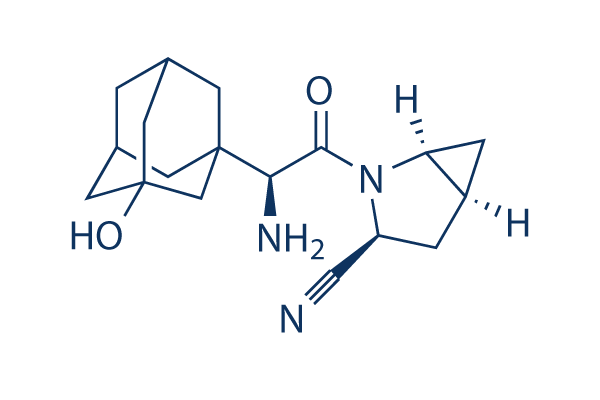
Chemical Structure
Molecular Weight: 315.41
Quality Control
Cell Culture, Treatment & Working Concentration
| Cell Lines | Assay Type | Concentration | Incubation Time | Formulation | Activity Description | PMID |
|---|---|---|---|---|---|---|
| Caco-2 cells | Function assay | Inhibition of human DPP4 expressed in Caco-2 cells, Ki=0.6 nM | ||||
| Click to View More Cell Line Experimental Data | ||||||
Solubility
|
In vitro |
DMSO
: 63 mg/mL
(199.74 mM)
Water : 63 mg/mL Ethanol : 63 mg/mL |
Molarity Calculator
|
In vivo |
|||||
In vivo Formulation Calculator (Clear solution)
Step 1: Enter information below (Recommended: An additional animal making an allowance for loss during the experiment)
Step 2: Enter the in vivo formulation (This is only the calculator, not formulation. Please contact us first if there is no in vivo formulation at the solubility Section.)
Calculation results:
Working concentration: mg/ml;
Method for preparing DMSO master liquid: mg drug pre-dissolved in μL DMSO ( Master liquid concentration mg/mL, Please contact us first if the concentration exceeds the DMSO solubility of the batch of drug. )
Method for preparing in vivo formulation: Take μL DMSO master liquid, next addμL PEG300, mix and clarify, next addμL Tween 80, mix and clarify, next add μL ddH2O, mix and clarify.
Method for preparing in vivo formulation: Take μL DMSO master liquid, next add μL Corn oil, mix and clarify.
Note: 1. Please make sure the liquid is clear before adding the next solvent.
2. Be sure to add the solvent(s) in order. You must ensure that the solution obtained, in the previous addition, is a clear solution before proceeding to add the next solvent. Physical methods such
as vortex, ultrasound or hot water bath can be used to aid dissolving.
Chemical Information, Storage & Stability
| Molecular Weight | 315.41 | Formula | C18H25N3O2 |
Storage (From the date of receipt) | |
|---|---|---|---|---|---|
| CAS No. | 361442-04-8 | Download SDF | Storage of Stock Solutions |
|
|
| Synonyms | Onglyza,BMS-477118 | Smiles | C1C2CC2N(C1C#N)C(=O)C(C34CC5CC(C3)CC(C5)(C4)O)N | ||
Mechanism of Action
| Targets/IC50/Ki |
DPP-4
26 nM
|
|---|---|
| In vitro |
Saxagliptin (BMS-477118) has an inhibition constant Ki of 1.3 nM for DPP4 inhibition, which is 10-fold more potent than either vildagliptin or sitagliptin (another two DPP4 inhibitors) with Ki of 13 and 18 nM. In addition, it demonstrates greater specificity for DPP4 than for either the DPP8 or DPP9 enzymes (400- and 75- fold, respectively). The active metablite of this compound is two-fold less potent than the parent. Both Saxagliptin and its metabolite are highly selective (>4000-fold) for the prevention of DPP4 compared with a range of other proteases (selectivity of sitagliptin and vildagliptin for DPP4 is >2600 and <250-fold, respectively, compared with DPP8 and DPP9). It reduces the degradation of the incretin hormone glucagon-like peptide-1, thereby enhancing its actions, and is associated with improved β-cell function and suppression of glucagon secretion.
|
| In vivo |
Saxagliptin (BMS-477118) is highly effective at eliciting marked dose-dependent enhancements in glucose clearance in the dose range 0.13-1.3 mg/kg in ob/ob mice relative to controls. Maximal responses of this compound in glucose excursion in Zuckerfa/fa rats are associated with plasma DPP4 inhibition of approximately 60% vs. control, and no additional antihyperglycemic effects are seen at higher percent inhibition. It dose-dependently elevates plasma insulin significantly at 15 min post-oGTT, with concomitant improvement in the glucose clearance curves at 60 min post-oGTT.
|
References |
|
Clinical Trial Information
(data from https://clinicaltrials.gov, updated on 2024-05-22)
| NCT Number | Recruitment | Conditions | Sponsor/Collaborators | Start Date | Phases |
|---|---|---|---|---|---|
| NCT04445714 | Completed | Type 2 Diabetes Mellitus |
AstraZeneca |
April 7 2021 | Phase 4 |
| NCT04521049 | Completed | Diabetes Mellitus Type 2 |
Beni-Suef University |
March 1 2019 | Phase 4 |
| NCT03199053 | Completed | Diabetes Mellitus Type 2 |
AstraZeneca |
October 11 2017 | Phase 3 |
| NCT02462369 | Unknown status | Microalbuminuria|Microalbuminuria /Creatinine Ratios ACR |
The Second Hospital of Nanjing Medical University |
June 2015 | Phase 4 |
Tech Support
Tel: +1-832-582-8158 Ext:3
If you have any other enquiries, please leave a message.
Signaling Pathway Map

Products are for research use only. Not for human use. We do not sell to patients.
©Copyright 2013 Selleck Chemicals. All Rights Reserved.