
-
 Argentina
-
 Australia
-
 Austria
-
 Belgium
-
 Brazil
-
 Canada
-
 China
China
-
 Czech Republic
-
 Denmark
-
 Finland
-
 France
-
 Germany
-
 Greece
-
 Hong Kong
-
 Hungary
-
 Iceland
-
 India
India
-
 Ireland
-
 Israel
-
 Italy
Italy
-
 Japan
Japan
-
 Korea
Korea
-
 Luxembourg
-
 Malaysia
-
 Netherlands
-
 New Zealand
-
 Norway
-
 Poland
-
 Qatar
Qatar
-
 Romania
-
 Saudi Arabia
-
 Singapore
-
 Spain
Spain
-
 Sweden
-
 Switzerland
-
 Taiwan
-
 Turkey
-
 United Kingdom
-
 United States
research use only
Nevirapine (NSC 641530) Reverse Transcriptase inhibitor
Cat.No.S1742
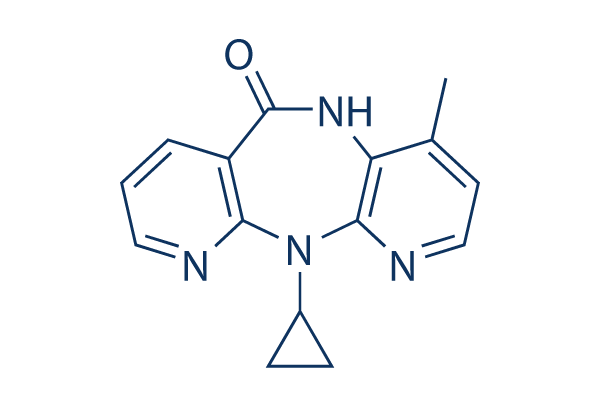
Chemical Structure
Molecular Weight: 266.3
Quality Control
| Related Targets | Integrase Bacterial Antibiotics Anti-infection Fungal Antiviral COVID-19 Parasite HIV HCV Protease |
|---|---|
| Other Reverse Transcriptase Inhibitors | Dapivirine (TMC120) Fangchinoline 3'-Fluoro-3'-deoxythymidine (Alovudine) Salicylanilide Bifendate Ulonivirine Islatravir Lersivirine (UK-453061) 4-Chloro-2-(trifluoroacetyl)aniline hydrochloride |
Cell Culture, Treatment & Working Concentration
| Cell Lines | Assay Type | Concentration | Incubation Time | Formulation | Activity Description | PMID |
|---|---|---|---|---|---|---|
| CEM-SS cells | Function assay | Antiviral activity against HIV1 RF in CEM-SS cells assessed as inhibition of virus-induced cytopathic effect by XTT assay, EC50=1.5 nM | ||||
| human MT4 cells | Function assay | Antiviral activity against Human immunodeficiency virus 1 subtype C infected in human MT4 cells assessed as reduction in virus induced cytopathicity, EC50=0.00488 μM | ||||
| human Jurkat E6-1 cells | Function assay | 2 days | Antiviral activity against HIV1 Env-pseudovirus infected in human Jurkat E6-1 cells after 2 days by luciferase assay, IC50=0.04 μM | |||
| human C1866 cells | Cytotoxicity assay | 72 h | Cytotoxicity against human C1866 cells after 72 hrs by MTT assay, EC50=0.04943 μM | |||
| human MT2 cells | Function assay | 4 days | Antiviral activity against wild type HIV1 3B infected in human MT2 cells assessed as inhibition of p24 antigen production after 4 days by ELISA, EC50=0.053 μM | |||
| HeLa cells | Function assay | Antiviral activity against wild type HIV1 in HeLa cells by MAGI assay, IC50=0.053 μM | ||||
| 293T cells | Function assay | Inhibition of wild type HIV1 reverse transcriptase in 293T cells, IC50=0.06 μM | ||||
| MDCK2 cells | Function assay | 10 μM | Inhibition of human MRP2 expressed in MDCK2 cells assessed as increase in intracellular CMF fluorescence at 10 uM by CMFDA assay | |||
| Click to View More Cell Line Experimental Data | ||||||
Solubility
|
In vitro |
DMSO
: 53 mg/mL
(199.02 mM)
Water : Insoluble Ethanol : Insoluble |
Molarity Calculator
|
In vivo |
|||||
In vivo Formulation Calculator (Clear solution)
Step 1: Enter information below (Recommended: An additional animal making an allowance for loss during the experiment)
Step 2: Enter the in vivo formulation (This is only the calculator, not formulation. Please contact us first if there is no in vivo formulation at the solubility Section.)
Calculation results:
Working concentration: mg/ml;
Method for preparing DMSO master liquid: mg drug pre-dissolved in μL DMSO ( Master liquid concentration mg/mL, Please contact us first if the concentration exceeds the DMSO solubility of the batch of drug. )
Method for preparing in vivo formulation: Take μL DMSO master liquid, next addμL PEG300, mix and clarify, next addμL Tween 80, mix and clarify, next add μL ddH2O, mix and clarify.
Method for preparing in vivo formulation: Take μL DMSO master liquid, next add μL Corn oil, mix and clarify.
Note: 1. Please make sure the liquid is clear before adding the next solvent.
2. Be sure to add the solvent(s) in order. You must ensure that the solution obtained, in the previous addition, is a clear solution before proceeding to add the next solvent. Physical methods such
as vortex, ultrasound or hot water bath can be used to aid dissolving.
Chemical Information, Storage & Stability
| Molecular Weight | 266.3 | Formula | C15H14N4O |
Storage (From the date of receipt) | |
|---|---|---|---|---|---|
| CAS No. | 129618-40-2 | Download SDF | Storage of Stock Solutions |
|
|
| Synonyms | NSC 641530,NVP | Smiles | CC1=C2C(=NC=C1)N(C3=C(C=CC=N3)C(=O)N2)C4CC4 | ||
Mechanism of Action
| Targets/IC50/Ki |
Reverse transcriptase
|
|---|---|
| In vitro |
Nevirapine (NSC 641530) is a non-nucleoside RT inhibitor with a well-characterized inhibitory activity on RT enzymes of retroviral origin. It is also an effective inhibitor of the endogenous RT in murine and human cell lines. This compound is a highly specific inhibitor of HIV-1 reverse transcriptase (RT) which exhibits an IC50 = 84 nM in enzyme assays and IC50 = 40nM against HIV-1 replication in cell culture. It alters the cleavage specificity of the RNase H, resulting in Nevirapine-induced stimulation of RNase H activity beyond the increase expected from the change in cleavage specificity. It is an inhibitor of only CYP3A4 at concentrations that are well above those of therapeutic relevance (Ki = 270 mM). Its exposure rescues the differentiation block present in acute myeloid leukemia (AML) cell lines and primary blasts from two AML patients, as indicated by morphological, functional and immunophenotypic assays. |
| In vivo |
Nevirapine (NSC 641530) is metabolized to 4-CANVP as a major metabolite in all male animals and in female mice, dogs, and monkeys. 3-OHNVP is a major fecal metabolite in all animals except for the male rat. In the bile of rats, 4-CANVP is a major metabolite along with 12-OHNVP glucuronide. |
References |
|
Clinical Trial Information
(data from https://clinicaltrials.gov, updated on 2024-05-22)
| NCT Number | Recruitment | Conditions | Sponsor/Collaborators | Start Date | Phases |
|---|---|---|---|---|---|
| NCT05725252 | Completed | Healthy Volunteers |
NVP Healthcare |
May 28 2023 | Phase 1 |
| NCT05354713 | Completed | Healthy Volunteers |
NVP Healthcare |
November 5 2022 | Phase 1 |
| NCT04926727 | Unknown status | Nausea Gravidarum|Vomiting of Pregnancy |
Italfarmaco|Opera CRO a TIGERMED Group Company |
October 4 2021 | -- |
| NCT02738502 | Completed | Maternal-fetal Infection Transmission |
ANRS Emerging Infectious Diseases|Institut National de la Santé Et de la Recherche Médicale France |
July 6 2016 | Phase 2 |
| NCT02383849 | Completed | Low-Birth-Weight Infant|Tuberculosis|HIV |
International Maternal Pediatric Adolescent AIDS Clinical Trials Group|National Institute of Allergy and Infectious Diseases (NIAID)|Eunice Kennedy Shriver National Institute of Child Health and Human Development (NICHD) |
August 4 2015 | -- |
Tech Support
Tel: +1-832-582-8158 Ext:3
If you have any other enquiries, please leave a message.
Signaling Pathway Map

Products are for research use only. Not for human use. We do not sell to patients.
©Copyright 2013 Selleck Chemicals. All Rights Reserved.