
-
 Australia
-
 Austria
-
 Belgium
-
 Brazil
-
 Canada
-
 China
China
-
 Czech Republic
-
 Denmark
-
 Finland
-
 France
-
 Germany
-
 Greece
-
 Hong Kong
-
 Hungary
-
 Iceland
-
 India
India
-
 Ireland
-
 Israel
-
 Italy
Italy
-
 Japan
Japan
-
 Korea
Korea
-
 Luxembourg
-
 Malaysia
-
 Netherlands
-
 New Zealand
-
 Norway
-
 Poland
-
 Qatar
Qatar
-
 Romania
-
 Saudi Arabia
-
 Singapore
-
 Spain
Spain
-
 Sweden
-
 Switzerland
-
 Taiwan
-
 Turkey
-
 United Kingdom
-
 United States
research use only
Lubiprostone Chloride Channel activator
Cat.No.S1675
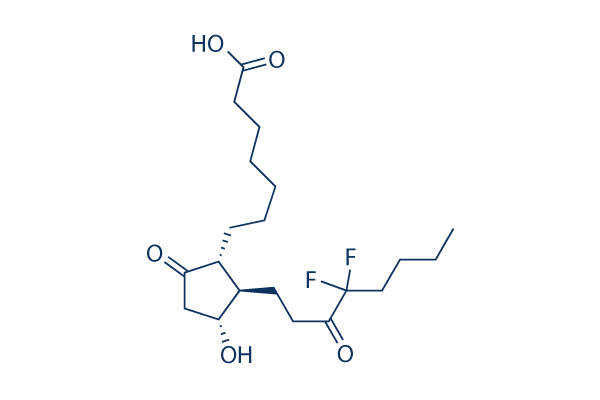
Chemical Structure
Molecular Weight: 390.46
Quality Control
| Related Targets | CFTR CRM1 CD markers AChR Calcium Channel Sodium Channel Potassium Channel GABA Receptor TRP Channel ATPase |
|---|---|
| Other Chloride Channel Inhibitors | Adjudin NMD670 R(+)-Methylindazone CaCCinh-A01 Dehydroandrographolide NS1652 T16Ainh-A01 |
Solubility
|
In vitro |
DMSO
: 79 mg/mL
(202.32 mM)
Ethanol : 79 mg/mL Water : Insoluble |
Molarity Calculator
|
In vivo |
|||||
In vivo Formulation Calculator (Clear solution)
Step 1: Enter information below (Recommended: An additional animal making an allowance for loss during the experiment)
Step 2: Enter the in vivo formulation (This is only the calculator, not formulation. Please contact us first if there is no in vivo formulation at the solubility Section.)
Calculation results:
Working concentration: mg/ml;
Method for preparing DMSO master liquid: mg drug pre-dissolved in μL DMSO ( Master liquid concentration mg/mL, Please contact us first if the concentration exceeds the DMSO solubility of the batch of drug. )
Method for preparing in vivo formulation: Take μL DMSO master liquid, next addμL PEG300, mix and clarify, next addμL Tween 80, mix and clarify, next add μL ddH2O, mix and clarify.
Method for preparing in vivo formulation: Take μL DMSO master liquid, next add μL Corn oil, mix and clarify.
Note: 1. Please make sure the liquid is clear before adding the next solvent.
2. Be sure to add the solvent(s) in order. You must ensure that the solution obtained, in the previous addition, is a clear solution before proceeding to add the next solvent. Physical methods such
as vortex, ultrasound or hot water bath can be used to aid dissolving.
Chemical Information, Storage & Stability
| Molecular Weight | 390.46 | Formula | C20H32F2O5 |
Storage (From the date of receipt) | |
|---|---|---|---|---|---|
| CAS No. | 136790-76-6 | Download SDF | Storage of Stock Solutions |
|
|
| Synonyms | RU 0211,SPI-0211 | Smiles | CCCCC(C1(CCC2C(O1)CC(=O)C2CCCCCCC(=O)O)O)(F)F | ||
Mechanism of Action
| Targets/IC50/Ki |
ClC-2 chloride channels
|
|---|---|
| In vitro |
Lubiprostone induces a robust secretory response in T84 monolayers. This compound induces a rise in cAMP levels that was sensitive to EP(4)-receptor blockage in T84 cells. It also induces a contraction in rat and human stomach longitudinal muscle, which is inhibited by pretreatment with the EP(1) receptor antagonist but not by the EP(3) or EP(4) receptor antagonists. This chemical also reduces electrically stimulated, neuronal contractions in rat and human colon circular muscle preparations. It (1 mM) stimulates higher elevations in TER despite lower I(sc) responses compared with the nonselective secretory agonist PGE(2) (1 mM). The compound significantly reduces mucosal-to-serosal fluxes of (3)H-labeled mannitol to levels comparable to those of normal control tissues and restored occludin localization to tight junctions. It causes comparable and maximal increases of I(sc) in T84 cells. Lubiprostone-induced increases in iodide efflux are ~80% of those obtained with forskolin. This agent activates Cl(-) secretion in T84 cells via cAMP, protein kinase A, and by increasing apical membrane CFTR protein. When applied to the small intestinal mucosa in eight concentrations ranging from 1-3000 nM, it evokes increases in Isc in a concentration-dependent manner with an EC50 of 42.5 nM. Applied to the mucosa of the colon in eight concentrations ranging from 1-3000 nM, this compound evokes increases in Isc in a concentration-dependent manner with an EC50 of 31.7 nM. |
| In vivo |
Lubiprostone induces a CdCl(2)-insensitive secretory response in mouse intestine, but this compound fails to induce intestinal Cl(-) secretion in Cftr-null mice. |
References |
|
Clinical Trial Information
(data from https://clinicaltrials.gov, updated on 2024-05-22)
| NCT Number | Recruitment | Conditions | Sponsor/Collaborators | Start Date | Phases |
|---|---|---|---|---|---|
| NCT01469819 | Completed | Chronic Idiopathic Constipation |
Texas Tech University Health Sciences Center El Paso|Takeda Pharmaceuticals North America Inc. |
June 2012 | Phase 2|Phase 3 |
| NCT01324284 | Completed | Colorectal Carcinoma |
Asian Institute of Gastroenterology India |
March 2011 | Phase 3 |
| NCT00934479 | Completed | Other Constipation|Irritable Bowel Syndrome |
Mayo Clinic|Arizona State University|Takeda Pharmaceuticals North America Inc. |
April 2010 | Phase 1 |
| NCT01085643 | Completed | Constipation-predominant Irritable Bowel Syndrome |
Cedars-Sinai Medical Center|Takeda Pharmaceuticals North America Inc. |
March 2010 | Not Applicable |
| NCT00985569 | Withdrawn | Constipation |
Synergy Health Solutions |
November 2009 | -- |
Tech Support
Tel: +1-832-582-8158 Ext:3
If you have any other enquiries, please leave a message.

Products are for research use only. Not for human use. We do not sell to patients.
©Copyright 2013 Selleck Chemicals. All Rights Reserved.