
-
 Argentina
-
 Australia
-
 Austria
-
 Belgium
-
 Brazil
-
 Canada
-
 China
China
-
 Czech Republic
-
 Denmark
-
 Finland
-
 France
-
 Germany
-
 Greece
-
 Hong Kong
-
 Hungary
-
 Iceland
-
 India
India
-
 Ireland
-
 Israel
-
 Italy
Italy
-
 Japan
Japan
-
 Korea
Korea
-
 Luxembourg
-
 Malaysia
-
 Netherlands
-
 New Zealand
-
 Norway
-
 Poland
-
 Portugal
-
 Qatar
Qatar
-
 Romania
-
 Saudi Arabia
-
 Singapore
-
 Spain
Spain
-
 Sweden
-
 Switzerland
-
 Taiwan
-
 Turkey
-
 United Kingdom
-
 United States
research use only
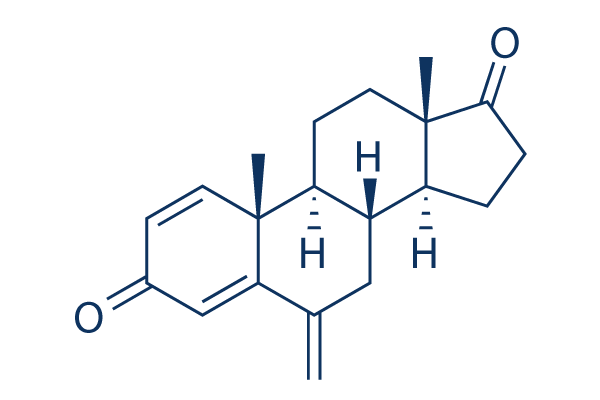
Exemestane Aromatase inhibitor
Cat.No.S1196
Quality Control
| Related Targets | Adrenergic Receptor Estrogen/progestogen Receptor GPR Androgen Receptor Glucocorticoid Receptor ACE RAAS Progesterone Receptor Opioid Receptor THR |
|---|---|
| Other Aromatase Inhibitors | Obacunone (AI3-37934) Fadrozole (CGS16949A) alpha-Naphthoflavone |
Cell Culture, Treatment & Working Concentration
| Cell Lines | Assay Type | Concentration | Incubation Time | Formulation | Activity Description | PMID |
|---|---|---|---|---|---|---|
| human MCF7a cells | Cytotoxicity assay | 10 days | Cytotoxicity against human MCF7a cells expressing Tet-off-3betaHSD1-Arom assessed as inhibition of TST-stimulated cell proliferation measured after 10 days, EC50=5.6 nM | |||
| human MCF7 cells | Cytotoxicity assay | 10 to 15 μM | 3-6 days | Cytotoxicity against human placental microsome aromatase expressing human MCF7 cells assessed as reduction in cell viability at 10 to 15 uM after 3 to 6 days by MTT assay in presence of estradiol | ||
| Click to View More Cell Line Experimental Data | ||||||
Solubility
|
In vitro |
DMSO
: 54 mg/mL
(182.18 mM)
Ethanol : 15 mg/mL Water : Insoluble |
Molarity Calculator
|
In vivo |
|||||
In vivo Formulation Calculator (Clear solution)
Step 1: Enter information below (Recommended: An additional animal making an allowance for loss during the experiment)
Step 2: Enter the in vivo formulation (This is only the calculator, not formulation. Please contact us first if there is no in vivo formulation at the solubility Section.)
Calculation results:
Working concentration: mg/ml;
Method for preparing DMSO master liquid: mg drug pre-dissolved in μL DMSO ( Master liquid concentration mg/mL, Please contact us first if the concentration exceeds the DMSO solubility of the batch of drug. )
Method for preparing in vivo formulation: Take μL DMSO master liquid, next addμL PEG300, mix and clarify, next addμL Tween 80, mix and clarify, next add μL ddH2O, mix and clarify.
Method for preparing in vivo formulation: Take μL DMSO master liquid, next add μL Corn oil, mix and clarify.
Note: 1. Please make sure the liquid is clear before adding the next solvent.
2. Be sure to add the solvent(s) in order. You must ensure that the solution obtained, in the previous addition, is a clear solution before proceeding to add the next solvent. Physical methods such
as vortex, ultrasound or hot water bath can be used to aid dissolving.
Chemical Information, Storage & Stability
| Molecular Weight | 296.4 | Formula | C20H24O2 |
Storage (From the date of receipt) | |
|---|---|---|---|---|---|
| CAS No. | 107868-30-4 | Download SDF | Storage of Stock Solutions |
|
|
| Synonyms | FCE24304, PNU155971,EXE | SMILES | CC12CCC3C(C1CCC2=O)CC(=C)C4=CC(=O)C=CC34C | ||
Read more about storage stability stock solution CAS number SMILES
Mechanism of Action
| Features |
17-hydroexemestane is the principal metabolite of Exemestane.
|
|---|---|
| Targets/IC50/Ki |
Aromatase (human)
30 nM
Aromatase (rat)
40 nM
|
| In vitro |
Exemestane competitively inhibits and time-dependently inactivates of human placental aromatase with Ki of 4.3 nM. This compound displaces [3H]DHT from rat prostate androgen receptor with IC50 of 0.9 μM. This chemical (1 μM) increases alkaline phosphatase activity in hFOB and Saos-2 cells and induces the expression of MYBL2, OSTM1, HOXD11, ADCYAP1R1, and glypican 2 in hFOB cells. It causes aromatase degradation in a dose-responsive manner in MCF-7aro cells. |
| Kinase Assay |
Assays with human placental aromatase
|
|
Microsomes are prepared from human placenta and stored at -80℃. The rate of aromatization is determined by measuring the tritiated water released from [1β-3H]A. The assay is carried out in a final volume of 1 mL, in 10 mM phosphate buffer, pH 7.5, containing 100 mM KCl, 1 mM EDTA, 1 mM dithiothreitol, 100 μM NADPH, the enzyme preparation and the appropriate concentrations of Exemestane (in duplicate) and the substrate. After a 10 min incubation at 37 ℃, the assay is terminated by the addition of 4 mL cold chloroform. The acqueous phase is treated with a charcoal suspension, the supernatant is removed and counted for radioactivity by liquid scintillation in Rialuma. For the determination of the IC50 values, various concentrations of this compound are incubated with 20 μg of microsomal protein, in the presence of a fixed amount (50 nM) of [3H]A.
|
|
| In vivo |
Exemestane increases lumbar spine BMD by 14.0% in OVX rats at dose of 100 mg/kg. This compound (100 mg/kg) and 17-hydroexemestane (20 mg/kg) significantly reduces an ovariectomy-induced increase in serum pyridinoline and serum osteocalcin in rats and causes significant reductions of serum cholesterol and low-density lipoprotein cholesterol inOVX rats. This chemical (20 mg/kg/day s.c.) induces 26% complete (CR) and 18% partial (PR) tumor regressions in rats with 7,12-dimethylbenzanthracene (DMBA)-induced mammary tumors. |
References |
|
Clinical Trial Information
(data from https://clinicaltrials.gov, updated on 2025-09-29)
| NCT Number | Recruitment | Conditions | Sponsor/Collaborators | Start Date | Phases |
|---|---|---|---|---|---|
| NCT07190443 | RECRUITING | Breast Cancer; Locoregional Recurrence; Abemaciclib; Endocrine Therapy |
Japanese Foundation for Cancer Research |
2025-02-07 | PHASE3 |
| NCT05512364 | RECRUITING | ER-positive Breast Cancer; HER2-negative Breast Cancer; Stage IIB Breast Cancer; Stage III Breast Cancer |
European Organisation for Research and Treatment of Cancer - EORTC |
2023-12-15 | PHASE3 |
| NCT06223698 | NOT_YET_RECRUITING | Breast Cancer |
Region Örebro County |
2025-05-02 | PHASE3 |
| NCT07729046 | NOT_YET_RECRUITING | Metastatic Invasive Breast Cancer; Resistant Breast Cancer; ER+, HER2-, Metastatic Breast Cancer |
University of California, San Diego |
2027-07 | PHASE2 |
| NCT07581834 | RECRUITING | Breast Diseases; Breast Neoplasms; Dalpiciclib; Endocrine Breast Diseases; CDK4/6 Inhibitor; HR+/HER2- Breast Cancer |
Fujian Cancer Hospital |
2026-01-21 | PHASE2 |
| NCT07101159 | NOT_YET_RECRUITING | Early Breast Cancer; Adjuvant Therapy; Hormone Receptor Positive / HER2-negative Breast Cancer |
Fujian Cancer Hospital |
2025-09 | PHASE2 |
Read more about Clinical Trials
Tech Support
Tel: +1-832-582-8158 Ext:3
If you have any other enquiries, please leave a message.
Signaling Pathway Map

Products are for research use only. Not for human use. We do not sell to patients.
©Copyright 2013 Selleck Chemicals. All Rights Reserved.