
-
 Argentina
-
 Australia
-
 Austria
-
 Belgium
-
 Brazil
-
 Canada
-
 China
China
-
 Czech Republic
-
 Denmark
-
 Finland
-
 France
-
 Germany
-
 Greece
-
 Hong Kong
-
 Hungary
-
 Iceland
-
 India
India
-
 Ireland
-
 Israel
-
 Italy
Italy
-
 Japan
Japan
-
 Korea
Korea
-
 Luxembourg
-
 Malaysia
-
 Netherlands
-
 New Zealand
-
 Norway
-
 Poland
-
 Portugal
-
 Qatar
Qatar
-
 Romania
-
 Saudi Arabia
-
 Singapore
-
 Spain
Spain
-
 Sweden
-
 Switzerland
-
 Taiwan
-
 Turkey
-
 United Kingdom
-
 United States
research use only
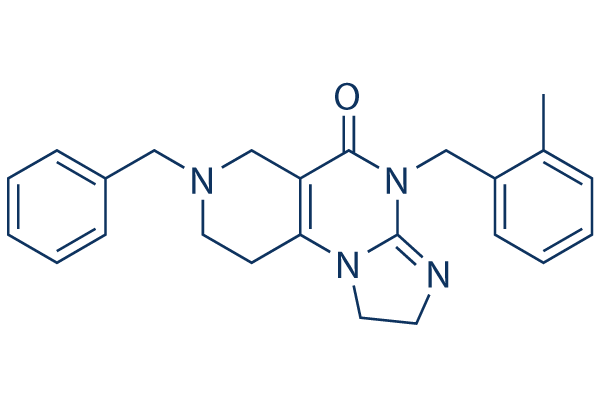
TIC10 (ONC201) Akt inhibitor
Cat.No.S7963
Quality Control
| Related Targets | PI3K mTOR GSK-3 ATM/ATR DNA-PK AMPK PDPK1 PTEN PI4K PP2A |
|---|---|
| Other Akt Inhibitors | SC79 AZD5363 (Capivasertib) MK-2206 Dihydrochloride Ipatasertib (GDC-0068) Perifosine GSK690693 Triciribine (API-2) Afuresertib (GSK2110183) CCT128930 A-674563 HCl |
Solubility
|
In vitro |
DMSO
: 77 mg/mL
(199.22 mM)
Ethanol : 77 mg/mL Water : Insoluble |
Molarity Calculator
|
In vivo |
|||||
In vivo Formulation Calculator (Clear solution)
Step 1: Enter information below (Recommended: An additional animal making an allowance for loss during the experiment)
Step 2: Enter the in vivo formulation (This is only the calculator, not formulation. Please contact us first if there is no in vivo formulation at the solubility Section.)
Calculation results:
Working concentration: mg/ml;
Method for preparing DMSO master liquid: mg drug pre-dissolved in μL DMSO ( Master liquid concentration mg/mL, Please contact us first if the concentration exceeds the DMSO solubility of the batch of drug. )
Method for preparing in vivo formulation: Take μL DMSO master liquid, next addμL PEG300, mix and clarify, next addμL Tween 80, mix and clarify, next add μL ddH2O, mix and clarify.
Method for preparing in vivo formulation: Take μL DMSO master liquid, next add μL Corn oil, mix and clarify.
Note: 1. Please make sure the liquid is clear before adding the next solvent.
2. Be sure to add the solvent(s) in order. You must ensure that the solution obtained, in the previous addition, is a clear solution before proceeding to add the next solvent. Physical methods such
as vortex, ultrasound or hot water bath can be used to aid dissolving.
Chemical Information, Storage & Stability
| Molecular Weight | 386.49 | Formula | C24H26N4O |
Storage (From the date of receipt) | |
|---|---|---|---|---|---|
| CAS No. | 1616632-77-9 | Download SDF | Storage of Stock Solutions |
|
|
| Synonyms | Dordaviprone | SMILES | CC1=CC=CC=C1CN2C(=O)C3=C(CCN(C3)CC4=CC=CC=C4)N5C2=NCC5 | ||
Read more about storage stability stock solution CAS number SMILES
Mechanism of Action
| Targets/IC50/Ki |
Akt
ERK
|
|---|---|
| In vitro |
In a p53-independent manner, TIC10 (ONC201) causes a dose-dependent increase in TRAIL mRNA and induces TRAIL protein localization on the cell surface of several cancer cell lines. It has broad-spectrum activity against multiple malignancies in vitro and induces an increase in sub-G1 DNA content suggestive of cell death in TRAIL-sensitive HCT116 p53−/− cells, but does not alter the cell cycle profiles of normal fibroblasts at equivalent doses. This compound decreases the clonogenic survival of cancer cell lines and spares normal fibroblasts. It increases the percentage of sub-G1 DNA in cancer cells in a p53-independent and Bax-dependent manner, as previously reported for TRAIL-mediated apoptosis. TIC10-induced TRAIL up-regulation is Foxo3a-dependent, which also up-regulates TRAIL death receptor DR5 among other targets, potentially allowing for sensitization of some TRAIL-resistant tumor cells. The agent inactivates kinases Akt and extracellular signal–regulated kinase (ERK), leading to the translocation of Foxo3a into the nucleus, where it binds to the TRAIL promoter to up-regulate gene transcription. It is an efficacious antitumor therapeutic agent that acts on tumor cells and their microenvironment to enhance the concentrations of the endogenous tumor suppressor TRAIL. |
| In vivo |
In the HCT116 p53−/− xenograft, treatment with TIC10 (ONC201) and TRAIL causes tumor regression to a comparable extent when both are administered as multiple doses. It also induces regression of MDA-MB-231 human triple-negative breast cancer xenografts, whereas TRAIL-treated tumors progressed. In DLD-1 colon cancer xenografts, this compound induces tumor stasis at 1 week after treatment, whereas TRAIL-treated tumors progress after a single dose. A single dose of it also induces a sustained regression of the SW480 xenograft and is equally effective when delivered by intraperitoneal or oral route, suggesting favorable oral bioavailability. It causes tumor-specific cell death by TRAIL-mediated direct and bystander effects and is an effective antitumor agent against orthotopic human glioblastoma multiforme tumors. |
References |
|
Applications
| Methods | Biomarkers | Images | PMID |
|---|---|---|---|
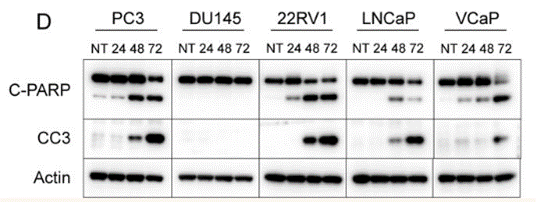
| Western blot | Cleaved PARP / CC3 ATF4 / ATF3 p-GCN2 / GCN2 / p-eIF2a / eIF2a p-p70S6K / p-S6 / p-4EBP1 / 4EBP1 / p-HSF1 / HSF1 |
|
29588331 |
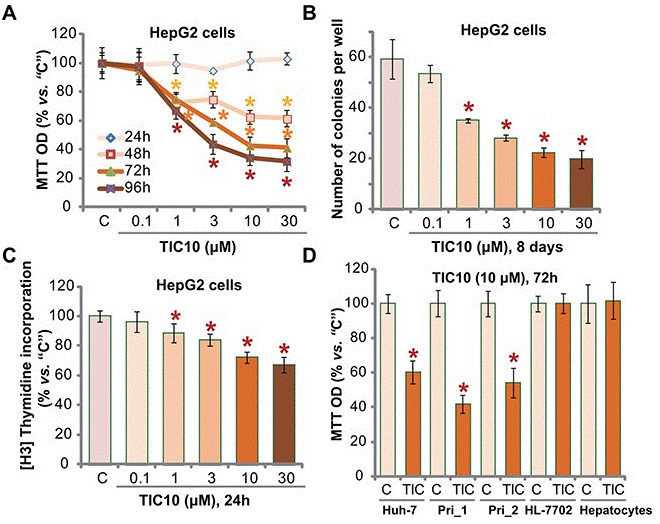
| Growth inhibition assay | Cell viability |
|
29588330 |
Clinical Trial Information
(data from https://clinicaltrials.gov, updated on 2026-08-13)
| NCT Number | Recruitment | Conditions | Sponsor/Collaborators | Start Date | Phases |
|---|---|---|---|---|---|
| NCT05476939 | RECRUITING | Diffuse Intrinsic Pontine Glioma; Diffuse Midline Glioma, H3 K27M-Mutant; Diffuse Midline Glioma, H3K27-altered |
Gustave Roussy, Cancer Campus, Grand Paris |
2022-09-29 | PHASE3 |
| NCT05580562 | RECRUITING | H3 K27M; Glioma |
Jazz Pharmaceuticals |
2023-01-23 | PHASE3 |
| NCT05542407 | RECRUITING | Endometrial Cancer; Metastasis; Endometrioid Endometrial Cancer; Carcinosarcoma; Serous Adenocarcinoma of Endometrium (Diagnosis); Clear Cell Endometrial Carcinoma; Endometrial Endometrioid Adenocarcinoma; Endometrial Mixed Cell Adenocarcinoma |
UNC Lineberger Comprehensive Cancer Center |
2023-10-23 | PHASE1 |
| NCT05009992 | RECRUITING | Diffuse Intrinsic Pontine Glioma; Diffuse Midline Glioma, H3 K27M-Mutant; Recurrent Diffuse Intrinsic Pontine Glioma; Recurrent Diffuse Midline Glioma, H3 K27M-Mutant; Recurrent WHO Grade III Glioma; WHO Grade III Glioma |
University of California, San Francisco |
2021-10-20 | PHASE2 |
| NCT04055649 | RECRUITING | Malignant Ovarian Epithelial Tumor; Platinum-Resistant Fallopian Tube Carcinoma; Platinum-Resistant Ovarian Carcinoma; Platinum-Resistant Primary Peritoneal Carcinoma; Recurrent Fallopian Tube Carcinoma; Recurrent Ovarian Carcinoma; Recurrent Primary Peritoneal Carcinoma; Refractory Fallopian Tube Carcinoma; Refractory Ovarian Carcinoma; Refractory Primary Peritoneal Carcinoma |
Ira Winer |
2020-01-21 | PHASE2 |
| NCT05630794 | RECRUITING | Colorectal Adenomatous Polyp; Colorectal Carcinoma; Familial Adenomatous Polyposis; Multiple Adenomatous Polyps |
National Cancer Institute (NCI) |
2025-10-06 | PHASE1 |
Read more about Clinical Trials
Tech Support
Tel: +1-832-582-8158 Ext:3
If you have any other enquiries, please leave a message.
Signaling Pathway Map

Products are for research use only. Not for human use. We do not sell to patients.
©Copyright 2013 Selleck Chemicals. All Rights Reserved.