
-
 Argentina
-
 Australia
-
 Austria
-
 Belgium
-
 Brazil
-
 Canada
-
 China
China
-
 Czech Republic
-
 Denmark
-
 Finland
-
 France
-
 Germany
-
 Greece
-
 Hong Kong
-
 Hungary
-
 Iceland
-
 India
India
-
 Ireland
-
 Israel
-
 Italy
Italy
-
 Japan
Japan
-
 Korea
Korea
-
 Luxembourg
-
 Malaysia
-
 Netherlands
-
 New Zealand
-
 Norway
-
 Poland
-
 Qatar
Qatar
-
 Romania
-
 Saudi Arabia
-
 Singapore
-
 Spain
Spain
-
 Sweden
-
 Switzerland
-
 Taiwan
-
 Turkey
-
 United Kingdom
-
 United States
research use only
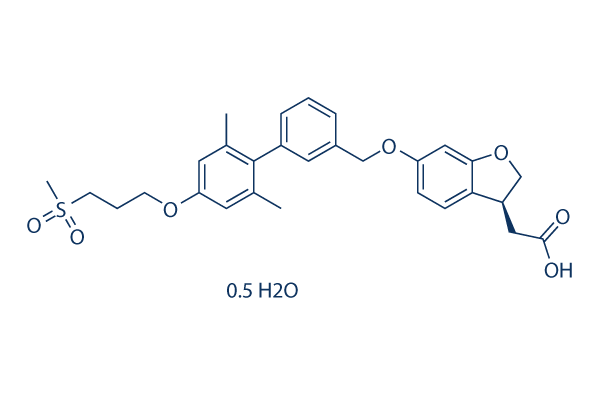
Fasiglifam(TAK-875) Hemihydrate GPR agonist
Cat.No.S2637
Quality Control
Cell Culture, Treatment & Working Concentration
| Cell Lines | Assay Type | Concentration | Incubation Time | Formulation | Activity Description | PMID |
|---|---|---|---|---|---|---|
| human 1321N1 cells | Function assay | Agonist activity at human FFA1 receptor expressed in human 1321N1 cells assessed as calcium mobilization by fluorescence spectrophotometry, EC50=14.13 nM | ||||
| CHO cells | Function assay | Agonist activity at human GP40 receptor expressed in CHO cells assessed as increase in intracellular calcium level for 90 secs by FLIPR assay in the presence of 0.1% BSA, EC50=0.016 μM | ||||
| Click to View More Cell Line Experimental Data | ||||||
Solubility
|
In vitro |
DMSO
: 100 mg/mL
(187.39 mM)
Water : Insoluble Ethanol : Insoluble |
Molarity Calculator
|
In vivo |
|||||
In vivo Formulation Calculator (Clear solution)
Step 1: Enter information below (Recommended: An additional animal making an allowance for loss during the experiment)
Step 2: Enter the in vivo formulation (This is only the calculator, not formulation. Please contact us first if there is no in vivo formulation at the solubility Section.)
Calculation results:
Working concentration: mg/ml;
Method for preparing DMSO master liquid: mg drug pre-dissolved in μL DMSO ( Master liquid concentration mg/mL, Please contact us first if the concentration exceeds the DMSO solubility of the batch of drug. )
Method for preparing in vivo formulation: Take μL DMSO master liquid, next addμL PEG300, mix and clarify, next addμL Tween 80, mix and clarify, next add μL ddH2O, mix and clarify.
Method for preparing in vivo formulation: Take μL DMSO master liquid, next add μL Corn oil, mix and clarify.
Note: 1. Please make sure the liquid is clear before adding the next solvent.
2. Be sure to add the solvent(s) in order. You must ensure that the solution obtained, in the previous addition, is a clear solution before proceeding to add the next solvent. Physical methods such
as vortex, ultrasound or hot water bath can be used to aid dissolving.
Chemical Information, Storage & Stability
| Molecular Weight | 533.63 | Formula | C29H32O7S.1/2H2O |
Storage (From the date of receipt) | |
|---|---|---|---|---|---|
| CAS No. | 1374598-80-7 | Download SDF | Storage of Stock Solutions |
|
|
| Synonyms | N/A | SMILES | CC1=CC(=CC(=C1C2=CC=CC(=C2)COC3=CC4=C(C=C3)C(CO4)CC(=O)O)C)OCCCS(=O)(=O)C.CC1=CC(=CC(=C1C2=CC=CC(=C2)COC3=CC4=C(C=C3)C(CO4)CC(=O)O)C)OCCCS(=O)(=O)C.O | ||
Read more about storage stability stock solution CAS number SMILES
Mechanism of Action
| Features |
More potent at activating hGPR40 than oleic acid.
|
|---|---|
| Targets/IC50/Ki |
GPR40
(CHO cells expressing human GPR40) 14 nM(EC50)
|
| In vitro |
TAK-875 exhibits potent agonist activity and high binding affinity to the human GPR40 receptor with Ki of 38 nM. TAK-875 displays weaker affinity toward the rat GPR40 receptor with Ki of 140 nM. TAK-875 displays excellent selectivity, as TAK-875 has little agonist potency to other members of the FFA receptor family with EC50 of >10 μM. TAK-875 treatment induces a concentration-dependent increase in intracellular IP production in CHO-hGPR40 with EC50 of 72 nM, more potently than that of endogenous ligand agonist oleic acid which requires much higher ligand concentrations to activate the receptor with EC50 of 29.9 μM. Neither TAK-875 nor oleic acid elicits an IP response in control CHO cells devoid of hGPR40. Consistent with the activation of the Gqα-mediated signaling pathway, TAK-875 augments glucose-dependent insulin secretion in pancreatic β cells. Prolonged stimulation of GPR40/FFA1 by TAK-875 does not cause pancreatic β Cell dysfunction or induction of apoptosis. |
| In vivo |
In a rat model of diabetes, single oral dosing of TAK-875 at 0.3-3 mg/kg reduces the blood glucose excursion and augments insulin secretion during an oral glucose tolerance test, when TAK-875 is administered 1 hour before an oral glucose challenge. In type 2 diabetic N-STZ-1.5 rats, administration of TAK-875 (1-10 mg/kg p.o.) shows a clear improvement in glucose tolerance and augments insulin secretion. Additionally, TAK-875 (10 mg/kg, p.o.) significantly augments plasma insulin levels and reduces fasting hyperglycemia in male Zucker diabetic fatty rats, whereas in fasted normal Sprague-Dawley rats, TAK-875 neither enhances insulin secretion nor causes hypoglycemia even at 30 mg/kg. |
References |
|
Clinical Trial Information
(data from https://clinicaltrials.gov, updated on 2014-01-27)
| NCT Number | Recruitment | Conditions | Sponsor/Collaborators | Start Date | Phases |
|---|---|---|---|---|---|
| NCT02015780 | WITHDRAWN | Type 2 Diabetes Mellitus; Chronic Kidney Disease |
Takeda |
2013-12 | PHASE3 |
| NCT01609582 | TERMINATED | Type 2 Diabetes; Cardiovascular Disease |
Takeda |
2012-06 | PHASE3 |
| NCT01834274 | TERMINATED | Diabetes Mellitus, Type 2 |
Takeda |
2013-06 | PHASE3 |
| NCT01549964 | TERMINATED | Glycemic Control |
Takeda |
2012-04 | PHASE3 |
| NCT01481116 | TERMINATED | Diabetes Mellitus, Type 2 |
Takeda |
2012-01 | PHASE3 |
| NCT01829464 | TERMINATED | Diabetes |
Takeda |
2013-05 | PHASE3 |
Read more about Clinical Trials
Tech Support
Tel: +1-832-582-8158 Ext:3
If you have any other enquiries, please leave a message.

Products are for research use only. Not for human use. We do not sell to patients.
©Copyright 2013 Selleck Chemicals. All Rights Reserved.