
-
 Argentina
-
 Australia
-
 Austria
-
 Belgium
-
 Brazil
-
 Canada
-
 China
China
-
 Czech Republic
-
 Denmark
-
 Finland
-
 France
-
 Germany
-
 Greece
-
 Hong Kong
-
 Hungary
-
 Iceland
-
 India
India
-
 Ireland
-
 Israel
-
 Italy
Italy
-
 Japan
Japan
-
 Korea
Korea
-
 Luxembourg
-
 Malaysia
-
 Netherlands
-
 New Zealand
-
 Norway
-
 Poland
-
 Portugal
-
 Qatar
Qatar
-
 Romania
-
 Saudi Arabia
-
 Singapore
-
 Spain
Spain
-
 Sweden
-
 Switzerland
-
 Taiwan
-
 Turkey
-
 United Kingdom
-
 United States
research use only
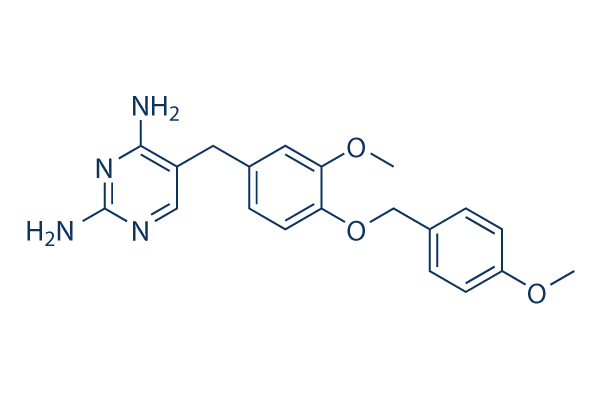
GW2580 CSF-1R inhibitor
Cat.No.S8042
Quality Control
| Related Targets | EGFR VEGFR FGFR PDGFR c-Met Src MEK FLT3 HER2 c-Kit |
|---|---|
| Other CSF-1R Inhibitors | Sotuletinib (BLZ945) PLX5622 Ki20227 Edicotinib(JNJ-40346527) Sulfatinib CSF1R-IN-1 Vimseltinib AZD7507 Chiauranib ARRY-382 |
Cell Culture, Treatment & Working Concentration
| Cell Lines | Assay Type | Concentration | Incubation Time | Formulation | Activity Description | PMID |
|---|---|---|---|---|---|---|
| HUVEC | Growth inhibition assay | Growth inhibition of VEGF-stimulated HUVEC after 3 days by spectrophotometry | ||||
| mouse NSO cells | Growth inhibition assay | Growth inhibition of serum-stimulated mouse NSO cells after 3 days by spectrophotometry, IC50=13.5 μM | ||||
| human BT474 cells | Growth inhibition assay | Growth inhibition of serum-stimulated human BT474 cells after 3 days by spectrophotometry, IC50=21 μM | ||||
| human HN5 cells | Growth inhibition assay | Growth inhibition of serum-stimulated human HN5 cells after 3 days by spectrophotometry, IC50=29 μM | ||||
| human PBMC | Function assay | Inhibition of LPS-induced IL6 production in human PBMC by ELISA, EC50=1.89 μM | ||||
| Click to View More Cell Line Experimental Data | ||||||
Solubility
|
In vitro |
DMSO
: 56 mg/mL
(152.83 mM)
Water : Insoluble Ethanol : Insoluble |
Molarity Calculator
|
In vivo |
|||||
In vivo Formulation Calculator (Clear solution)
Step 1: Enter information below (Recommended: An additional animal making an allowance for loss during the experiment)
Step 2: Enter the in vivo formulation (This is only the calculator, not formulation. Please contact us first if there is no in vivo formulation at the solubility Section.)
Calculation results:
Working concentration: mg/ml;
Method for preparing DMSO master liquid: mg drug pre-dissolved in μL DMSO ( Master liquid concentration mg/mL, Please contact us first if the concentration exceeds the DMSO solubility of the batch of drug. )
Method for preparing in vivo formulation: Take μL DMSO master liquid, next addμL PEG300, mix and clarify, next addμL Tween 80, mix and clarify, next add μL ddH2O, mix and clarify.
Method for preparing in vivo formulation: Take μL DMSO master liquid, next add μL Corn oil, mix and clarify.
Note: 1. Please make sure the liquid is clear before adding the next solvent.
2. Be sure to add the solvent(s) in order. You must ensure that the solution obtained, in the previous addition, is a clear solution before proceeding to add the next solvent. Physical methods such
as vortex, ultrasound or hot water bath can be used to aid dissolving.
Chemical Information, Storage & Stability
| Molecular Weight | 366.41 | Formula | C20H22N4O3 |
Storage (From the date of receipt) | |
|---|---|---|---|---|---|
| CAS No. | 870483-87-7 | Download SDF | Storage of Stock Solutions |
|
|
| Synonyms | SC-203877 | SMILES | COC1=CC=C(C=C1)COC2=C(C=C(C=C2)CC3=CN=C(N=C3N)N)OC | ||
Read more about storage stability stock solution CAS number SMILES
Mechanism of Action
| Targets/IC50/Ki |
c-Fms
30 nM
|
|---|---|
| In vitro |
GW2580 completely inhibits human cFMS kinase in vitro at 0.06 μM. This compound inhibits the growth of CSF-1 stimulated M-NFS-60 myeloid tumor cells, serum stimulated NSO myeloid tumor cells, CSF-1 stimulated freshly isolated human monocytes, and VEGF stimulated human umbilical vein vascular endothelial cells with IC50 of 0.33, 13.5, 0.47 and 12 μM, respectively. 1 μM of this chemical completely inhibits CSF-1-induced growth of mouse M-NFS-60 myeloid cells and human monocytes and completely inhibits bone degradation in cultures of human osteoclasts, rat calvaria, and rat fetal long bone. It inhibits CSF1R phosphorylation in RAW264.7 murine macrophages stimulated with 10 ng/mL with IC50 of approximately 10 nM. This compound also inhibits TRKA activity with IC50 of 0.88 μM.
|
| Kinase Assay |
cFMS tyrosine kinase assay
|
|
The enzyme is activated by autophosphorylation by incubating 10 μM enzyme, 100 μM ATP, and 5 mM MgCl2 in 50 mM Tris HCL for 90 min at room temperature. Enzyme reactions are performed in a volume of 45 μL, by using round-bottom polystyrene 96-well plates on a Biomek 2000. This compound in 1 μL DMSO or DMSO alone are added to each well containing 30 μL of a 1.5× substrate reaction mix containing 50 mM Mops (3-[N-Morpholino]propanesulfonic acid), pH 7.5, 15 mM MgCl2, 6 μM peptide substrate, biotin-EAIYAPFAKKK-NH2 7.5 mM DTT, 75 mM NaCl, 10 μM ATP, and 0.5 μCi (1 Ci = 37 GBq) [33P-γ] ATP per assay. The reaction is initiated by the addition of 15 μL of diluted enzyme solution, resulting in a final enzyme concentration 20 nM. EDTA is added to control wells for determination of background. The reaction is allowed to proceed for 40 min and stopped by the addition of an equal volume of 0.5% phosphoric acid, and 75 μL is transferred to a 96-well phosphocellulose filter plate that has been prewet with 100 μL of 0.5% phosphoric acid. The plate is filtered on a Millipore filter-plate vacuum manifold and washed three times with the phosphoric acid solution, followed by the addition of 40 μL of scintillation solution. The plates are sealed and counted in a Packard Topcount NXT scintillation counter.
|
|
| In vivo |
GW2580 (dosed orally at 40 mg/kg 0.5 h before the CSF-1-priming dose) blocks the ability of exogenous CSF-1 to increase LPS-induced TNF-α production in mice by 63%. When given to mice before CSF-1 priming, this compound completely blocks the ability of CSF-1 to prime the mouse for increased IL-6 production. This chemical (80 mg/kg p.o.) completely inhibits the growth of CSF-1-dependent M-NFS-60 tumor cells in the peritoneal cavity. It (80 mg/kg) dosed orally twice a day the week before thioglycolate injection and for the 4-day period after thioglycolate injection, diminishes the accumulation of macrophages in the peritoneal cavity after thioglycolate injection (by 45%). In a 21-day adjuvant arthritis model, this compound (50 mg/kg) dosed twice a day from days 0 to 21, 7 to 21, or 14 to 21 inhibits joint connective tissue and bone destruction.
This chemical (160 mg/kg) induces a more than 2-fold reduction of total CD45+ CD11b+ myeloid cells, CD11b+ F4/80+ TAMs, and CD11b+ Gr-1+ MDSCs in implanted 3LL lung tumor, through inhibiting tumor recruitment of myeloid cells from peripheral blood. It (80 mg/kg) treatment is able to suppress Vegf-a (by 35%) and Mmp9 (by 70%) expression, as well as tumor vascular density (CD31 staining). Combination therapy with this compound and an anti-VEGFR-2 antibody results in synergistic tumor growth reduction. DC101 alone reduces tumor growth by 35%, the combination of DC101 and this chemical results in an apparent synergistic tumor growth reduction of approximately 70%.
|
References |
|
Tech Support
Tel: +1-832-582-8158 Ext:3
If you have any other enquiries, please leave a message.
Frequently Asked Questions
Question 1:
How to reconstitute it for i.p. injection in mice?
Answer:
It can be dissolved in 5% DMSO/30% PEG 300/5% Tween 80/ddH2O at 5 mg/ml clearly. When preparing this kind of vehicle, please dissolve it in DMSO clearly first, then add PEG and Tween. After they are mixed homogeneously, dilute with water.
Signaling Pathway Map

Products are for research use only. Not for human use. We do not sell to patients.
©Copyright 2013 Selleck Chemicals. All Rights Reserved.