
-
 Argentina
-
 Australia
-
 Austria
-
 Belgium
-
 Brazil
-
 Canada
-
 China
China
-
 Czech Republic
-
 Denmark
-
 Finland
-
 France
-
 Germany
-
 Greece
-
 Hong Kong
-
 Hungary
-
 Iceland
-
 India
India
-
 Ireland
-
 Israel
-
 Italy
Italy
-
 Japan
Japan
-
 Korea
Korea
-
 Luxembourg
-
 Malaysia
-
 Netherlands
-
 New Zealand
-
 Norway
-
 Poland
-
 Qatar
Qatar
-
 Romania
-
 Saudi Arabia
-
 Singapore
-
 Spain
Spain
-
 Sweden
-
 Switzerland
-
 Taiwan
-
 Turkey
-
 United Kingdom
-
 United States
research use only
Compstatin Complement C3 Inhibitor
Cat.No.S8522
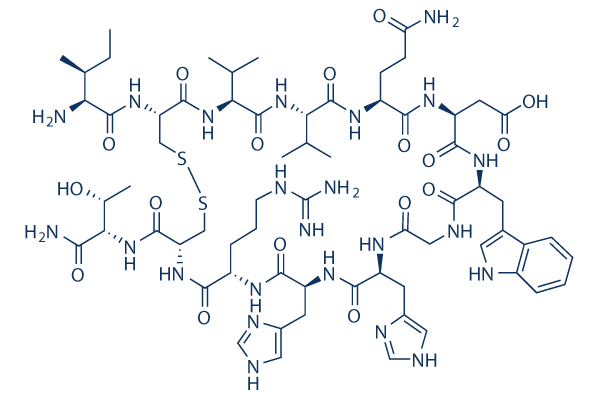
Chemical Structure
Molecular Weight: 1550.77
Quality Control
| Related Targets | PD-1/PD-L1 CXCR STING AhR Immunology & Inflammation related CD markers Interleukins Anti-infection Antioxidant COX |
|---|---|
| Other Complement System Inhibitors | SB290157 trifluoroacetate TLQP-21 TFA Danicopan Phaseoloidin JR14a Pegcetacoplan acetate |
Cell Culture, Treatment & Working Concentration
| Cell Lines | Assay Type | Concentration | Incubation Time | Formulation | Activity Description | PMID |
|---|---|---|---|---|---|---|
| RPE cells | Function assay | 50 uM | Inhibition of complement activation in human fetal RPE cells assessed as reduction in C5b-9 formation at 50 uM by fluorescence assay in presence of complement-competant human serum | 25494040 | ||
| fetal RPE cells | Function assay | 15 mins | Inhibition of complement activation in human fetal RPE cells assessed as hemolysis of serum-treated rabbit erythrocytes compound preincubated with serum for 15 mins measured 20 mins after erythrocyte addition by hemolytic assay | 25494040 | ||
| Click to View More Cell Line Experimental Data | ||||||
Solubility
|
In vitro |
Water : 100 mg/mL |
Molarity Calculator
|
In vivo |
|||||
In vivo Formulation Calculator (Clear solution)
Step 1: Enter information below (Recommended: An additional animal making an allowance for loss during the experiment)
Step 2: Enter the in vivo formulation (This is only the calculator, not formulation. Please contact us first if there is no in vivo formulation at the solubility Section.)
Calculation results:
Working concentration: mg/ml;
Method for preparing DMSO master liquid: mg drug pre-dissolved in μL DMSO ( Master liquid concentration mg/mL, Please contact us first if the concentration exceeds the DMSO solubility of the batch of drug. )
Method for preparing in vivo formulation: Take μL DMSO master liquid, next addμL PEG300, mix and clarify, next addμL Tween 80, mix and clarify, next add μL ddH2O, mix and clarify.
Method for preparing in vivo formulation: Take μL DMSO master liquid, next add μL Corn oil, mix and clarify.
Note: 1. Please make sure the liquid is clear before adding the next solvent.
2. Be sure to add the solvent(s) in order. You must ensure that the solution obtained, in the previous addition, is a clear solution before proceeding to add the next solvent. Physical methods such
as vortex, ultrasound or hot water bath can be used to aid dissolving.
Chemical Information, Storage & Stability
| Molecular Weight | 1550.77 | Formula | C66H99N23O17S2 |
Storage (From the date of receipt) | |
|---|---|---|---|---|---|
| CAS No. | 206645-99-0 | Download SDF | Storage of Stock Solutions |
|
|
| Synonyms | N/A | Smiles | CCC(C)C(C(=O)NC1CSSCC(NC(=O)C(NC(=O)C(NC(=O)C(NC(=O)CNC(=O)C(NC(=O)C(NC(=O)C(NC(=O)C(NC(=O)C(NC1=O)C(C)C)C(C)C)CCC(=O)N)CC(=O)O)CC2=CNC3=CC=CC=C32)CC4=CN=CN4)CC5=CN=CN5)CCCN=C(N)N)C(=O)NC(C(C)O)C(=O)N)N | ||
Mechanism of Action
| Targets/IC50/Ki |
complement component C3
12 μM
|
|---|---|
| In vitro |
Compstatin binds to native C3 and inhibits its cleavage by C3 convertase. Binding of this compound to native C3 is a multistep reaction that is preferred over its binding to the C3 fragments C3b and C3c. N-acetylation of this compound provides stability against enzymatic degradation. This compound features a high selectivity for human and primate C3. While binding to C3 from baboons and other primates shows comparable interaction profiles as its human counterpart, no binding is detected for C3 from lower mammalian species such as mice, rats, guinea pigs, rabbits, or pigs. |
| In vivo |
Compstatin completely inhibits in vivo heparin-induced complement activation without adverse effects on heart rate or systemic arterial, central venous, and pulmonary arterial pressures. This compound is a safe and effective complement inhibitor that has the potential to prevent complement activation during and after clinical cardiac surgery. Furthermore, it can serve as the prototype for designing an orally administrated drug. In the extracorporeal circulation model, this peptide inhibits the generation of C3a and C5a, the formation of the membrane attack complex, and CD11b expression on neutrophils (PMNs). The peptide also inhibits binding of C3/C3 fragments, PMNs, and monocytes to the polymer surface. |
References |
|
Tech Support
Tel: +1-832-582-8158 Ext:3
If you have any other enquiries, please leave a message.

Products are for research use only. Not for human use. We do not sell to patients.
©Copyright 2013 Selleck Chemicals. All Rights Reserved.