
-
 Argentina
-
 Australia
-
 Austria
-
 Belgium
-
 Brazil
-
 Canada
-
 China
China
-
 Czech Republic
-
 Denmark
-
 Finland
-
 France
-
 Germany
-
 Greece
-
 Hong Kong
-
 Hungary
-
 Iceland
-
 India
India
-
 Ireland
-
 Israel
-
 Italy
Italy
-
 Japan
Japan
-
 Korea
Korea
-
 Luxembourg
-
 Malaysia
-
 Netherlands
-
 New Zealand
-
 Norway
-
 Poland
-
 Portugal
-
 Qatar
Qatar
-
 Romania
-
 Saudi Arabia
-
 Singapore
-
 Spain
Spain
-
 Sweden
-
 Switzerland
-
 Taiwan
-
 Turkey
-
 United Kingdom
-
 United States
research use only
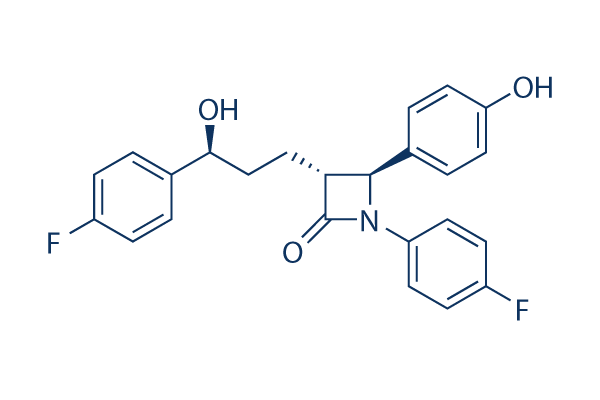
Ezetimibe (SCH-58235) LDL modulator
Cat.No.S1655
Quality Control
| Related Targets | Dehydrogenase HSP Transferase P450 (e.g. CYP17) PDE phosphatase PPAR Vitamin Carbohydrate Metabolism Mitochondrial Metabolism |
|---|---|
| Other LDL Inhibitors | Cashew Extract Phillygenin |
Solubility
|
In vitro |
DMSO
: 82 mg/mL
(200.29 mM)
Ethanol : 82 mg/mL Water : Insoluble |
Molarity Calculator
|
In vivo |
|||||
In vivo Formulation Calculator (Clear solution)
Step 1: Enter information below (Recommended: An additional animal making an allowance for loss during the experiment)
Step 2: Enter the in vivo formulation (This is only the calculator, not formulation. Please contact us first if there is no in vivo formulation at the solubility Section.)
Calculation results:
Working concentration: mg/ml;
Method for preparing DMSO master liquid: mg drug pre-dissolved in μL DMSO ( Master liquid concentration mg/mL, Please contact us first if the concentration exceeds the DMSO solubility of the batch of drug. )
Method for preparing in vivo formulation: Take μL DMSO master liquid, next addμL PEG300, mix and clarify, next addμL Tween 80, mix and clarify, next add μL ddH2O, mix and clarify.
Method for preparing in vivo formulation: Take μL DMSO master liquid, next add μL Corn oil, mix and clarify.
Note: 1. Please make sure the liquid is clear before adding the next solvent.
2. Be sure to add the solvent(s) in order. You must ensure that the solution obtained, in the previous addition, is a clear solution before proceeding to add the next solvent. Physical methods such
as vortex, ultrasound or hot water bath can be used to aid dissolving.
Chemical Information, Storage & Stability
| Molecular Weight | 409.4 | Formula | C24H21F2NO3 |
Storage (From the date of receipt) | |
|---|---|---|---|---|---|
| CAS No. | 163222-33-1 | Download SDF | Storage of Stock Solutions |
|
|
| Synonyms | SCH-58235 | SMILES | C1=CC(=CC=C1C2C(C(=O)N2C3=CC=C(C=C3)F)CCC(C4=CC=C(C=C4)F)O)O | ||
Read more about storage stability stock solution CAS number SMILES
Mechanism of Action
| Targets/IC50/Ki |
NPC1L1
|
|---|---|
| In vitro |
Ezetimibe (SCH-58235) produces a significant reduction in total cholesterol, LDL cholesterol, and triglycerides as well as a small but significant increase in HDL cholesterol. This compound reduces cholesterol transport by 31% in Caco-2 cells, but not retinol transport. It results in a significant decrease in mRNA expression for the surface receptors SR-BI, Niemann-Pick type C1 Like 1 protein (NPC1L1), and ATP-binding cassette transporter, subfamily A (ABCA1) and for the nuclear receptors retinoid acid receptor (RAR)gamma, sterol-regulatory element binding proteins (SREBP)-1 and -2, and liver X receptor (LXR)beta as assessed by real-time PCR analysis in Caco-2 cells.
|
| In vivo |
Ezetimibe (SCH-58235) reduces plasma cholesterol levels from 964 to 374 mg/dL, from 726 to 231 mg/dL, and from 516 to 178 mg/dL in the western, low-fat, and cholesterol-free diet mice, respectively. It reduces aortic atherosclerotic lesion surface area from 20.2% to 4.1% in the western diet group and from 24.1% to 7.0% in the low-fat cholesterol diet mice. This compound reduces carotid artery atherosclerotic lesion cross-sectional area by 97% in the western and low-fat cholesterol groups and by 91% in the cholesterol-free mice. It inhibits cholesterol absorption, reduces plasma cholesterol, increases high density lipoprotein levels, and inhibits the progression of atherosclerosis under western, low-fat, and cholesterol-free dietary conditions in apoE-/- mice. Ezetimibe potently inhibits the transport of cholesterol across the intestinal wall, thereby reducing plasma cholesterol in preclinical animal models of hypercholesterolemia. It eliminates exocrine pancreatic function from the intestine while maintaining bile flow, as established in the rat. The compound reduces plasma cholesterol and hepatic cholesterol accumulation in cholesterol-fed hamsters with an ED(50) of 0.04 mg /kg.
|
References |
|
Applications
| Methods | Biomarkers | Images | PMID |
|---|---|---|---|
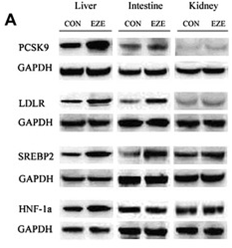
| Western blot | PCSK9 / LDLR / SREBP2 / HNF1-a LC3B-I / LC3B-II / Nuclear TFEB p-AMPK / AMPK |
|
25889684 |
Clinical Trial Information
(data from https://clinicaltrials.gov, updated on 2025-08-07)
| NCT Number | Recruitment | Conditions | Sponsor/Collaborators | Start Date | Phases |
|---|---|---|---|---|---|
| NCT06722521 | RECRUITING | Primary Prevention; Vascular Calcification |
Asan Medical Center |
2025-07-09 | PHASE4 |
| NCT07524101 | RECRUITING | Renal Insufficiency; Atherosclerosis; Dyslipidemia; Hypercholesterolemia; Cardiovascular Diseases |
Yonsei University |
2026-05-28 | |
| NCT05579626 | ENROLLING_BY_INVITATION | Pre Diabetes; ASCVD |
Seung-Whan Lee, M.D., Ph.D. |
2023-03-14 | PHASE4 |
| NCT06649240 | RECRUITING | Ischemic Stroke; Small Vessel Cerebrovascular Disease; Cholesterol, LDL; Secondary Prevention; Cardiovascular Diseases |
Seoul National University Hospital |
2024-10-04 | |
| NCT07359105 | RECRUITING | Dyslipidemia Associated With Type II Diabetes Mellitus |
Sin Gon Kim |
2026-03-09 | |
| NCT07799779 | NOT_YET_RECRUITING | Acute Coronary Syndromes (ACS) |
Seoul National University Bundang Hospital |
2026-09 | PHASE4 |
Read more about Clinical Trials
Tech Support
Tel: +1-832-582-8158 Ext:3
If you have any other enquiries, please leave a message.
Frequently Asked Questions
Question 1:
I am planning to deliver it per orally and wonder proper vehicle for this compound and effective dose level for lowering intestinal cholesterol absorption.
Answer:
It can be dissolved in 2% DMSO/30% PEG 300/5% Tween 80/ddH2O at 10 mg/ml clearly. If you are going to use this vehicle, please dissolve the compound in DMSO clearly first. Then add PEG 300 and Tween 80, after mixed homogeneously, then dilute with water.

Products are for research use only. Not for human use. We do not sell to patients.
©Copyright 2013 Selleck Chemicals. All Rights Reserved.