alpha-MSH TFA (α-MSH TFA, α-MSH Trifluoroacetate, alpha-MSH Trifluoroacetate,α-Melanocyte-stimulating hormone TFA, α-Melanocyte-stimulating hormone Trifluoroacetate) is a 13-amino acid peptide hormone. an endogenous MC4R agonist. alpha-MSH TFA is an endogenous MC3R and MC4R agonist with EC50s of 0.16 nM and 56 nM for hMC3R and hMC4R in Hepa cells, respectively.

-
 Argentina
-
 Australia
-
 Austria
-
 Belgium
-
 Brazil
-
 Canada
-
 China
China
-
 Czech Republic
-
 Denmark
-
 Finland
-
 France
-
 Germany
-
 Greece
-
 Hong Kong
-
 Hungary
-
 Iceland
-
 India
India
-
 Ireland
-
 Israel
-
 Italy
Italy
-
 Japan
Japan
-
 Korea
Korea
-
 Luxembourg
-
 Malaysia
-
 Netherlands
-
 New Zealand
-
 Norway
-
 Poland
-
 Qatar
Qatar
-
 Romania
-
 Saudi Arabia
-
 Singapore
-
 Spain
Spain
-
 Sweden
-
 Switzerland
-
 Taiwan
-
 Turkey
-
 United Kingdom
-
 United States
research use only
alpha-MSH TFA
Cat.No.P1207
Amino-acid Sequence
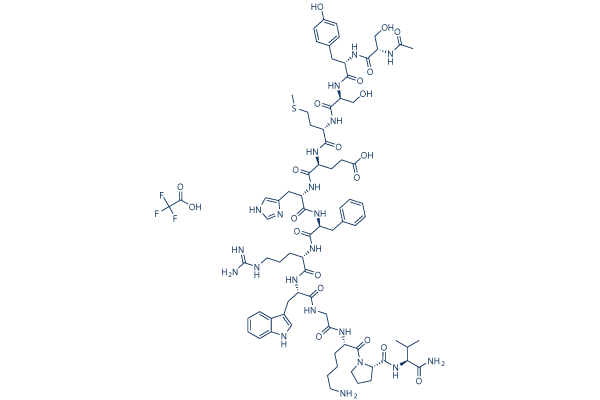
CAS No. 171869-93-5
Quality Control
Batch:
P120701
DMSO]
100 mg/mL]
false]
Water]
50 mg/mL]
false]
Ethanol]
Insoluble]
false
Purity:
99.76%
99.76
| Featured Inhibitors | Y-27632 Dihydrochloride SB431542 CHIR-99021 (Laduviglusib) RMC-7977 RMC-6236 (Daraxonrasib) MRTX1133 MG132 Z-VAD-FMK VT3989 IAG933 |
|---|
Chemical Information & Solubility
| Storage (From the date of receipt) | 3 years-20°C powder | ||
|
In vitro |
DMSO
: 100 mg/mL
(56.21 mM);
Water : 50 mg/mL Ethanol : Insoluble |
Molecular Weight Calculator |
|
In vivo Add solvents to the product individually and in order. |
In vivo Formulation Calculator |
||||
Biological Activity
| Description | alpha-MSH TFA (α-MSH TFA, α-MSH Trifluoroacetate, alpha-MSH Trifluoroacetate,α-Melanocyte-stimulating hormone TFA, α-Melanocyte-stimulating hormone Trifluoroacetate) is a 13-amino acid peptide hormone. an endogenous MC4R agonist. alpha-MSH TFA is an endogenous MC3R and MC4R agonist with EC50s of 0.16 nM and 56 nM for hMC3R and hMC4R in Hepa cells, respectively. |
|---|---|
| Targets/IC50/Ki |
hMC3R
hMC4
|
In vitro |
||||
| In vitro | Alpha-MSH exerts an inhibitory effect on IL-8 production by macrophages, an influence that may occur via modulating NFκB activation. In human glioma cells, inflammatory reactions are modulated by α-MSH peptides, apparently by modulating NFκB activation through preventing IκB degradation. |
|||
|---|---|---|---|---|
In Vivo |
||
| In vivo |
Alpha-MSH inhibits both the induction and elicitation of contact sensitivity and can lead to hapten-specific tolerance. Although IL-10–deficient mice have reduced capacity to modulate both peripheral local and systemic inflammatory reactions, they are capable of reacting to exogenous α-MSH with reduced acute inflammatory reactions. |
|
|---|---|---|
References |
|
Product Information
| Molecular Formula | C77H109N21O19S.xC2HF3O2 |
|---|---|
| Molecular Weight | 1778.91 |
| CAS No. | 171869-93-5 |
| Appearance | White Powder |
| Peptide Content (by %N) | ≥80% |
| Single Impurity (by HPLC) | ≤1.0% |
| Assay (By Anhydrous, Acetic Acid-free) | 95.0~105.0% |
| MS | Consistent |
| Packing | plastic vial(dedicated for peptide packing) or glass vial, quantity according to customer's detail requirement. |
| Storage (From the date of receipt) |
3 years-20°C powder |
| Shipping | Room temperature shipping(Stability testing shows this product can be shipped without any cooling measures.) |

Products are for research use only. Not for human use. We do not sell to patients.
©Copyright 2013 Selleck Chemicals. All Rights Reserved.