
-
 Australia
-
 Austria
-
 Belgium
-
 Brazil
-
 Canada
-
 China
China
-
 Czech Republic
-
 Denmark
-
 Finland
-
 France
-
 Germany
-
 Greece
-
 Hong Kong
-
 Hungary
-
 Iceland
-
 India
India
-
 Ireland
-
 Israel
-
 Italy
Italy
-
 Japan
Japan
-
 Korea
Korea
-
 Luxembourg
-
 Malaysia
-
 Netherlands
-
 New Zealand
-
 Norway
-
 Poland
-
 Qatar
Qatar
-
 Romania
-
 Saudi Arabia
-
 Singapore
-
 Spain
Spain
-
 Sweden
-
 Switzerland
-
 Taiwan
-
 Turkey
-
 United Kingdom
-
 United States
research use only
Hydroxypropyl Cellulose
Cat.No.S4115
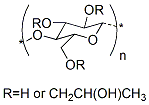
Chemical Structure
Molarity Calculator
|
In vivo |
|||||
In vivo Formulation Calculator (Clear solution)
Step 1: Enter information below (Recommended: An additional animal making an allowance for loss during the experiment)
Step 2: Enter the in vivo formulation (This is only the calculator, not formulation. Please contact us first if there is no in vivo formulation at the solubility Section.)
Calculation results:
Working concentration: mg/ml;
Method for preparing DMSO master liquid: mg drug pre-dissolved in μL DMSO ( Master liquid concentration mg/mL, Please contact us first if the concentration exceeds the DMSO solubility of the batch of drug. )
Method for preparing in vivo formulation: Take μL DMSO master liquid, next addμL PEG300, mix and clarify, next addμL Tween 80, mix and clarify, next add μL ddH2O, mix and clarify.
Method for preparing in vivo formulation: Take μL DMSO master liquid, next add μL Corn oil, mix and clarify.
Note: 1. Please make sure the liquid is clear before adding the next solvent.
2. Be sure to add the solvent(s) in order. You must ensure that the solution obtained, in the previous addition, is a clear solution before proceeding to add the next solvent. Physical methods such
as vortex, ultrasound or hot water bath can be used to aid dissolving.
Chemical Information, Storage & Stability
| Molecular Weight | Formula | C3H8O2.xUnspecified |
Storage (From the date of receipt) | ||
|---|---|---|---|---|---|
| CAS No. | 9004-64-2 | Download SDF | Storage of Stock Solutions |
|
|
Mechanism of Action
| Features |
An ether of cellulose where some of the hydroxyl groups of the cellulose have been hydroxypropylated forming -OCH2CHCH3 groups.
|
|---|---|
| In vitro |
Hydroxypropyl cellulose (HPC) has a relatively low viscosity, allowing for microchip channel filling to be performed with ease at concentrations as high as 5%, a MES/TRIS buffer system at pH 6.1 eliminates the need for surface preconditioning procedures due to the promotion of hydrogen bonding of HPC with the wall. Hydroxypropyl cellulose (HPC) is used as a core molecule for controlled grafting of monomers by ATRP. Hydroxypropyl cellulose (HPC) is either allowed to react with an ATRP initiator or the first generation initiator-functionalized 2,2-bis(methylol)propionic acid dendron to create macroinitiators having high degrees of functionality. Hydroxypropyl cellulose (HPC)/vinyl polymer networks are synthesized in film form from liquid-crystalline solutions of HPC in a mixed solvent of methacrylate monomer/methanol/water (2:1:2 in weight) containing cross-linking agents, via photopolymerization of the methacrylate monomer. The polymer composite films, HPC/PDEGMEM and HPC/PHPMA, prepared at ca. 60-70 wt % concentrations of HPC in the starting solutions, are iridescently colored due to the selective light reflection, originating from the cholesteric helical arrangement carried over successively into the network system.
|
References |
|
Tech Support
Tel: +1-832-582-8158 Ext:3
If you have any other enquiries, please leave a message.

Products are for research use only. Not for human use. We do not sell to patients.
©Copyright 2013 Selleck Chemicals. All Rights Reserved.