
-
 Australia
-
 Austria
-
 Belgium
-
 Brazil
-
 Canada
-
 China
China
-
 Czech Republic
-
 Denmark
-
 Finland
-
 France
-
 Germany
-
 Greece
-
 Hong Kong
-
 Hungary
-
 Iceland
-
 India
India
-
 Ireland
-
 Israel
-
 Italy
Italy
-
 Japan
Japan
-
 Korea
Korea
-
 Luxembourg
-
 Malaysia
-
 Netherlands
-
 New Zealand
-
 Norway
-
 Poland
-
 Qatar
Qatar
-
 Romania
-
 Saudi Arabia
-
 Singapore
-
 Spain
Spain
-
 Sweden
-
 Switzerland
-
 Taiwan
-
 Turkey
-
 United Kingdom
-
 United States
research use only
Evofosfamide (TH-302)
Cat.No.S2757
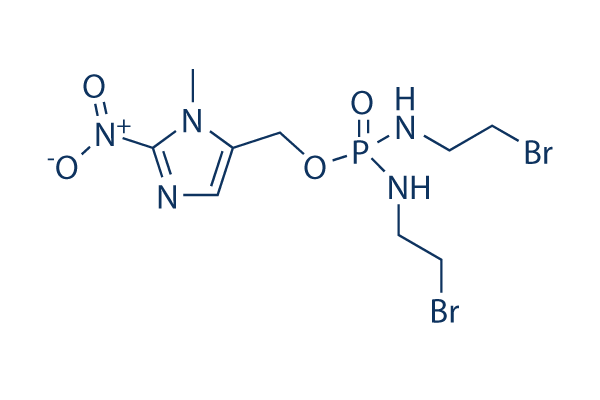
Chemical Structure
Molecular Weight: 449.04
Quality Control
Cell Culture, Treatment & Working Concentration
| Cell Lines | Assay Type | Concentration | Incubation Time | Formulation | Activity Description | PMID |
|---|---|---|---|---|---|---|
| H460 | Cytotoxicity assay | 2 hrs | Cytotoxicity against human H460 cells under hypoxic condition after 2 hrs by Alamar blue staining assay, IC50=0.019μM. | 18257544 | ||
| H460 | Cytotoxicity assay | 2 hrs | Cytotoxicity against human H460 cells under hypoxic condition after 2 hrs by clonogenic assay, IC90=0.1μM. | 18257544 | ||
| HT29 | Cytotoxicity assay | 2 hrs | Cytotoxicity against human HT29 cells under hypoxic condition after 2 hrs by clonogenic assay, IC90=0.2μM. | 18257544 | ||
| H460 | Cytotoxicity assay | 2 hrs | Cytotoxicity against human H460 cells under normoxic condition after 2 hrs by Alamar blue staining assay, IC50=5.1μM. | 18257544 | ||
| H460 | Cytotoxicity assay | 2 hrs | Cytotoxicity against human H460 cells under normoxic condition after 2 hrs by clonogenic assay, IC90=30μM. | 18257544 | ||
| HT29 | Cytotoxicity assay | 2 hrs | Cytotoxicity against human HT29 cells under normoxic condition after 2 hrs by clonogenic assay, IC90=40μM. | 18257544 | ||
| NCI-H460 | Cytotoxicity assay | 24 hrs | Cytotoxicity against human NCI-H460 cells pretreated for 24 hrs under hypoxic condition followed by compound washout measured after 72 hrs by MTT assay, IC50=9.08μM. | 28350997 | ||
| HT-29 | Cytotoxicity assay | 24 hrs | Cytotoxicity against human HT-29 cells pretreated for 24 hrs under hypoxic condition followed by compound washout measured after 72 hrs by MTT assay, IC50=49.51μM. | 28350997 | ||
| NCI-H460 | Cytotoxicity assay | 24 hrs | Cytotoxicity against human NCI-H460 cells after 24 hrs under hypoxic condition by luminescence-based Cell-Titer Glo assay, IC50=0.0093μM. | 29079474 | ||
| NCI-H460 | Cytotoxicity assay | 24 hrs | Cytotoxicity against human NCI-H460 cells after 24 hrs under normoxic condition by luminescence-based Cell-Titer Glo assay, IC50=6.65μM. | 29079474 | ||
| DU145 | Cytotoxicity assay | 2 hrs | Cytotoxicity against human DU145 cells incubated for 2 hrs under hypoxic condition measured after 72 hrs by Alamar blue assay, IC50=4.14μM. | 29259746 | ||
| PC3 | Cytotoxicity assay | 2 hrs | Cytotoxicity against human PC3 cells incubated for 2 hrs under hypoxic condition measured after 72 hrs by Alamar blue assay, IC50=6.49μM. | 29259746 | ||
| HEMC-SS | Antiproliferative assay | 24 hrs | Antiproliferative activity against human HEMC-SS cells treated for 24 hrs under hypoxic condition followed by compound wash-out and incubated under normoxic condition for 48 hrs by alamar blue assay, IC50=0.13μM. | 30199705 | ||
| HEMC-SS | Antiproliferative assay | 24 hrs | Antiproliferative activity against human HEMC-SS cells treated for 24 hrs under normoxic condition followed by compound wash-out and incubated under normoxic condition for 48 hrs by alamar blue assay, IC50=2.9μM. | 30199705 | ||
| NCI-H460 | Antiproliferative assay | Antiproliferative activity against human NCI-H460 cells in presence of N2, IC50=2μM. | 30295477 | |||
| NCI-H460 | Antiproliferative assay | Antiproliferative activity against human NCI-H460 cells in presence of O2, IC50=25μM. | 30295477 | |||
| MDA-MB-468 | Cytotoxicity assay | 4 hrs | Cytotoxicity against human MDA-MB-468 cells incubated for 4 hrs under hypoxic condition followed by compound washout and measured after 5 days by SRB assay, IC50=0.0062μM. | 30885680 | ||
| SW620 | Cytotoxicity assay | 4 hrs | Cytotoxicity against human SW620 cells incubated for 4 hrs under hypoxic condition followed by compound washout and measured after 5 days by SRB assay, IC50=0.052μM. | 30885680 | ||
| MDA-MB-468 | Cytotoxicity assay | 4 hrs | Cytotoxicity against human MDA-MB-468 cells incubated for 4 hrs under aerobic condition followed by compound washout and measured after 5 days by SRB assay, IC50=4.403μM. | 30885680 | ||
| SW620 | Cytotoxicity assay | 4 hrs | Cytotoxicity against human SW620 cells incubated for 4 hrs under aerobic condition followed by compound washout and measured after 5 days by SRB assay, IC50=20.6μM. | 30885680 | ||
| Click to View More Cell Line Experimental Data | ||||||
Solubility
|
In vitro |
DMSO
: 90 mg/mL
(200.42 mM)
Ethanol : 90 mg/mL Water : 10 mg/mL |
Molarity Calculator
|
In vivo |
|||||
In vivo Formulation Calculator (Clear solution)
Step 1: Enter information below (Recommended: An additional animal making an allowance for loss during the experiment)
Step 2: Enter the in vivo formulation (This is only the calculator, not formulation. Please contact us first if there is no in vivo formulation at the solubility Section.)
Calculation results:
Working concentration: mg/ml;
Method for preparing DMSO master liquid: mg drug pre-dissolved in μL DMSO ( Master liquid concentration mg/mL, Please contact us first if the concentration exceeds the DMSO solubility of the batch of drug. )
Method for preparing in vivo formulation: Take μL DMSO master liquid, next addμL PEG300, mix and clarify, next addμL Tween 80, mix and clarify, next add μL ddH2O, mix and clarify.
Method for preparing in vivo formulation: Take μL DMSO master liquid, next add μL Corn oil, mix and clarify.
Note: 1. Please make sure the liquid is clear before adding the next solvent.
2. Be sure to add the solvent(s) in order. You must ensure that the solution obtained, in the previous addition, is a clear solution before proceeding to add the next solvent. Physical methods such
as vortex, ultrasound or hot water bath can be used to aid dissolving.
Chemical Information, Storage & Stability
| Molecular Weight | 449.04 | Formula | C9H16Br2N5O4P |
Storage (From the date of receipt) | |
|---|---|---|---|---|---|
| CAS No. | 918633-87-1 | Download SDF | Storage of Stock Solutions |
|
|
Mechanism of Action
| In vitro |
Evofosfamide (TH-302) is selectively potent under hypoxia and stable to liver microsomes. Substitution of the chlorine with bromine on the phosphorus mustard in 3b increases the potency by 10-fold and maintaines the high hypoxic selectivity [Hypoxia cytotoxicity ratio (HCR) = 270]. In both human lung cancer H460 cells and human colon cancer HT29 cells, potent cytotoxicity of this compound is observed under N2. It inhibits H460 cells and HT29 cells with IC90 of 0.1 μM and 0.2 μM, respectively. It shows much enhanced potency in H460 spheroids compared to H460 monolayer cells under normoxia. This compound exhibits potent cytotoxicity to MM cells with hypoxic selectivity and dose dependency. It can induce G0/G1 cell-cycle arrest under hypoxic conditions. The effect of it on cell-cycle machinery is mediated by down-regulating cyclin D1/2/3, CDK4/6, p21cip-1, p27kip-1, and pRb expression, whereas CDK2 expression remained undisturbed. It can induce dose-dependent apoptosis in both human and murine MM cells in hypoxic conditions. TH-302-activated apoptosis is mediated through down-regulating the antiapoptotic proteins BCL-2 and BCL-xL, as well as up-regulating the expression of cleaved proapoptotic protein caspase-3, -8, and -9 and poly ADP-ribose polymerase. In contrast to the hypoxia-specific toxicity, it shows very low toxicity in normoxic condition, even at high concentrations. |
|---|---|
| In vivo |
Evofosfamide (TH-302) inhibits primary tumor growth by 41% on day 25 after implantation, whereas this compound plus a nucleoside analog inhibits primary tumor growth by 96% on day 25. When administered at 6.25, 12.5, 25, or 50 mg/kg in the H460 NSCLC xenograft model QD × 5/wk × 2 wks (once a day for 5 days per week for 2 weeks) i.p., it shows tumor growth inhibition at Day 22 of 43%, 51%, 75%, and 89%, respectively. At 100 mg/kg, it causes a decrease in blood cell counts 3 days after treatment end, but these are totally recovered 7 days post-treatment. Under all tested regimens, it exhibits efficacy metrics ranging from 58% to 89% tumor growth inhibition. Its induced cell killing is breathing oxygen concentration dependent, with the greatest cytotoxicity occurring when the tumor-bearing mice are exposed to low oxygen concentrations. Tumor growth is significantly reduced by this compound in animals breathing 10% O2 compared with 95% O2 breathing. After treatment, the pimonidazole-positive area is significantly decreased at 48 hours after dosing (6.3 % in vehicle vs. 1.8 % in the TH-302 treatment group). |
References |
|
Clinical Trial Information
(data from https://clinicaltrials.gov, updated on 2024-05-22)
| NCT Number | Recruitment | Conditions | Sponsor/Collaborators | Start Date | Phases |
|---|---|---|---|---|---|
| NCT02020226 | Unknown status | Solid Tumors |
Threshold Pharmaceuticals |
November 2013 | Phase 1 |
| NCT01833546 | Completed | Solid Tumor|Pancreatic Cancer |
Merck KGaA Darmstadt Germany|Threshold Pharmaceuticals |
April 18 2013 | Phase 1 |
Tech Support
Tel: +1-832-582-8158 Ext:3
If you have any other enquiries, please leave a message.

Products are for research use only. Not for human use. We do not sell to patients.
©Copyright 2013 Selleck Chemicals. All Rights Reserved.