
-
 Australia
-
 Austria
-
 Belgium
-
 Brazil
-
 Canada
-
 China
China
-
 Czech Republic
-
 Denmark
-
 Finland
-
 France
-
 Germany
-
 Greece
-
 Hong Kong
-
 Hungary
-
 Iceland
-
 India
India
-
 Ireland
-
 Israel
-
 Italy
Italy
-
 Japan
Japan
-
 Korea
Korea
-
 Luxembourg
-
 Malaysia
-
 Netherlands
-
 New Zealand
-
 Norway
-
 Poland
-
 Qatar
Qatar
-
 Romania
-
 Saudi Arabia
-
 Singapore
-
 Spain
Spain
-
 Sweden
-
 Switzerland
-
 Taiwan
-
 Turkey
-
 United Kingdom
-
 United States
research use only
PI-103 PI3K inhibitor
Cat.No.S1038
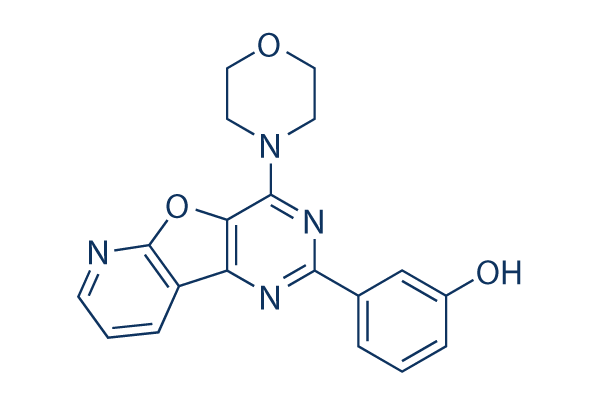
Chemical Structure
Molecular Weight: 348.36
Quality Control
| Related Targets | Akt mTOR GSK-3 ATM/ATR DNA-PK AMPK PDPK1 PTEN PP2A PDK |
|---|---|
| Other PI3K Inhibitors | GDC-0077 (Inavolisib) SAR405 Quercetin (Sophoretin) LY294002 XL147 analogue Tersolisib (STX-478) Buparlisib (BKM120) 740 Y-P (PDGFR 740Y-P) GO-203 TFA Eganelisib (IPI-549) |
Cell Culture, Treatment & Working Concentration
| Cell Lines | Assay Type | Concentration | Incubation Time | Formulation | Activity Description | PMID |
|---|---|---|---|---|---|---|
| UCH-1 | Apoptosis Assay | 0.1-10 μM | 24 h | DMSO | induces apoptosis | 19528441 |
| UCH-1 | Growth Inhibition Assay | 0.01-10 μM | 6 d | inhibits proliferation dose dependently | 19528441 | |
| UCH-1 | Function Assay | 0-5 μM | inhibits the phosphorylation of both AKT and mTOR in a dose-dependent manner | 19528441 | ||
| HUVEC | Growth Inhibition Assay | IC50=0.08 μM | 19584227 | |||
| SKOV-3 | Growth Inhibition Assay | IC50=0.12 μM | 19584227 | |||
| PC3 | Growth Inhibition Assay | IC50=0.10 μM | 19584227 | |||
| DETROIT562 | Growth Inhibition Assay | IC50=0.13 μM | 19584227 | |||
| IGROV-1 | Growth Inhibition Assay | IC50=0.06 μM | 19584227 | |||
| U87MG | Growth Inhibition Assay | IC50=0.14 μM | 19584227 | |||
| U118MG | Function Assay | 0.1-1 μM | 24 h | DMSO | inhibits PI3K-mediated signaling | 19633683 |
| U138MG | Function Assay | 0.1-1 μM | 24 h | DMSO | inhibits PI3K-mediated signaling | 19633683 |
| U87MG | Function Assay | 0.1-1 μM | 24 h | DMSO | inhibits PI3K-mediated signaling | 19633683 |
| PC3 | Growth Inhibition Assay | 24h | GI50 = 100 nM | 20551061 | ||
| 518A2 | Function Assay | 0.001–1 μM | 24 h | suppresses phosphorylation of phosphatidyl inositol 3-kinase downstream targets | 21048785 | |
| Mel-Juso | Function Assay | 0.001–1 μM | 24 h | suppresses phosphorylation of phosphatidyl inositol 3-kinase downstream targets | 21048785 | |
| 518A2 | Cell Viability Assay | 0.01–10 μM | 72 h | inhibits cell viability dose dependently | 21048785 | |
| Mel-Juso | Cell Viability Assay | 0.01–10 μM | 72 h | inhibits cell viability dose dependently | 21048785 | |
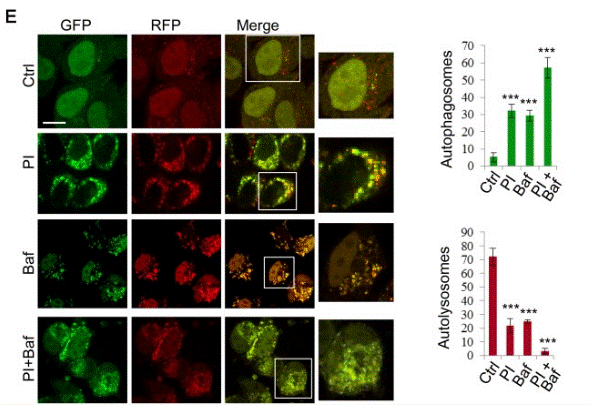
| SF767 | Function Assay | 1 μM | 48 h | induces autophagosome formation | 21062993 | |
| U373 | Function Assay | 1 μM | 48 h | induces autophagosome formation | 21062993 | |
| U87 | Function Assay | 1 μM | 48 h | induces autophagosome formation | 21062993 | |
| LN229 | Function Assay | 1 μM | 48 h | induces autophagosome formation | 21062993 | |
| PC-9 | Growth Inhibition Assay | 0-3 μM | 72 h | IC50=0.8 μM | 21220474 | |
| HCC827 | Growth Inhibition Assay | 0-3 μM | 72 h | IC50=0.3 μM | 21220474 | |
| HCC1937 | Function Assay | 1 μM | 24 h | reduces the phosphorylation of AKT | 22488590 | |
| SUM1315MO2 | Function Assay | 1 μM | 24 h | reduces the phosphorylation of AKT | 22488590 | |
| SUM149PT | Function Assay | 1 μM | 24 h | reduces the phosphorylation of AKT | 22488590 | |
| MDA-MB-436 | Function Assay | 1 μM | 24 h | reduces the phosphorylation of AKT | 22488590 | |
| KMS12-BM | Growth Inhibition Assay | 0-2 μM | 24 h | IC50>2 μM | 22829234 | |
| NCI-H929 | Growth Inhibition Assay | 0-2 μM | 24 h | IC50=0.25 μM | 22829234 | |
| MM1S | Growth Inhibition Assay | 0-2 μM | 24 h | IC50=0.5 μM | 22829234 | |
| MOLT-16 | Growth Inhibition Assay | 1 μM | 7 d | decreases the cell number significantly | 23038273 | |
| LOUCY | Growth Inhibition Assay | 1 μM | 7 d | decreases the cell number significantly | 23038273 | |
| CCRF-CEM | Growth Inhibition Assay | 1 μM | 7 d | decreases the cell number significantly | 23038273 | |
| PF-382 | Growth Inhibition Assay | 1 μM | 7 d | decreases the cell number significantly | 23038273 | |
| MOLT-4 | Growth Inhibition Assay | 1 μM | 7 d | decreases the cell number significantly | 23038273 | |
| Jurkat | Growth Inhibition Assay | 1 μM | 7 d | decreases the cell number significantly | 23038273 | |
| RPMI-8402 | Growth Inhibition Assay | 1 μM | 7 d | decreases the cell number significantly | 23038273 | |
| Karpas-45 | Growth Inhibition Assay | 1 μM | 7 d | decreases the cell number significantly | 23038273 | |
| KE37 | Growth Inhibition Assay | 1 μM | 7 d | decreases the cell number significantly | 23038273 | |
| ALL-SIL | Growth Inhibition Assay | 1 μM | 7 d | decreases the cell number significantly | 23038273 | |
| PEER | Growth Inhibition Assay | 1 μM | 7 d | decreases the cell number significantly | 23038273 | |
| SUP-T1 | Growth Inhibition Assay | 1 μM | 7 d | decreases the cell number significantly | 23038273 | |
| DND41 | Growth Inhibition Assay | 1 μM | 7 d | decreases the cell number significantly | 23038273 | |
| HPB-ALL | Growth Inhibition Assay | 1 μM | 7 d | decreases the cell number significantly | 23038273 | |
| TALL-1 | Growth Inhibition Assay | 1 μM | 7 d | decreases the cell number significantly | 23038273 | |
| H3122 | Function Assay | 0-3.3 μM | 72 h | induces complete downregulation of pAKT | 23259591 | |
| HCC827 | Function Assay | 0-3.3 μM | 72 h | induces complete downregulation of pAKT | 23259591 | |
| A549 | Function Assay | 0-3.3 μM | 72 h | induces complete downregulation of pAKT | 23259591 | |
| HT1080 | Apoptosis Assay | 3 µM | 12 h | DMSO | sensitizes RD cells to DOX-induced apoptosis | 23300809 |
| TP5014 | Apoptosis Assay | 3 µM | 12 h | DMSO | sensitizes RD cells to DOX-induced apoptosis | 23300809 |
| RD | Apoptosis Assay | 3 µM | 12 h | DMSO | sensitizes RD cells to DOX-induced apoptosis | 23300809 |
| SKNBE(2c) | Function Assay | 1.5/2.5/5 μM | 24 h | induces G1 cell-cycle arrest and apoptosis | 23378341 | |
| SY5Y | Function Assay | 1.5/2.5/5 μM | 24 h | induces G1 cell-cycle arrest and apoptosis | 23378341 | |
| MDA-MB-231 | Cell Viability Assay | 0.3 μM | 72 h | enhances cytotoxic effects of PI3K/AKT pathway inhibitors | 23601074 | |
| MDA-MB-468 | Cell Viability Assay | 0.3 μM | 72 h | enhances cytotoxic effects of PI3K/AKT pathway inhibitors | 23601074 | |
| SUM149PT | Cell Viability Assay | 0.3 μM | 72 h | enhances cytotoxic effects of PI3K/AKT pathway inhibitors | 23601074 | |
| RMS13 | Apoptosis Assay | 1/1.5/2 μM | 72 h | DMSO | induces caspase-dependent apoptosis combined with UO126 | 23684925 |
| RH30 | Apoptosis Assay | 1/1.5/2 μM | 72 h | DMSO | induces caspase-dependent apoptosis combined with UO126 | 23684925 |
| TE671 | Apoptosis Assay | 1/1.5/2 μM | 72 h | DMSO | induces caspase-dependent apoptosis combined with UO126 | 23684925 |
| RD | Apoptosis Assay | 1/1.5/2 μM | 72 h | DMSO | induces caspase-dependent apoptosis combined with UO126 | 23684925 |
| FaDu | Function Assay | 0.25/0.5/1 μM | 24 h | inhibits Akt phosphorylation significantly | 24351425 | |
| UT5 | Function Assay | 0.25/0.5/1 μM | 24 h | inhibits Akt phosphorylation significantly | 24351425 | |
| SAS | Function Assay | 0.25/0.5/1 μM | 24 h | inhibits Akt phosphorylation significantly | 24351425 | |
| H661 | Function Assay | 0.25/0.5/1 μM | 24 h | inhibits Akt phosphorylation significantly | 24351425 | |
| H460 | Function Assay | 0.25/0.5/1 μM | 24 h | inhibits Akt phosphorylation slightly | 24351425 | |
| A549 | Function Assay | 0.25/0.5/1 μM | 24 h | inhibits Akt phosphorylation slightly | 24351425 | |
| NUGC4 LG | Growth Inhibition Assay | IC50=14.0 ± 5.321 μM | 24597478 | |||
| NUGC4 HG | Growth Inhibition Assay | IC50=14.0 ± 3.913 μM | 24597478 | |||
| MKN45 LG | Growth Inhibition Assay | IC50=0.87 ± 0.030 μM | 24597478 | |||
| MKN45 HG | Growth Inhibition Assay | IC50=1.01 ± 0.051 μM | 24597478 | |||
| HGC27 LG | Growth Inhibition Assay | IC50=0.02 ± 0.004 μM | 24597478 | |||
| HGC27 HG | Growth Inhibition Assay | IC50=0.38 ± 0.022 μM | 24597478 | |||
| AGS LG | Growth Inhibition Assay | IC50=0.05 ± 0.001 μM | 24597478 | |||
| AGS HG | Growth Inhibition Assay | IC50=0.68 ± 0.031 μM | 24597478 | |||
| SW982 | Apoptosis Assay | 0.01-0.5 μM | 48 h | induces apoptosis dose dependently | 24695632 | |
| SW872 | Apoptosis Assay | 0.01-0.5 μM | 48 h | induces apoptosis dose dependently | 24695632 | |
| SW982 | Function Assay | 0.01-0.5 μM | 24 h | reduces AKT phosphorylation (pAKT) and 4EBP1 phosphorylation (p4EBP1) in a dose-dependent manner | 24695632 | |
| SW872 | Function Assay | 0.01-0.5 μM | 24 h | reduces AKT phosphorylation (pAKT) and 4EBP1 phosphorylation (p4EBP1) in a dose-dependent manner | 24695632 | |
| HS578T | Function Assay | 0.01-10 μM | 24 h | downregulates the levels of β-TrCP1, c-Myc and cyclin E proteins | 25721419 | |
| MDA-MB-231 | Function Assay | 0.01-10 μM | 24 h | downregulates the levels of β-TrCP1, c-Myc and cyclin E proteins | 25721419 | |
| MDA-MB-468 | Function Assay | 0.01-10 μM | 24 h | downregulates the levels of β-TrCP1, c-Myc and cyclin E proteins | 25721419 | |
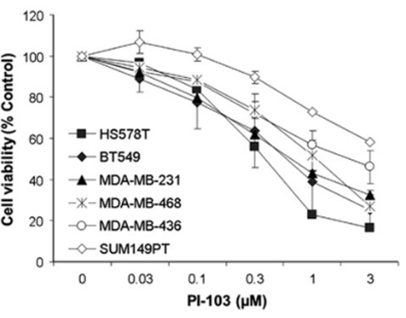
| SUM149PT | Cell Viability Assay | 0-3 μM | 72 h | inhibits cell viability dose dependently | 25721419 | |
| MDA-MB-436 | Cell Viability Assay | 0-3 μM | 72 h | inhibits cell viability dose dependently | 25721419 | |
| MDA-MB-468 | Cell Viability Assay | 0-3 μM | 72 h | inhibits cell viability dose dependently | 25721419 | |
| MDA-MB-231 | Cell Viability Assay | 0-3 μM | 72 h | inhibits cell viability dose dependently | 25721419 | |
| BT549 | Cell Viability Assay | 0-3 μM | 72 h | inhibits cell viability dose dependently | 25721419 | |
| HS578T | Cell Viability Assay | 0-3 μM | 72 h | inhibits cell viability dose dependently | 25721419 | |
| VJ | Apoptosis Assay | 1/1.5/2 μM | 72 h | induces apoptosis combined with GANT61 | 25749378 | |
| RH30 | Apoptosis Assay | 1/1.5/2 μM | 72 h | induces apoptosis combined with GANT61 | 25749378 | |
| RMS13 | Apoptosis Assay | 1/1.5/2 μM | 72 h | induces apoptosis combined with GANT61 | 25749378 | |
| TE381.T | Apoptosis Assay | 1/1.5/2 μM | 72 h | induces apoptosis combined with GANT61 | 25749378 | |
| RD | Apoptosis Assay | 1/1.5/2 μM | 72 h | induces apoptosis combined with GANT61 | 25749378 | |
| G 40 DC | Growth Inhibition Assay | 0.05-20 μM | 24/72 h | DMSO | inhibits cell viability dose and time dependently | 26121251 |
| G 38 DC | Growth Inhibition Assay | 0.05-20 μM | 24/72 h | DMSO | inhibits cell viability dose and time dependently | 26121251 |
| G 35 DC | Growth Inhibition Assay | 0.05-20 μM | 24/72 h | DMSO | inhibits cell viability dose and time dependently | 26121251 |
| G 40 SC | Growth Inhibition Assay | 0.05-20 μM | 24/72 h | DMSO | inhibits cell viability dose and time dependently | 26121251 |
| G 38 SC | Growth Inhibition Assay | 0.05-20 μM | 24/72 h | DMSO | inhibits cell viability dose and time dependently | 26121251 |
| G 35 SC | Growth Inhibition Assay | 0.05-20 μM | 24/72 h | DMSO | inhibits cell viability dose and time dependently | 26121251 |
| SH-SY5Y | Apoptosis Assay | 1 μM | 0.5-24 h | sensitizes neuroblastoma cells to doxorubicin-induced apoptosis | 26224681 | |
| SH-SY5Y | Growth Inhibition Assay | 0-8 μM | 24/48/72 h | induces time- and concentration-dependent inhibition on NB cell growth | 26224681 | |
| SK-N-BE | Growth Inhibition Assay | 0-8 μM | 24/48/72 h | induces time- and concentration-dependent inhibition on NB cell growth | 26224681 | |
| TT | Antiproliferative assay | 13 days | Antiproliferative activity against human TT cells after 13 days by fluorescence assay, IC50=0.0022μM. | 18849971 | ||
| Sf9 | Function assay | 30 mins | Inhibition of N-terminal His-6-tagged full length human PI3Kalpha expressed in baculovirus-infected sf9 cells after 30 mins by TR-FRET assay, IC50=0.0179μM. | 24900786 | ||
| HEK293T | Function assay | 15 mins | Inhibition of mTORC1 (unknown origin) expressed in HEK293T cells after 15 mins in presence of gamma-[32]P-ATP by high-throughput screening assay, IC50=0.02μM. | 29211480 | ||
| Sf9 | Function assay | 30 mins | Inhibition of GST-tagged full length human PI3Kalpha D810A mutant expressed in baculovirus-infected sf9 cells after 30 mins by TR-FRET assay, IC50=0.074μM. | 24900786 | ||
| Sf9 | Function assay | 30 mins | Inhibition of GST-tagged full length human PI3Kalpha Y836A mutant expressed in baculovirus-infected sf9 cells after 30 mins by TR-FRET assay, IC50=0.7963μM. | 24900786 | ||
| Caco2 | Antiproliferative assay | 48 hrs | Antiproliferative activity against human Caco2 cells after 48 hrs by Hoechst 33342 staining-based assay, IC50=0.8μM. | 30655216 | ||
| Caco2 | Antiproliferative assay | 48 hrs | Antiproliferative activity against human Caco2 cells incubated for 48 hrs by Hoechst 3342 dye staining based assay, IC50=0.9μM. | 23063566 | ||
| HCT116 | Antiproliferative assay | 48 hrs | Antiproliferative activity against human HCT116 cells incubated for 48 hrs by Hoechst 3342 dye staining based assay, IC50=1μM. | 23063566 | ||
| Sf9 | Function assay | 30 mins | Inhibition of GST-tagged full length human PI3Kalpha M772A mutant expressed in baculovirus-infected sf9 cells after 30 mins by TR-FRET assay, IC50=1.0344μM. | 24900786 | ||
| PC3 | Antiproliferative assay | 48 hrs | Antiproliferative activity against human PC3 cells after 48 hrs by Hoechst 33342 staining-based assay, IC50=1.2μM. | 30655216 | ||
| HuH7 | Antiproliferative assay | 48 hrs | Antiproliferative activity against human HuH7 cells incubated for 48 hrs by Hoechst 3342 dye staining based assay, IC50=1.5μM. | 23063566 | ||
| PC3 | Antiproliferative assay | 48 hrs | Antiproliferative activity against human PC3 cells incubated for 48 hrs by Hoechst 3342 dye staining based assay, IC50=1.5μM. | 23063566 | ||
| Caco2 | Cytotoxicity assay | 48 hrs | Cytotoxicity against human Caco2 cells assessed as cell viability after 48 hrs by Hoechst 33342 staining based assay, IC50=2μM. | 28214231 | ||
| HaCaT | Antiproliferative assay | 48 hrs | Antiproliferative activity against human HaCaT cells after 48 hrs by Hoechst 33342 staining-based assay, IC50=2μM. | 30655216 | ||
| NCI-H727 | Antiproliferative assay | 48 hrs | Antiproliferative activity against human NCI-H727 cells incubated for 48 hrs by Hoechst 3342 dye staining based assay, IC50=3μM. | 23063566 | ||
| MCF7 | Cytotoxicity assay | 48 hrs | Cytotoxicity against human MCF7 cells measured after 48 hrs by MTT assay, IC50=3μM. | 28011424 | ||
| HCT116 | Antiproliferative assay | 48 hrs | Antiproliferative activity against human HCT116 cells after 48 hrs by Hoechst 33342 staining-based assay, IC50=3μM. | 30655216 | ||
| HaCaT | Cytotoxicity assay | 48 hrs | Cytotoxicity against human HaCaT cells assessed as cell viability after 48 hrs by Hoechst 33342 staining based assay, IC50=3.5μM. | 28214231 | ||
| HCT116 | Cytotoxicity assay | 48 hrs | Cytotoxicity against human HCT116 cells assessed as cell viability after 48 hrs by Hoechst 33342 staining based assay, IC50=3.9μM. | 28214231 | ||
| A549 | Cytotoxicity assay | 48 hrs | Cytotoxicity against human A549 cells measured after 48 hrs by MTT assay, IC50=4μM. | 28011424 | ||
| MIAPaCa2 | Cytotoxicity assay | 48 hrs | Cytotoxicity against human MIAPaCa2 cells measured after 48 hrs by MTT assay, IC50=6μM. | 28011424 | ||
| HuH7 | Antiproliferative assay | 48 hrs | Antiproliferative activity against human HuH7 cells after 48 hrs by Hoechst 33342 staining-based assay, IC50=6μM. | 30655216 | ||
| ECV304 | Antiproliferative assay | Antiproliferative activity against human ECV304 cells, IC50=6.3μM. | 22130133 | |||
| Bel7404 | Antiproliferative assay | Antiproliferative activity against human Bel7404 cells, IC50=7μM. | 22130133 | |||
| PC3 | Cytotoxicity assay | 48 hrs | Cytotoxicity against human PC3 cells assessed as cell viability after 48 hrs by Hoechst 33342 staining based assay, IC50=7.6μM. | 28214231 | ||
| HepG2 | Cytotoxicity assay | 48 hrs | Cytotoxicity against human HepG2 cells measured after 48 hrs by MTT assay, IC50=8μM. | 28011424 | ||
| MDA-MB-231 | Antiproliferative assay | 48 hrs | Antiproliferative activity against human MDA-MB-231 cells after 48 hrs by Hoechst 33342 staining-based assay, IC50=8μM. | 30655216 | ||
| MDA-MB-231 | Antiproliferative assay | 48 hrs | Antiproliferative activity against human MDA-MB-231 cells incubated for 48 hrs by Hoechst 3342 dye staining based assay, IC50=15μM. | 23063566 | ||
| MCF7 | Antiproliferative assay | Antiproliferative activity against human MCF7 cells, IC50=22.4μM. | 22130133 | |||
| HEK293 | Function assay | 0.5uM | Inhibition of PKB-S473 phosphorylation in IGF-1 treated HEK293 cells at 0.5uM | 17850214 | ||
| U87 | Antiproliferative assay | 0.04 to 10 uM | 72 hrs | Antiproliferative activity against human U87 cells harboring mutations in PI(3)K pathway components at 0.04 to 10 uM after 72 hrs by fluorescence assay | 18849971 | |
| LN229 | Antiproliferative assay | 0.04 to 10 uM | 72 hrs | Antiproliferative activity against human LN229 cells harboring mutations in PI(3)K pathway components at 0.04 to 10 uM after 72 hrs by fluorescence assay | 18849971 | |
| U87 | Cell cycle assay | 2.5 uM | 24 hrs | Cell cycle arrest in human U87 cells assessed as accumulation at G0/G1 phase at 2.5 uM after 24 hrs by FACS analysis | 18849971 | |
| LN229 | Cell cycle assay | 2.5 uM | 24 hrs | Cell cycle arrest in human LN229 cells assessed as accumulation at G0/G1 phase at 2.5 uM after 24 hrs by FACS analysis | 18849971 | |
| SEG1 | Cell cycle assay | 2.5 uM | 24 hrs | Cell cycle arrest in human SEG1 cells assessed as accumulation at G0/G1 phase at 2.5 uM after 24 hrs by FACS analysis | 18849971 | |
| TT | Function assay | 0.04 to 10 uM | 2 hrs | Inhibition of S6K autophosphorylation in human TT cells at 0.04 to 10 uM after 2 hrs by Western blot analysis | 18849971 | |
| K562 | Cell cycle assay | 2.5 uM | 24 hrs | Cell cycle arrest in human K562 cells harboring Bcr/Abl gene assessed as accumulation at G0/G1 phase at 2.5 uM after 24 hrs by FACS analysis | 18849971 | |
| K562 | Cell cycle assay | 2.5 uM | 24 hrs | Cell cycle arrest in human K562 cells harboring Bcr/Abl T315I mutant gene assessed as accumulation at G0/G1 phase at 2.5 uM after 24 hrs by FACS analysis | 18849971 | |
| BA/F3 | Cell cycle assay | 2.5 uM | 24 hrs | Cell cycle arrest in mouse BA/F3 cells harboring Bcr/Abl gene assessed as accumulation at G0/G1 phase at 2.5 uM after 24 hrs by FACS analysis | 18849971 | |
| BA/F3 | Cell cycle assay | 2.5 uM | 24 hrs | Cell cycle arrest in mouse BA/F3 cells harboring Bcr/Abl T315I mutant gene assessed as accumulation at G0/G1 phase at 2.5 uM after 24 hrs by FACS analysis | 18849971 | |
| Rh30 | Cell cycle assay | 1 to 10 uM | Cell cycle arrest in human Rh30 cells assessed as increase in G1 cell population at 1 to 10 uM by flow cytometric analysis | 22130133 | ||
| TC32 | qHTS assay | qHTS of pediatric cancer cell lines to identify multiple opportunities for drug repurposing: Primary screen for TC32 cells | 29435139 | |||
| DAOY | qHTS assay | qHTS of pediatric cancer cell lines to identify multiple opportunities for drug repurposing: Primary screen for DAOY cells | 29435139 | |||
| SJ-GBM2 | qHTS assay | qHTS of pediatric cancer cell lines to identify multiple opportunities for drug repurposing: Primary screen for SJ-GBM2 cells | 29435139 | |||
| A673 | qHTS assay | qHTS of pediatric cancer cell lines to identify multiple opportunities for drug repurposing: Primary screen for A673 cells | 29435139 | |||
| SK-N-MC | qHTS assay | qHTS of pediatric cancer cell lines to identify multiple opportunities for drug repurposing: Primary screen for SK-N-MC cells | 29435139 | |||
| BT-37 | qHTS assay | qHTS of pediatric cancer cell lines to identify multiple opportunities for drug repurposing: Primary screen for BT-37 cells | 29435139 | |||
| NB-EBc1 | qHTS assay | qHTS of pediatric cancer cell lines to identify multiple opportunities for drug repurposing: Primary screen for NB-EBc1 cells | 29435139 | |||
| Saos-2 | qHTS assay | qHTS of pediatric cancer cell lines to identify multiple opportunities for drug repurposing: Primary screen for Saos-2 cells | 29435139 | |||
| SK-N-SH | qHTS assay | qHTS of pediatric cancer cell lines to identify multiple opportunities for drug repurposing: Primary screen for SK-N-SH cells | 29435139 | |||
| NB1643 | qHTS assay | qHTS of pediatric cancer cell lines to identify multiple opportunities for drug repurposing: Primary screen for NB1643 cells | 29435139 | |||
| LAN-5 | qHTS assay | qHTS of pediatric cancer cell lines to identify multiple opportunities for drug repurposing: Primary screen for LAN-5 cells | 29435139 | |||
| Rh18 | qHTS assay | qHTS of pediatric cancer cell lines to identify multiple opportunities for drug repurposing: Primary screen for Rh18 cells | 29435139 | |||
| OHS-50 | qHTS assay | qHTS of pediatric cancer cell lines to identify multiple opportunities for drug repurposing: Primary screen for OHS-50 cells | 29435139 | |||
| RD | qHTS assay | qHTS of pediatric cancer cell lines to identify multiple opportunities for drug repurposing: Primary screen for RD cells | 29435139 | |||
| MG 63 (6-TG R) | qHTS assay | qHTS of pediatric cancer cell lines to identify multiple opportunities for drug repurposing: Primary screen for MG 63 (6-TG R) cells | 29435139 | |||
| Rh30 | qHTS assay | qHTS of pediatric cancer cell lines to identify multiple opportunities for drug repurposing: Primary screen for Rh30 cells | 29435139 | |||
| Rh41 | qHTS assay | qHTS of pediatric cancer cell lines to identify multiple opportunities for drug repurposing: Primary screen for Rh41 cells | 29435139 | |||
| NB1643 | qHTS assay | qHTS of pediatric cancer cell lines to identify multiple opportunities for drug repurposing: Confirmatory screen for NB1643 cells | 29435139 | |||
| A673 | qHTS assay | qHTS of pediatric cancer cell lines to identify multiple opportunities for drug repurposing: Confirmatory screen for A673 cells) | 29435139 | |||
| SK-N-MC | qHTS assay | qHTS of pediatric cancer cell lines to identify multiple opportunities for drug repurposing: Confirmatory screen for SK-N-MC cells | 29435139 | |||
| LAN-5 | qHTS assay | qHTS of pediatric cancer cell lines to identify multiple opportunities for drug repurposing: Confirmatory screen for LAN-5 cells | 29435139 | |||
| NB-EBc1 | qHTS assay | qHTS of pediatric cancer cell lines to identify multiple opportunities for drug repurposing: Confirmatory screen for NB-EBc1 cells | 29435139 | |||
| SJ-GBM2 | qHTS assay | qHTS of pediatric cancer cell lines to identify multiple opportunities for drug repurposing: Confirmatory screen for SJ-GBM2 cells | 29435139 | |||
| BT-37 | qHTS assay | qHTS of pediatric cancer cell lines to identify multiple opportunities for drug repurposing: Confirmatory screen for BT-37 cells | 29435139 | |||
| TC32 | qHTS assay | qHTS of pediatric cancer cell lines to identify multiple opportunities for drug repurposing: Confirmatory screen for TC32 cells | 29435139 | |||
| MG 63 (6-TG R) | qHTS assay | qHTS of pediatric cancer cell lines to identify multiple opportunities for drug repurposing: Confirmatory screen for MG 63 (6-TG R) cells | 29435139 | |||
| Rh41 | qHTS assay | qHTS of pediatric cancer cell lines to identify multiple opportunities for drug repurposing: Confirmatory screen for Rh41 cells | 29435139 | |||
| Rh18 | qHTS assay | qHTS of pediatric cancer cell lines to identify multiple opportunities for drug repurposing: Confirmatory screen for Rh18 cells | 29435139 | |||
| Saos-2 | qHTS assay | qHTS of pediatric cancer cell lines to identify multiple opportunities for drug repurposing: Confirmatory screen for Saos-2 cells | 29435139 | |||
| OHS-50 | qHTS assay | qHTS of pediatric cancer cell lines to identify multiple opportunities for drug repurposing: Confirmatory screen for OHS-50 cells | 29435139 | |||
| SK-N-SH | qHTS assay | qHTS of pediatric cancer cell lines to identify multiple opportunities for drug repurposing: Confirmatory screen for SK-N-SH cells | 29435139 | |||
| Caco2 | Cell cycle assay | Cell cycle arrest in human Caco2 cells assessed as accumulation at G1/S phase by Hoechst staining based fluorescence assay | 28214231 | |||
| HCT116 | Cell cycle assay | Cell cycle arrest in human HCT116 cells assessed as accumulation at G2/M phase by Hoechst staining based fluorescence assay | 28214231 | |||
| PC3 | Cell cycle assay | Cell cycle arrest in human PC3 cells assessed as accumulation at G1/S phase by Hoechst staining based fluorescence assay | 28214231 | |||
| HaCaT | Cell cycle assay | Cell cycle arrest in human HaCaT cells assessed as accumulation at G1/S phase by Hoechst staining based fluorescence assay | 28214231 | |||
| Click to View More Cell Line Experimental Data | ||||||
Solubility
|
In vitro |
DMSO
: 24 mg/mL
(68.89 mM)
Water : Insoluble Ethanol : Insoluble |
Molarity Calculator
|
In vivo |
|||||
In vivo Formulation Calculator (Clear solution)
Step 1: Enter information below (Recommended: An additional animal making an allowance for loss during the experiment)
Step 2: Enter the in vivo formulation (This is only the calculator, not formulation. Please contact us first if there is no in vivo formulation at the solubility Section.)
Calculation results:
Working concentration: mg/ml;
Method for preparing DMSO master liquid: mg drug pre-dissolved in μL DMSO ( Master liquid concentration mg/mL, Please contact us first if the concentration exceeds the DMSO solubility of the batch of drug. )
Method for preparing in vivo formulation: Take μL DMSO master liquid, next addμL PEG300, mix and clarify, next addμL Tween 80, mix and clarify, next add μL ddH2O, mix and clarify.
Method for preparing in vivo formulation: Take μL DMSO master liquid, next add μL Corn oil, mix and clarify.
Note: 1. Please make sure the liquid is clear before adding the next solvent.
2. Be sure to add the solvent(s) in order. You must ensure that the solution obtained, in the previous addition, is a clear solution before proceeding to add the next solvent. Physical methods such
as vortex, ultrasound or hot water bath can be used to aid dissolving.
Chemical Information, Storage & Stability
| Molecular Weight | 348.36 | Formula | C19H16N4O3 |
Storage (From the date of receipt) | |
|---|---|---|---|---|---|
| CAS No. | 371935-74-9 | Download SDF | Storage of Stock Solutions |
|
|
| Synonyms | N/A | Smiles | C1COCCN1C2=NC(=NC3=C2OC4=C3C=CC=N4)C5=CC(=CC=C5)O | ||
Mechanism of Action
| Features |
The first potent, synthetic mTOR inhibitor.
|
|---|---|
| Targets/IC50/Ki |
p110α
(Cell-free assay) 2 nM
p110β
(Cell-free assay) 3 nM
p110δ
(Cell-free assay) 3 nM
p110γ
(Cell-free assay) 15 nM
DNA-PK
(Cell-free assay) 23 nM
mTOR
(Cell-free assay) 30 nM
|
| In vitro |
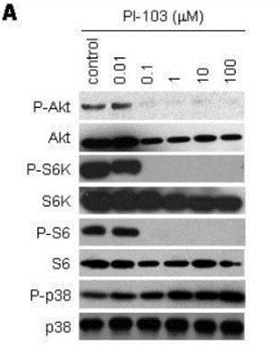
PI-103 potently inhibits both the rapamycin-sensitive (mTORC1) and rapamycin-insensitive (mTORC2) complexes of the protein kinase mTOR. This compound inhibits constitutive and growth factor-induced PI3K/Akt, as well as mTORC1 activation. In blast cells, it inhibits leukemic proliferation, the clonogenicity of leukemic progenitors and induces mitochondrial apoptosis, especially in the compartment containing leukemic stem cells. This chemical inhibits p110α >200-fold more potently than p110β. It also potently blocks production of PI(3,4)P2 and PIP3 in adipocytes and PIP3 in myotubes. This compound inhibits phosphorylation of Akt with an IC95 100-fold lower than that for LY294002. Strikingly, it completely protects animals from stimulated decline in blood glucose. It has additive proapoptotic effects in blast cells and in immature leukemic cells. |
| Kinase Assay |
Enzyme Assays
|
|
Phosphatidylinositide 3-kinase inhibitory activity was determined using a scintillation proximity assay in the presence of 1 μmol/L ATP. Inhibition of mTOR protein kinase was determined using a TR-FRET-based LanthaScreen method from Invitrogen. This compound was assayed at a maximum concentration of 10 μmol/L in the presence of 1 μmol/L ATP, and IC50 values were determined using GraphPad Prism software.
|
|
| In vivo |
When tumors reach 50-100 mm3, animals are randomized and treated with vehicle or PI-103. This compound exhibits significant activity, decreasing average tumor size by 4-fold after 18 days. Mice treated with this chemical have no obvious signs of toxicity premorbidly (based on body weight, food and water intake, activity, and general exam) or at necropsy. Treated tumors display decreased levels of phosphorylated Akt and S6, consistent with blockade of p110α and mTOR. This treatment is cytostatic to glioma xenografts. |
References |
|
Applications
| Methods | Biomarkers | Images | PMID |
|---|---|---|---|
| Western blot | p-AKT / AKT / p-S6K / S6K / p-S6 / S6 / p-p38 / p38 p-GSK3 / GSK3 / p-BAD / BAD / p-MDM2 / MDM2 / p-p27 / p27 β-TrCP1 / p-mTOR |
|
18922908 |
| Immunofluorescence | autophagosomes / autolysosomes |
|
26814436 |
| Growth inhibition assay | Cell viability |
|
25721419 |
Tech Support
Tel: +1-832-582-8158 Ext:3
If you have any other enquiries, please leave a message.
Signaling Pathway Map

Products are for research use only. Not for human use. We do not sell to patients.
©Copyright 2013 Selleck Chemicals. All Rights Reserved.