
-
 Australia
-
 Austria
-
 Belgium
-
 Brazil
-
 Canada
-
 China
China
-
 Czech Republic
-
 Denmark
-
 Finland
-
 France
-
 Germany
-
 Greece
-
 Hong Kong
-
 Hungary
-
 Iceland
-
 India
India
-
 Ireland
-
 Israel
-
 Italy
Italy
-
 Japan
Japan
-
 Korea
Korea
-
 Luxembourg
-
 Malaysia
-
 Netherlands
-
 New Zealand
-
 Norway
-
 Poland
-
 Qatar
Qatar
-
 Romania
-
 Saudi Arabia
-
 Singapore
-
 Spain
Spain
-
 Sweden
-
 Switzerland
-
 Taiwan
-
 Turkey
-
 United Kingdom
-
 United States
research use only
JNJ-7706621 Aurora Kinase/CDK Inhibitor
Cat.No.S1249
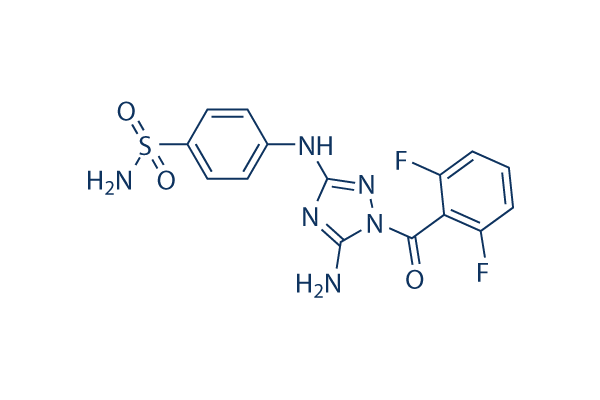
Chemical Structure
Molecular Weight: 394.36
Quality Control
Cell Culture, Treatment & Working Concentration
| Cell Lines | Assay Type | Concentration | Incubation Time | Formulation | Activity Description | PMID |
|---|---|---|---|---|---|---|
| PC3 cells | Function assay | In vitro inhibitory concentration against cell proliferation in human PC-3 (prostate adenocarcinoma) tumor cells, IC50=0.12 μM | ||||
| HCT116 cells | Function assay | In vitro inhibitory concentration against cell proliferation in human HCT116 (colon carcinoma) tumor cells, IC50=0.25 μM | ||||
| human HeLa cells | Function assay | In vitro inhibitory concentration against cell proliferation in human HeLa (cervical adenocarcinoma) tumor cells, IC50=0.28 μM | ||||
| human A375 cells | Proliferation assay | Antiproliferative activity against human A375 cells, IC50=0.447 μM | ||||
| MDA-MB-231 cells | Function assay | In vitro inhibitory concentration against cell proliferation in various human MDA-MB-231 (breast carcinoma) tumor cells, IC50=0.59 μM | ||||
| SK-OV-3 cells | Function assay | In vitro inhibitory concentration against cell proliferation in human SK-OV-3 (ovarian adenocarcinoma) tumor cells, IC50=0.75 μM | ||||
| Click to View More Cell Line Experimental Data | ||||||
Solubility
|
In vitro |
DMSO
: 79 mg/mL
(200.32 mM)
Ethanol : 3 mg/mL Water : Insoluble |
Molarity Calculator
|
In vivo |
|||||
In vivo Formulation Calculator (Clear solution)
Step 1: Enter information below (Recommended: An additional animal making an allowance for loss during the experiment)
Step 2: Enter the in vivo formulation (This is only the calculator, not formulation. Please contact us first if there is no in vivo formulation at the solubility Section.)
Calculation results:
Working concentration: mg/ml;
Method for preparing DMSO master liquid: mg drug pre-dissolved in μL DMSO ( Master liquid concentration mg/mL, Please contact us first if the concentration exceeds the DMSO solubility of the batch of drug. )
Method for preparing in vivo formulation: Take μL DMSO master liquid, next addμL PEG300, mix and clarify, next addμL Tween 80, mix and clarify, next add μL ddH2O, mix and clarify.
Method for preparing in vivo formulation: Take μL DMSO master liquid, next add μL Corn oil, mix and clarify.
Note: 1. Please make sure the liquid is clear before adding the next solvent.
2. Be sure to add the solvent(s) in order. You must ensure that the solution obtained, in the previous addition, is a clear solution before proceeding to add the next solvent. Physical methods such
as vortex, ultrasound or hot water bath can be used to aid dissolving.
Chemical Information, Storage & Stability
| Molecular Weight | 394.36 | Formula | C15H12F2N6O3S |
Storage (From the date of receipt) | |
|---|---|---|---|---|---|
| CAS No. | 443797-96-4 | Download SDF | Storage of Stock Solutions |
|
|
| Synonyms | N/A | Smiles | C1=CC(=C(C(=C1)F)C(=O)N2C(=NC(=N2)NC3=CC=C(C=C3)S(=O)(=O)N)N)F | ||
Mechanism of Action
| Features |
A broad-spectrum inhibitor.
|
|---|---|
| Targets/IC50/Ki |
CDK2/CyclinE
(Cell-free assay) 3 nM
CDK2/CyclinA
(Cell-free assay) 4 nM
CDK1/CyclinB
(Cell-free assay) 9 nM
Aurora A
(Cell-free assay) 11 nM
Aurora B
(Cell-free assay) 15 nM
CDK3/CyclinE
(Cell-free assay) 58 nM
VEGFR2
(Cell-free assay) 154 nM
CDK6/CyclinD1
(Cell-free assay) 175 nM
FGFR2
(Cell-free assay) 226 nM
CDK4/CyclinD1
(Cell-free assay) 253 nM
GSK-3β
(Cell-free assay) 254 nM
Tie-2
(Cell-free assay) 465 nM
FGFR1
(Cell-free assay) 575 nM
VEGFR3
(Cell-free assay) 735 nM
|
| In vitro |
JNJ-7706621 also shows some inhibition to VEGF-R2, FGF-R2, and GSK3β, with IC50 of 154-254 nM. This compound shows inhibitory effect on a panel of human cancer cell types, including HeLa, HCT-116, SK-OV-3, PC3, DU145, A375, MDA-MB-231, MES-SA, and MES-SA/Dx5, with IC50 of 112-514 nM, independent of p53, retinoblastoma, or P-glycoprotein status. It is several-fold less potent at inhibiting growth of normal cell types, including MRC-5, HASMC, HUVEC, and HMVEC, with IC50 of 3.67-5.42 μM. In HeLa or U937 cells, this chemical (0.5-3 μM) delays exit from G1, arrests cells in G2-M, induces endoreduplication, activates apoptosis, and reduces colony formation. In a HeLa cell line, incremental treatment with increasing concentrations of this compound leads to a 16-fold resistance, which may be mediated by ABCG2.
|
| Kinase Assay |
In vitro kinase assay for CDK1 and Aurora kinases
|
|
For CDK1 kinase activity, a method is developed using the CDK1/cyclin B complex purified from baculovirus to phosphorylate a biotinylated peptide substrate containing the consensus phosphorylation site for histone H1, which is phosphorylated in vivo by CDK1. Inhibition of CDK1 activity is measured by observing a reduced amount of 33P-γ-ATP incorporation into the immobilized substrate in streptavidin-coated 96-well scintillating microplates. CDK1 enzyme is diluted in 50 mM Tris-HCl (pH 8), 10 mM MgCl2, 0.1 mM Na3VO 4, 1 mM DTT, 1% DMSO, 0.25 μM peptide, 0.1 μCi per well 33P-γ-ATP, and 5 μM ATP in the presence or absence of various concentrations of this compound and incubated at 30 °C for 1 hour. The reaction is terminated by washing with PBS containing 100 mM EDTA and plates are counted in a scintillation counter. Linear regression analysis of the percent inhibition by this chemical is used to determine IC50. The Aurora kinase assays are done with 10 μM ATP and a peptide containing a dual repeat of the kemptide phosphorylation motif.
|
|
| In vivo |
In mouse xenograft model of A375 melanoma human tumor, JNJ-7706621 (100 or 125 mg/kg) causes tumor regression.
|
References |
|
Tech Support
Tel: +1-832-582-8158 Ext:3
If you have any other enquiries, please leave a message.
Signaling Pathway Map

Products are for research use only. Not for human use. We do not sell to patients.
©Copyright 2013 Selleck Chemicals. All Rights Reserved.