
-
 Argentina
-
 Australia
-
 Austria
-
 Belgium
-
 Brazil
-
 Canada
-
 China
China
-
 Czech Republic
-
 Denmark
-
 Finland
-
 France
-
 Germany
-
 Greece
-
 Hong Kong
-
 Hungary
-
 Iceland
-
 India
India
-
 Ireland
-
 Israel
-
 Italy
Italy
-
 Japan
Japan
-
 Korea
Korea
-
 Luxembourg
-
 Malaysia
-
 Netherlands
-
 New Zealand
-
 Norway
-
 Poland
-
 Portugal
-
 Qatar
Qatar
-
 Romania
-
 Saudi Arabia
-
 Singapore
-
 Spain
Spain
-
 Sweden
-
 Switzerland
-
 Taiwan
-
 Turkey
-
 United Kingdom
-
 United States
Sirtuin Activators/Inhibitors
Other DNA Damage/DNA Repair Related Inhibitors
| Cat.No. | Product Name | Information | Product Use Citations | Product Validations |
|---|---|---|---|---|
| S2935 | Nicotinamide Riboside Chloride (NR-Cl) | Nicotinamide Riboside Chloride is the chloride salt form of nicotinamide riboside(NR).NR is a new form pyridine-nucleoside of vitamin B3 that functions as a precursor to nicotinamide adenine dinucleotide(NAD) or NAD+ . Nicotinamide riboside chloride is a crystal form of Nicotinamide riboside (NR) chloride. Nicotinamide riboside chloride increases NAD[+] levels and activates SIRT1 and SIRT3, culminating in enhanced oxidative metabolism and protection against high fat diet-induced metabolic abnormalities. Nicotinamide riboside chloride is used in dietary supplements. |
|
|
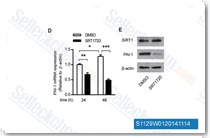
| S1129 | SRT 1720 Hydrochloride | SRT1720 HCl is a selective SIRT1 activator with EC50 of 0.16 μM in a cell-free assay, but is >230-fold less potent for SIRT2 and SIRT3. SRT1720 induces autophagy. |
|
|
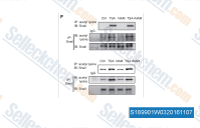
| S1899 | Nicotinamide (Niacinamide) | Nicotinamide, a water-soluble vitamin, is an active component of coenzymes NAD and NADP, and also act as an inhibitor of sirtuins. |
|
|
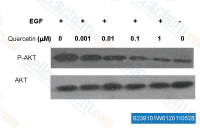
| S2391 | Quercetin (Sophoretin) | Quercetin, a natural flavonoid present in vegetables, fruit and wine, is a stimulator of recombinant SIRT1 and also a PI3K inhibitor with IC50 of 2.4-5.4 μM. Quercetin induces mitophagy, apoptosis and protective autophagy. Phase 4. |
|
|
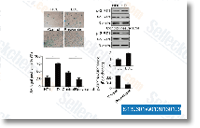
| S1396 | Resveratrol (trans-Resveratrol) | Resveratrol has a wide spectrum of targets including cyclooxygenases(i.e. COX, IC50=1.1 μM), lipooxygenases(LOX, IC50=2.7 μM), kinases, sirtuins and other proteins. It has anti-cancer, anti-inflammatory, blood-sugar-lowering and other beneficial cardiovascular effects. Resveratrol induces mitophagy/autophagy and autophagy-dependent apoptosis. |
|
|
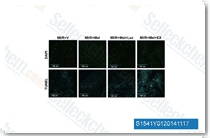
| S1541 | Selisistat (EX-527) | Selisistat (EX 527, SEN0014196) is a potent and selective SIRT1 inhibitor with IC50 of 38 nM in a cell-free assay, exhibits >200-fold selectivity against SIRT2 and SIRT3. Phase 2. |
|
|
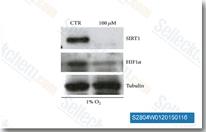
| S2804 | Sirtinol | Sirtinol is a specific SIRT1 and SIRT2 inhibitor with IC50 of 131 μM and 38 μM in cell-free assays, respectively. |
|
|
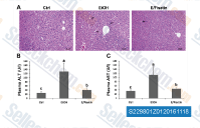
| S2298 | Fisetin | Fisetin (Fustel) is a potent sirtuin activating compound (STAC) and an agent that modulates sirtuins. |
|
|
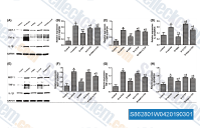
| S8628 | 3-TYP | 3-TYP (3-(1H-1,2,3-triazol-4-yl) pyridine) is a selective SIRT3 inhibitor which is selective for Sirt3 over Sirt1 and Sirt2. The IC50 values for SITR1, SIRT2, SIRT3 are 88 nM, 92 nM, 16 nM respectively. |
|
|
| S7577 | AGK2 | AGK2 is a potent, and selective SIRT2 inhibitor with IC50 of 3.5 μM that minimally affects either SIRT1 or SIRT3 at 10-fold higher levels. |
|
|
Signaling Pathway Map

Products are for research use only. Not for human use. We do not sell to patients.
©Copyright 2013 Selleck Chemicals. All Rights Reserved.