
-
 Argentina
-
 Australia
-
 Austria
-
 Belgium
-
 Brazil
-
 Canada
-
 China
China
-
 Czech Republic
-
 Denmark
-
 Finland
-
 France
-
 Germany
-
 Greece
-
 Hong Kong
-
 Hungary
-
 Iceland
-
 India
India
-
 Ireland
-
 Israel
-
 Italy
Italy
-
 Japan
Japan
-
 Korea
Korea
-
 Luxembourg
-
 Malaysia
-
 Netherlands
-
 New Zealand
-
 Norway
-
 Poland
-
 Portugal
-
 Qatar
Qatar
-
 Romania
-
 Saudi Arabia
-
 Singapore
-
 Spain
Spain
-
 Sweden
-
 Switzerland
-
 Taiwan
-
 Turkey
-
 United Kingdom
-
 United States
Sirtuin Activators
| Cat.No. | Product Name | Information | Product Use Citations | Product Validations |
|---|---|---|---|---|
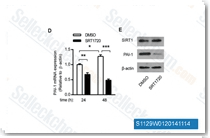
| S1129 | SRT 1720 Hydrochloride | SRT1720 HCl is a selective SIRT1 activator with EC50 of 0.16 μM in a cell-free assay, but is >230-fold less potent for SIRT2 and SIRT3. SRT1720 induces autophagy. |
|
|
| S7792 | SRT2104 (GSK2245840) | SRT2104 (GSK2245840) is a selective SIRT1 activator involved in the regulation of energy homeostasis and is currently in Phase 2. |
|
|
| S8270 | SRT2183 | SRT2183 is a small-molecule activator of the sirtuin subtype SIRT1, currently being developed by Sirtris Pharmaceuticals. |
|
|
| S2935 | Nicotinamide Riboside Chloride (NR-Cl) | Nicotinamide Riboside Chloride is the chloride salt form of nicotinamide riboside(NR).NR is a new form pyridine-nucleoside of vitamin B3 that functions as a precursor to nicotinamide adenine dinucleotide(NAD) or NAD+ . Nicotinamide riboside chloride is a crystal form of Nicotinamide riboside (NR) chloride. Nicotinamide riboside chloride increases NAD[+] levels and activates SIRT1 and SIRT3, culminating in enhanced oxidative metabolism and protection against high fat diet-induced metabolic abnormalities. Nicotinamide riboside chloride is used in dietary supplements. |
|
|
| S4735 | Salvianolic acid B | Salvianolic acid B (Sal B, Lithospermate B, Lithospermic acid B), an antioxidant and free radical scavenging compound, is the most abundant bioactive compound extracted from the root of Salvia miltiorrhiza Bunge. |
|
|
| S8481 | SRT3025 HCl | SRT3025 is an orally available small molecule activator of the SIRT1 enzyme. |
|
|
| S8909 | UBCS039 | UBCS039 is the first synthetic SIRT6 activator with EC50 of 38 μM, induces a time-dependent activation of autophagy in several human tumor cell lines. |
|
|
| S5918 | CAY10602 | CAY10602 is a potent SIRT1 activator. |
|
|
| E8162 | Nicotinamide riboside | Nicotinamide riboside is an orally active NAD(+) precursor essential for cellular energy and metabolic functions. It Supplementation increases NAD(+) levels, activating sirtuins like SIRT1 and SIRT3, which improve oxidative metabolism and provide protection against metabolic issues induced by a high-fat diet. It also helps to reduce cognitive decline in a transgenic mouse model of Alzheimer's disease. |
|
|
| S3262 | Scopolin | Scopolin, a coumarin isolated from Arabidopsis thaliana (Arabidopsis), attenuates hepatic steatosis through activation of SIRT1-mediated signaling cascades, a potent regulator of lipid homeostasis. | ||
| E5988 | SKLB-11A | SKLB-11A is a selective, first-in-class allosteric activator of SIRT3 that binds with a Kd of 4.7 μM and enhances its deacetylase activity with EC50 of 21.95 μM. It improves cardiac function and alleviates myocardial damage in vivo. | ||
| E0394 | YK 3-237 | YK-3-237, a SIRT1 activator, reduces acetylation of mutant p53 and inhibits the proliferation of triple-negative breast cancer cells. | ||
| E5907 | 2-APQC | 2-APQC is a potent activator of SIRT3 with a Kd value of 2.756 μM. It alleviates myocardial hypertrophy and fibrosis by regulating mitochondrial homeostasis, exhibiting promising cardioprotective potential in vitro and in vivo. It may serve as a potential candidate for future heart failure (HF) therapeutics. | ||
| S6880 | SRT-1460 | SRT-1460 is a potent and selective activator of Sirtuin 1 (SIRT1) with EC1.5 of 2.9 μM. This compound reduces cell viability and growth of pancreatic cancer cells and induces apoptosis. | ||
| E6635 New | MC3138 | MC3138 is a selective activator of SIRT5 and inhibits proliferation in SIRT5-low PDAC cell lines and organoids by restoring SIRT5-mediated desuccinylation and deacetylation. | ||
| E1267 | MDL-800 | MDL 800 is an allosteric activator of sirtuin 6 (SIRT6). It selectively activates SIRT6 deacetylase activity over SIRT1-5 and -7 and histone deacetylase 1 (HDAC1) and HDAC2-11 deacetylase activity in cell-free assays at 100 µM. It induces histone deacetylation, and reduces proliferation of BEL-7405 hepatocellular carcinoma (HCC) cells with EC50 of 90.4 µM. | ||
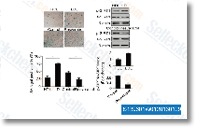
| S1396 | Resveratrol (trans-Resveratrol) | Resveratrol has a wide spectrum of targets including cyclooxygenases(i.e. COX, IC50=1.1 μM), lipooxygenases(LOX, IC50=2.7 μM), kinases, sirtuins and other proteins. It has anti-cancer, anti-inflammatory, blood-sugar-lowering and other beneficial cardiovascular effects. Resveratrol induces mitophagy/autophagy and autophagy-dependent apoptosis. |
|
|
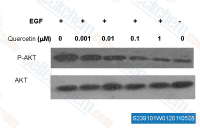
| S2391 | Quercetin (Sophoretin) | Quercetin, a natural flavonoid present in vegetables, fruit and wine, is a stimulator of recombinant SIRT1 and also a PI3K inhibitor with IC50 of 2.4-5.4 μM. Quercetin induces mitophagy, apoptosis and protective autophagy. Phase 4. |
|
|
| S3168 | cis-Resveratrol | cis-Resveratrol (cis-RESV, cRes, (Z)-Resveratrol) is the Cis isomer of Resveratrol. Resveratrol is a natural phenolic compound with anti-oxidant, anti-inflammatory, cardioprotective, and anti-cancer properties. Resveratrol is an inhibitor of pregnane X receptor (PXR) and an activator of Nrf2 and SIRT1 and may induce apoptosis. Resveratrol also inhibits a wide spectrum of targets including 5-lipoxygenase (LOX), cyclooxygenase (COX), IKKβ, DNA polymerases α and δ with IC50 of 2.7 μM, <1 μM, 1 μM, 3.3 μM and 5 μM, respectively. |
|
|

Products are for research use only. Not for human use. We do not sell to patients.
©Copyright 2013 Selleck Chemicals. All Rights Reserved.