
-
 Argentina
-
 Australia
-
 Austria
-
 Belgium
-
 Brazil
-
 Canada
-
 China
China
-
 Czech Republic
-
 Denmark
-
 Finland
-
 France
-
 Germany
-
 Greece
-
 Hong Kong
-
 Hungary
-
 Iceland
-
 India
India
-
 Ireland
-
 Israel
-
 Italy
Italy
-
 Japan
Japan
-
 Korea
Korea
-
 Luxembourg
-
 Malaysia
-
 Netherlands
-
 New Zealand
-
 Norway
-
 Poland
-
 Portugal
-
 Qatar
Qatar
-
 Romania
-
 Saudi Arabia
-
 Singapore
-
 Spain
Spain
-
 Sweden
-
 Switzerland
-
 Taiwan
-
 Turkey
-
 United Kingdom
-
 United States
HSP Inhibitors
| Cat.No. | Product Name | Information | Product Use Citations | Product Validations |
|---|---|---|---|---|
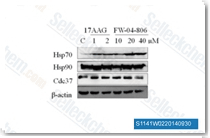
| S1141 | Tanespimycin (17-AAG) | Tanespimycin (17-AAG, CP127374, NSC-330507, KOS 953) is a potent HSP90 inhibitor with IC50 of 5 nM in a cell-free assay, having a 100-fold higher binding affinity for HSP90 derived from tumour cells than HSP90 from normal cells. Tanespimycin (17-AAG) induces apoptosis, necrosis, autophagy and mitophagy. Phase 3. |
|
|
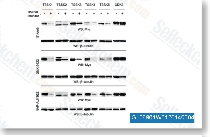
| S1069 | Luminespib (NVP-AUY922) | Luminespib (AUY-922, NVP-AUY922, VER-52296) is a highly potent HSP90 inhibitor for HSP90α/β with IC50 of 13 nM /21 nM in cell-free assays, weaker potency against the HSP90 family members GRP94 and TRAP-1, exhibits the tightest binding of any small-molecule HSP90 ligand. Luminespib (AUY-922, NVP-AUY922) effectively downregulates and destabilizes the IGF-1Rβ protein and results in growth inhibition, autophagy and apoptosis. Phase 2. |
|
|
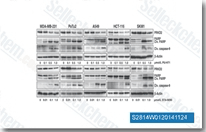
| S1159 | Ganetespib (STA-9090) | Ganetespib (STA-9090) is an HSP90 inhibitor with IC50 of 4 nM in OSA 8 cells, induces apoptosis of OSA cells while normal osteoblasts are not affected; active metabolite of STA-1474. Phase 3. |
|
|
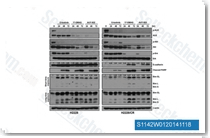
| S1142 | Alvespimycin (17-DMAG) Hydrochloride | Alvespimycin (17-DMAG, NSC 707545, BMS 826476, KOS 1022) HCl is a potent HSP90 inhibitor with IC50 of 62 nM in a cell-free assay. |
|
|
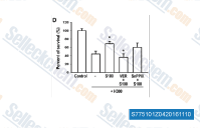
| S7751 | VER-155008 | VER155008 is a potent Hsp70 family inhibitor with IC50 of 0.5 μM, 2.6 μM, and 2.6 μM in cell-free assays for HSP70, HSC70, and GRP78 (HSPA5, Bip), respectively, >100-fold selectivity over HSP90. VER155008 inhibits autophagy and causes reduced levels of HSP90 client proteins. |
|
|
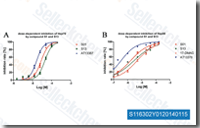
| S1163 | Onalespib (AT13387) | Onalespib (AT13387) is a selective potent Hsp90 inhibitor with IC50 of 18 nM in A375 cells, displays a long duration of anti-tumor activity. Phase 2. |
|
|
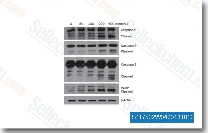
| S1175 | BIIB021 | BIIB021 (CNF2024) is an orally available, fully synthetic small-molecule inhibitor of HSP90 with Ki and EC50 of 1.7 nM and 38 nM, respectively. Phase 2. |
|
|
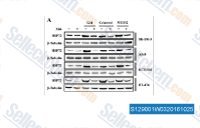
| S1290 | Celastrol (Tripterine) | Celastrol is a potent proteasome inhibitor for the chymotrypsin-like activity of a purified 20S proteasome with IC50 of 2.5 μM. Celastrol induces apoptosis and autophagy via the ROS/JNK signaling pathway. Celastrol inhibits dopaminergic neuronal death of Parkinson's disease through activating mitophagy. |
|
|
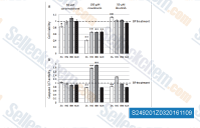
| S2492 | Novobiocin Sodium (Cathomycin, Albamycin) | Novobiocin Sodium (NSC 2382, Albamycin, Cathomycin) is an aminocoumarin antibiotic that targets bacterial DNA gyrase (TopoIV), used to treat susceptible gram positive bacteria. |
|
|
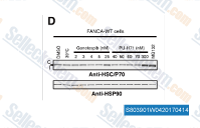
| S8039 | Zelavespib (PU-H71) | Zelavespib (PU-H71, NSC 750424) is a potent and selective inhibitor of HSP90 with IC50 of 51 nM. This compound is in Phase 1. |
|
|
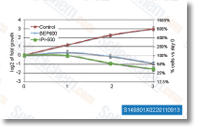
| S1498 | NVP-BEP800 | NVP-BEP800 (VER82576) is a novel, fully synthetic HSP90β inhibitor with IC50 of 58 nM, exhibits>70-fold selectivity against Hsp90 family members Grp94 and Trap-1. |
|
|
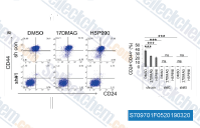
| S7097 | HSP990 (NVP-HSP990) | HSP990 (NVP-HSP990) is a novel, potent and selective HSP90 inhibitor for HSP90α/β with IC50 of 0.6 nM/0.8 nM, and it induces cell cycle arrest and apoptosis. |
|
|
| S8402 | KRIBB11 | KRIBB11 abolishes the heat shock-induced luciferase activity with an IC50 of 1.2 μM. It is an inhibitor of the transcription factor Heat Shock Factor 1 (HSF1). This compound induces growth arrest and apoptosis. |
|
|
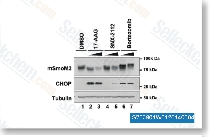
| S2639 | SNX-2112 | SNX-2112 selectively binds to the ATP pocket of HSP90α and HSP90β with Ka of 30 nM and 30 nM, uniformly more potent than 17-AAG. |
|
|
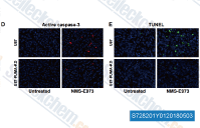
| S7282 | NMS-E973 | NMS-E973 is a potent and selective Hsp90 inhibitor with DC50 of <10 nM for Hsp90 binding, no activiy against a panel of 52 diverse protein kinases. |
|
|
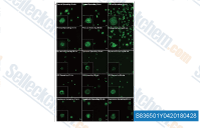
| S8365 | Apoptozole | Apoptozole (Apoptosis Activator VII) is an inhibitor of heat shock protein 70(HSP70) and Hsc70 with dissociation constants Kd of 0.14 μM and 0.21 μM, respectively. It induces caspase-dependent apoptosis. |
|
|
| S7716 | TAS-116 (Pimitespib) | Pimitespib (TAS-116) is a novel, small-molecule HSP90 inhibitor which inhibits geldanamycin-FITC binding to HSP90 proteins with Ki values of 34.7 nmol/L, 21.3 nmol/L, >50,000 nmol/L, and >50,000 nmol/L for HSP90α, HSP90β, GRP94, and TRAP1, respectively. Furthermore, TAS-116 does not inhibit other ATPases such as HSP70 (IC50 >200 μmol/L). |
|
|
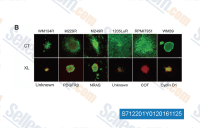
| S7122 | XL888 | XL888 is an ATP-competitive inhibitor of HSP90 with IC50 of 24 nM. Phase 1. |
|
|
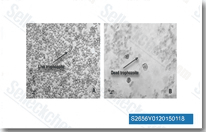
| S2656 | PF-04929113 (SNX-5422) | PF-04929113 (SNX-5422) is a potent and selective HSP90 inhibitor with Kd of 41 nM. This compound induces Her-2 degradation with IC50 of 37 nM and is in Phase 1/2. |
|
|
| S7428 | Rocaglamide | Rocaglamide (Roc-A), isolated from Aglaia species, is a potent inhibitor of heat shock factor 1 (HSF1) activation with IC50 of ~50 nM for HSF1. This compound inhibits the function of the translation initiation factor eIF4A. It also inhibits NF-κB activity. This chemical exhibits anti-tumor activity. |
|
|
| S9806 | DTHIB | DTHIB (Direct Targeted HSF1 InhiBitor) is a direct and selective inhibitor of heat shock factor 1 (HSF1) with Kd of 160 nM for this compound binding to the HSF1 DNA binding domain (DBD). This compound exhibits potently anticancer activities. |
|
|
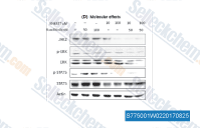
| S7750 | KNK437 | KNK437 is a pan-HSP inhibitor, which inhibits the synthesis of inducible HSPs, including HSP105, HSP72, and HSP40. |
|
|
| S6721 | JG98 | JG-98 is an allosteric inhibitor of Hsp70 that binds tightly to a deep pocket that is conserved in members of the Hsp70 family. JG-98 induces classical apoptosis features, including morphological changes consistent with programmed cell death and positive annexin staining. JG-98 exhibits anticancer activity. |
|
|
| S7458 | VER-49009 | VER-49009 (CCT0129397) is a potent HSP90 inhibitor with IC50 of 47 nM for HSP90β. |
|
|
| S7459 | VER-50589 | VER-50589 is a potent HSP90 inhibitor with IC50 of 21 nM for HSP90β. |
|
|
| S2685 | KW-2478 | KW-2478 is a nonansamycin HSP90 inhibitor with IC50 of 3.8 nM. Phase 1. |
|
|
| S7340 | CH5138303 | CH5138303 is an orally available Hsp90 inhibitor with Kd of 0.48 nM. |
|
|
| S6193 | YUM70 | YUM70 is a potent inhibitor of glucose-regulated protein 78 (GRP78) inhibitor with an IC50 of 1.5 μM. This compound induces endoplasmic reticulum (ER) stress-mediated apoptosis in pancreatic cancer.Although this chemical inhibits GRP78 enzymatic activity, it increases the expression of GRP78 by increasing the chaperone translation mechanism. |
|
|
| S3404 | HSP27 inhibitor J2 | HSP27 inhibitor J2 (J2) is an inhibitor of HSP27, which induces abnormal HSP27 dimers formation and suppresses the generation of HSP27 giant polymers, inhibiting the chaperone role of HSP27 and diminishing its cellular protective function. This compound enhances the antiproliferative activity of 17-AAG and increases the sensitivity of cisplatin-induced lung cancer cell growth inhibition. |
|
|
| E0249 | Pseudolaric Acid A | Pseudolaric acid A, a Hsp90 inhibitor with an IC50 of 0.60 μM, 2.72 μM, 1.36 μM, 2.92 μM and 6.16 μM in HL-60, A549, SMMC-7721, HeLa and SW480 cells respectively, is the main bioactive ingredient in Pseudolarix cortex, and induces cell cycle arrest at G2/M phase and promotes cell death through caspase-8/caspase-3 pathway, demonstrating potent antiproliferation and anticancer activities. | ||
| E5996 | Col003 | Col003 is a potent inhibitor of Hsp47 that competitively binds to the collagen-binding site on Hsp47 and inhibited the interaction between Hsp47 and collagen with an IC50 of 1.8 μM. It can be used in research as a potential lead compound for the treatment of fibrosis. | ||
| E1208 | NPX800 | NPX800 is a potent heat shock factor 1 (HSF1) inhibitor, which has the potential for cancer research. | ||
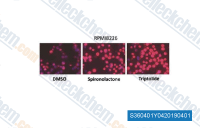
| S3604 | Triptolide | Triptolide is a diterpene triepoxide, immunosuppresive agent extracted from the Chinese herb Tripterygium wilfordii. It functions as a NF-κB inhibitor with dual actions by disruption of p65/CBP interaction and by reduction of p65 protein. Triptolide (PG490) abrogates the transactivation function of heat shock transcription factor 1 (HSF1). Triptolide inhibits MDM2 and induces apoptosis through a p53-independent pathway. |
|
|
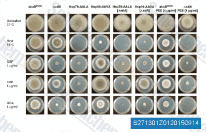
| S2713 | Geldanamycin (NSC 122750) | Geldanamycin is a natural existing HSP90 inhibitor with Kd of 1.2 μM, specifically disrupts glucocorticoid receptor (GR)/HSP association. Geldanamycin attenuates virus infection-induced ALI (acute lung injury)/ARDS (acute respiratory distress syndrome) by reducing the host's inflammatory responses. |
|
|
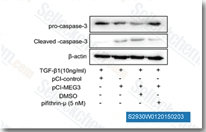
| S2930 | Pifithrin-μ | Pifithrin-μ (NSC 303580, PFTμ, 2-Phenylethynesulfonamide) is a specific p53 inhibitor by reducing its affinity to Bcl-xL and Bcl-2, and this compound also inhibits HSP70 function and autophagy. |
|
|
| S8068 | Chaetocin | Chaetocin, a natural product from Chaetomium species, is a histone methyltransferase inhibitor with IC50 of 0.8 μM, 2.5 μM and 3 μM for dSU(VAR)3-9, mouse G9a and Neurospora crassa DIM5, respectively. Chaetocin is an anticancer agent and inhibitor of thioredoxin reductase (TrxR). |
|
|
| E4678 | EZH2/HSP90-IN-29 | EZH2/HSP90-IN-29 is a potent dual inhibitor of EZH2 and HSP90, with IC50s of 6.29 nM and 60.1 nM, for EZH2 and HSP90, respectively, that induces M-phase cell cycle arrest, promotes apoptosis/necrosis-related gene expression, and inhibits ROS catabolism. It crosses the blood-brain barrier and can show potential as a tractable anti-GBM agent for glioblastoma research. | ||

Products are for research use only. Not for human use. We do not sell to patients.
©Copyright 2013 Selleck Chemicals. All Rights Reserved.