
-
 Argentina
-
 Australia
-
 Austria
-
 Belgium
-
 Brazil
-
 Canada
-
 China
China
-
 Czech Republic
-
 Denmark
-
 Finland
-
 France
-
 Germany
-
 Greece
-
 Hong Kong
-
 Hungary
-
 Iceland
-
 India
India
-
 Ireland
-
 Israel
-
 Italy
Italy
-
 Japan
Japan
-
 Korea
Korea
-
 Luxembourg
-
 Malaysia
-
 Netherlands
-
 New Zealand
-
 Norway
-
 Poland
-
 Qatar
Qatar
-
 Romania
-
 Saudi Arabia
-
 Singapore
-
 Spain
Spain
-
 Sweden
-
 Switzerland
-
 Taiwan
-
 Turkey
-
 United Kingdom
-
 United States
research use only
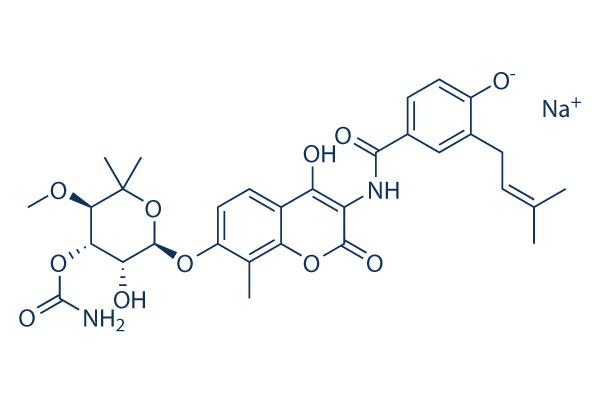
Novobiocin Sodium (Cathomycin, Albamycin) Hsp90 C-terminal Inhibitor
Cat.No.S2492
Quality Control
Cell Culture, Treatment & Working Concentration
| Cell Lines | Assay Type | Concentration | Incubation Time | Formulation | Activity Description | PMID |
|---|---|---|---|---|---|---|
| MCF7-MX | Function assay | TP_TRANSPORTER: inhibition of mitoxantrone efflux in BCRP-expressing MCF7-MX cells, IC50=25μM | 16460798 | |||
| MELN | Function assay | 200 uM | 18 hrs | Inhibition of estradiol-induced ER-mediated transcription in MELN cells by measuring luciferase activity at 200 uM after 18 hrs | 17979263 | |
| SH-SY5Y | Neuroprotection assay | Neuroprotection against beta-amyloid peptide 1-42-induced toxicity in human SH-SY5Y cells assessed as lactate dehydrogenase release, EC50=0.04839μM | 19138859 | |||
| SH-SY5Y | Neuroprotection assay | 10 nM | Neuroprotection against beta-amyloid peptide 1-42-induced toxicity in retinoic acid-differentiated human SH-SY5Y cells assessed as lactate dehydrogenase release at 10 nM | 19138859 | ||
| SH-SY5Y | Neuroprotection assay | Neuroprotection against beta-amyloid peptide 1-42-induced toxicity in retinoic acid-differentiated human SH-SY5Y cells assessed as lactate dehydrogenase release | 19138859 | |||
| LNCaP-LN3 | Antiproliferative assay | Antiproliferative activity against human LNCaP-LN3 cells, IC50=1.05μM | 21129982 | |||
| yeast PP30 | Function assay | 100 uM | 3 hrs | Inhibition of human HSP90alpha expressed in yeast PP30 cells co-expressing HSF-lacZ reporter assessed as inhibition of heat stress-induced response at 100 uM after 3 hrs | 21129982 | |
| Sf9 | Function assay | Inhibition of Escherichia coli His6-tagged ParC/ParE expressed in baculovirus-infected Sf9 cells by gel electrophoresis, IC50=0.21μM | 21235241 | |||
| SKBR3 | Function assay | 1000 uM | 18 hrs | Inhibition of HSP90 in human SKBR3 cells assessed as aggregation of intracellular HER2 at 1000 uM after 18 hrs by DAPI staining-based immunofluorescence microscopic analysis | 23859777 | |
| BL21 (DE3) pLysS | Function assay | 100 mins | Inhibition of 6-His-tagged Mycobacterium smegmatis GyrB expressed in Escherichia coli BL21 (DE3) pLysS cells incubated for 100 mins in presence of ATP by malachite green dye based ATP assay, IC50=0.18μM | 25129171 | ||
| BL21 (DE3) pLysS | Function assay | 100 mins | Inhibition of Mycobacterium smegmatis GyrB ATPase activity expressed in Escherichia coli BL21 (DE3) pLysS cells after 100 mins by inorganic phosphate release detection based malachite green reagent assay, IC50=0.18μM | 25801151 | ||
| BL21 (DE3) pLysS | Function assay | 100 mins | Inhibition of Mycobacterium smegmatis DNA gyrase B expressed in Escherichia coli BL21 (DE3) pLysS cells assessed as reduction in ATPase activity incubated for 100 mins by inorganic phosphate detection assay, IC50=0.18μM | 26318054 | ||
| BL21 (DE3) pLysS | Function assay | 120 mins | Inhibition of Mycobacterium smegmatis 155 6His-tagged DNA gyrase B catalytic domain ATPase activity expressed in Escherichia coli BL21 (DE3) pLysS cells assessed as inorganic phosphate release after 120 mins in presence of ATP by malachite green dye based, IC50=0.046μM | 27371925 | ||
| Click to View More Cell Line Experimental Data | ||||||
Solubility
|
In vitro |
DMSO
: 100 mg/mL
(157.57 mM)
Water : 100 mg/mL Ethanol : 100 mg/mL |
Molarity Calculator
|
In vivo |
|||||
In vivo Formulation Calculator (Clear solution)
Step 1: Enter information below (Recommended: An additional animal making an allowance for loss during the experiment)
Step 2: Enter the in vivo formulation (This is only the calculator, not formulation. Please contact us first if there is no in vivo formulation at the solubility Section.)
Calculation results:
Working concentration: mg/ml;
Method for preparing DMSO master liquid: mg drug pre-dissolved in μL DMSO ( Master liquid concentration mg/mL, Please contact us first if the concentration exceeds the DMSO solubility of the batch of drug. )
Method for preparing in vivo formulation: Take μL DMSO master liquid, next addμL PEG300, mix and clarify, next addμL Tween 80, mix and clarify, next add μL ddH2O, mix and clarify.
Method for preparing in vivo formulation: Take μL DMSO master liquid, next add μL Corn oil, mix and clarify.
Note: 1. Please make sure the liquid is clear before adding the next solvent.
2. Be sure to add the solvent(s) in order. You must ensure that the solution obtained, in the previous addition, is a clear solution before proceeding to add the next solvent. Physical methods such
as vortex, ultrasound or hot water bath can be used to aid dissolving.
Chemical Information, Storage & Stability
| Molecular Weight | 634.61 | Formula | C31H35N2O11.Na |
Storage (From the date of receipt) | |
|---|---|---|---|---|---|
| CAS No. | 1476-53-5 | Download SDF | Storage of Stock Solutions |
|
|
| Synonyms | Albamycin,Cathomycin,NSC 2382 | SMILES | CC1=C(C=CC2=C1OC(=O)C(=C2O)NC(=O)C3=CC(=C(C=C3)[O-])CC=C(C)C)OC4C(C(C(C(O4)(C)C)OC)OC(=O)N)O.[Na+] | ||
Read more about storage stability stock solution CAS number SMILES
Mechanism of Action
| Targets/IC50/Ki |
Topoisomerase II
Topoisomerase IV
|
|---|---|
| In vitro |
Novobiocin also interacts with Hsp90, altering the affinity of the chaperone for geldanamycin and radicicol and causing in vitro and in vivo depletion of key regulatory Hsp90-dependent kinases including v-Src, Raf-1, and p185(ErbB2). Novobiocin interferes with association of the co-chaperones Hsc70 and p23 with Hsp90. Novobiocin specifically inhibits the maturation of the heme-regulated eIF2alpha kinase (HRI) in a concentration-dependent manner. Novobiocin induces the dissociation of Hsp90 and Cdc37 from immature HRI, while the Hsp90 cochaperones p23, FKBP52, and protein phosphatase 5 remained associated with immature HRI. Novobiocin causes morphological and biochemical changes which lead to induction of cell death exhibiting characteristic features of metazoan apoptosis. Novobiocin, a HSP90 inhibitor, could decrease the expression of SMYD3 and dose dependently inhibit the proliferation and migration of MDA-MB-231 human breast cancer cells. Novobiocin can inhibit the migration of breast cancer cells and such event may involve the downregulation of SMYD3. Novobiocin, an aminocoumarin antibiotic, interferes with heat shock protein 90 and hypoxia inducible factor dependent gene expression and thus compromises cell survival. Novobiocin (500 礛) results in a significant increase of [Ca(2+)]i, decrease of forward scatter, increase of annexin-V-binding and enhances ceramide formation. Novobiocin stimulates eryptosis, an effect at least in part due to entry of extracellular Ca(2+) and formation of ceramide. |
| In vivo |
Novobiocin sodium shows anti-infection activity in mice infected with amoxicillin-resistant Streptococcus pneumoniae. |
References |
|
Clinical Trial Information
(data from https://clinicaltrials.gov, updated on 2026-08-03)
| NCT Number | Recruitment | Conditions | Sponsor/Collaborators | Start Date | Phases |
|---|---|---|---|---|---|
| NCT05687110 | RECRUITING | Metastatic Malignant Solid Neoplasm; Unresectable Malignant Solid Neoplasm |
National Cancer Institute (NCI) |
2023-07-06 | PHASE1 |
Read more about Clinical Trials
Tech Support
Tel: +1-832-582-8158 Ext:3
If you have any other enquiries, please leave a message.
Signaling Pathway Map

Products are for research use only. Not for human use. We do not sell to patients.
©Copyright 2013 Selleck Chemicals. All Rights Reserved.