
-
 Australia
-
 Austria
-
 Belgium
-
 Brazil
-
 Canada
-
 China
China
-
 Czech Republic
-
 Denmark
-
 Finland
-
 France
-
 Germany
-
 Greece
-
 Hong Kong
-
 Hungary
-
 Iceland
-
 India
India
-
 Ireland
-
 Israel
-
 Italy
Italy
-
 Japan
Japan
-
 Korea
Korea
-
 Luxembourg
-
 Malaysia
-
 Netherlands
-
 New Zealand
-
 Norway
-
 Poland
-
 Qatar
Qatar
-
 Romania
-
 Saudi Arabia
-
 Singapore
-
 Spain
Spain
-
 Sweden
-
 Switzerland
-
 Taiwan
-
 Turkey
-
 United Kingdom
-
 United States
research use only
Honokiol Antineoplastic and Immunosuppressive Antibiotics inhibitor
Cat.No.S2310
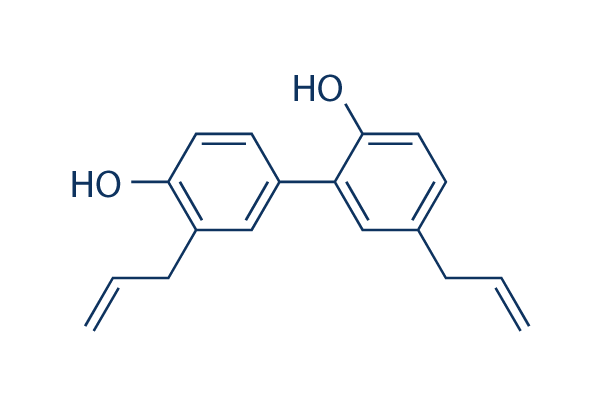
Chemical Structure
Molecular Weight: 266.334
Quality Control
| Related Targets | PI3K Akt mTOR GSK-3 ATM/ATR DNA-PK AMPK PDPK1 PTEN PP2A |
|---|---|
| Other Antineoplastic and Immunosuppressive Antibiotics Inhibitors | Staurosporine (STS) Cyclosporin A Oligomycin A (MCH 32) Puromycin Dihydrochloride Nigericin sodium salt Geldanamycin (NSC 122750) Streptozotocin (STZ) Sodium Monensin (NSC 343257) Cephalomannine Hygromycin B |
Cell Culture, Treatment & Working Concentration
| Cell Lines | Assay Type | Concentration | Incubation Time | Formulation | Activity Description | PMID |
|---|---|---|---|---|---|---|
| human UACC-903 cells | Cytotoxicity assay | Cytotoxicity against human UACC-903 cells after 72 hrs by MTS assay, IC50=5.1 μM | ||||
| Vero E6 cells | Function assay | Antiviral activity against SARS coronavirus in Vero E6 cells assessed as inhibition of viral replication by ELISA, EC50=6.5 μM | ||||
| human UACC-903 cells | Cytotoxicity assay | Cytotoxicity against human UACC-903 cells after 24 hrs by MTS assay, IC50=7.45 μM | ||||
| human A549 cells | Cytotoxicity assay | Cytotoxicity against human A549 cells after 72 hrs by MTS assay, IC50=7.75 μM | ||||
| human CEM cells | Cytotoxicity assay | Cytotoxicity against human CEM cells, IC50=10.9 μM | ||||
| HEK293 cells | Function assay | Agonist activity at RXRalpha in HEK293 cells assessed as transcriptional activation after 48 hrs by luciferase reporter gene assay, EC50=11.8 μM | ||||
| human A549 cell | Cytotoxicity assay | 24 h | Cytotoxicity against human A549 cells after 24 hrs by MTS assay, IC50=12.51 μM | |||
| human HT-29 cells | Cytotoxicity assay | 72 h | Cytotoxicity against human HT-29 cells after 72 hrs by MTS assay, IC50=13.24 μM | |||
| human PBM cells | Cytotoxicity assay | Cytotoxicity against human PBM cells, IC50=16.1 μM | ||||
| Hep-G2 cells | Cytotoxicity assay | Cytotoxicity of compound against human liver tumor cell line (Hep-G2) was determined, IC50=16.5 μM | ||||
| human HepG2 cells | Proliferation assay | 24 h | Antiproliferative activity against human HepG2 cells after 24 hrs by MTT assay, IC50=16.5 μM | |||
| human K562 cells | Proliferation assay | Antiproliferative activity against human K562 cells by MTT assay, IC50=21.1 μM | ||||
| Vero cells | Cytotoxicity assay | Cytotoxicity against Vero cells, IC50=22.5 μM | ||||
| human A2780 cells | Proliferation assay | Antiproliferative activity against cisplatin-sensitive human A2780 cells by MTT assay, IC50=30.5 μM | ||||
| human SPC-A1 cells | Proliferation assay | Antiproliferative activity against human SPC-A1 cells by MTT assay, IC50=36.1 μM | ||||
| HUVEC cells | Function assay | 20 μM | 24 h | Antimigratory activity against human HUVEC cells at 20 uM after 24 hrs by wound-healing assay | ||
| HEK293 cells | Function assay | 24-48 h | Agonist activity at human RXR-alpha expressed in HEK293 cells coexpressing with pCMX-beta-gal after 24 to 48 hrs by luciferase reporter gene assay | |||
| human SH-SY5Y cells | Function assay | 10 μM | 30 mins | Neuroprotective activity in human SH-SY5Y cells assessed as inhibition of CHP and TBHP-induced cell death at 10 uM incubated for 30 mins prior to challenge measured after 3 hrs by MTT assay | ||
| Click to View More Cell Line Experimental Data | ||||||
Solubility
|
In vitro |
DMSO
: 53 mg/mL
(198.99 mM)
Water : Insoluble Ethanol : Insoluble |
Molarity Calculator
|
In vivo |
|||||
In vivo Formulation Calculator (Clear solution)
Step 1: Enter information below (Recommended: An additional animal making an allowance for loss during the experiment)
Step 2: Enter the in vivo formulation (This is only the calculator, not formulation. Please contact us first if there is no in vivo formulation at the solubility Section.)
Calculation results:
Working concentration: mg/ml;
Method for preparing DMSO master liquid: mg drug pre-dissolved in μL DMSO ( Master liquid concentration mg/mL, Please contact us first if the concentration exceeds the DMSO solubility of the batch of drug. )
Method for preparing in vivo formulation: Take μL DMSO master liquid, next addμL PEG300, mix and clarify, next addμL Tween 80, mix and clarify, next add μL ddH2O, mix and clarify.
Method for preparing in vivo formulation: Take μL DMSO master liquid, next add μL Corn oil, mix and clarify.
Note: 1. Please make sure the liquid is clear before adding the next solvent.
2. Be sure to add the solvent(s) in order. You must ensure that the solution obtained, in the previous addition, is a clear solution before proceeding to add the next solvent. Physical methods such
as vortex, ultrasound or hot water bath can be used to aid dissolving.
Chemical Information, Storage & Stability
| Molecular Weight | 266.334 | Formula | C18H18O2 |
Storage (From the date of receipt) | |
|---|---|---|---|---|---|
| CAS No. | 35354-74-6 | Download SDF | Storage of Stock Solutions |
|
|
| Synonyms | NSC 293100 | Smiles | C=CCC1=CC(=C(C=C1)O)C2=CC(=C(C=C2)O)CC=C | ||
Mechanism of Action
| Targets/IC50/Ki |
Akt-phosphorylation
MEK
|
|---|---|
| In vitro |
Honokiol shows pro-apoptotic effects in melanoma, sarcoma, myeloma, leukemia, bladder, lung, prostate, oral squamous cell carcinoma and colon cancer cell lines. This compound is effective on inducing apoptosis in SVR angiosarcoma cells. Treatment of SVR cells with this chemical causes decreased phosphorylation of MAP kinase, akt, and c-src. In addition, it potentiates TRAIL-mediated apoptosis, and its cytotoxicity is partially abrogated by neutralizing antibodies to TRAIL. This compound also has direct antiangiogenic activity, in that it blocks the phosphorylation and rac activation due to VEGF-VEGFR2 interactions. It causes apoptosis in CLL cells through activation of caspase 8, followed by caspase 9 and 3 activation. This chemical prevents interleukin-4-mediated survival of CLL cells, and potentiats the cytotoxicity of CB-1348, FaraA, and 2-CdA. It kills myeloma cells from relapsed patients at doses that does not kill PBMCs. Caspase 3, 7, 8, and 9 are induced by this compound treatment, as well as PARP cleavage. It is found to induce apoptosis in the colon cancer cell lines RKO. This chemical potentiates apoptosis, suppresses osteoclastogenesis, and inhibits invasion through modulation of nuclear factor-kappaB activation pathway. It may act as a potent anti-inflammatory agent with multipotential activities due to an inhibitory effect on the PI3K/Akt pathway. |
| In vivo |
Honokiol is highly effective against SVR angiosarcoma in nude mice. This compound inhibits the growth of RKO cells in murine xenografts. It prevents the growth of MDA-MD-231 breast cancer cells in murine xenografts. |
References |
|
Applications
| Methods | Biomarkers | Images | PMID |
|---|---|---|---|
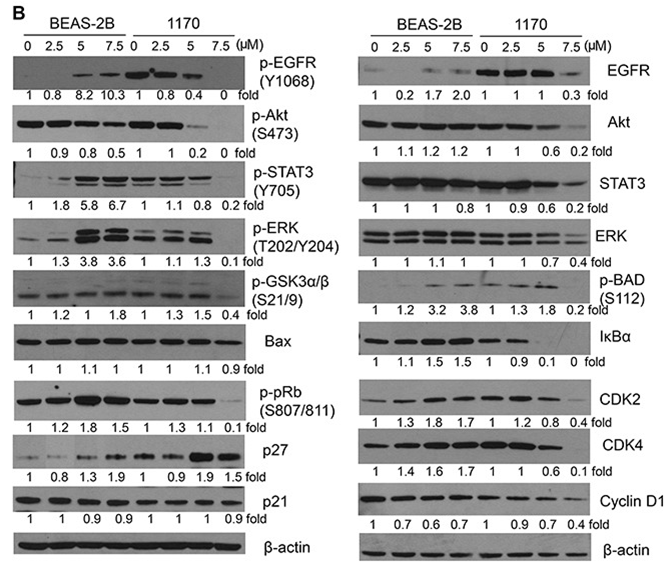
| Western blot | p-EGFR / p-AKT / p-STAT3 / p-ERK / p-GSK3α/β / Bax / p-pRb / p-BAD / IκBα / CDK2 / CDK4 / Cyclin D1 p-Lyn / Lyn / p-PI3K |
|
27458163 |
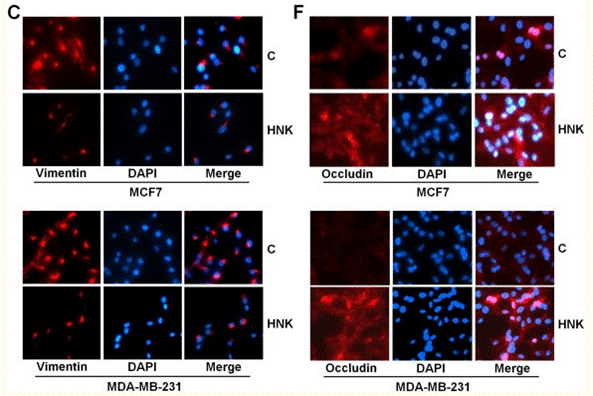
| Immunofluorescence | Vimentin / Occludin IκBα / NF-κB p65 |
|
24508063 |
Tech Support
Tel: +1-832-582-8158 Ext:3
If you have any other enquiries, please leave a message.

Products are for research use only. Not for human use. We do not sell to patients.
©Copyright 2013 Selleck Chemicals. All Rights Reserved.