
-
 Australia
-
 Austria
-
 Belgium
-
 Brazil
-
 Canada
-
 China
China
-
 Czech Republic
-
 Denmark
-
 Finland
-
 France
-
 Germany
-
 Greece
-
 Hong Kong
-
 Hungary
-
 Iceland
-
 India
India
-
 Ireland
-
 Israel
-
 Italy
Italy
-
 Japan
Japan
-
 Korea
Korea
-
 Luxembourg
-
 Malaysia
-
 Netherlands
-
 New Zealand
-
 Norway
-
 Poland
-
 Qatar
Qatar
-
 Romania
-
 Saudi Arabia
-
 Singapore
-
 Spain
Spain
-
 Sweden
-
 Switzerland
-
 Taiwan
-
 Turkey
-
 United Kingdom
-
 United States
research use only
BMS-777607 c-Met inhibitor
Cat.No.S1561
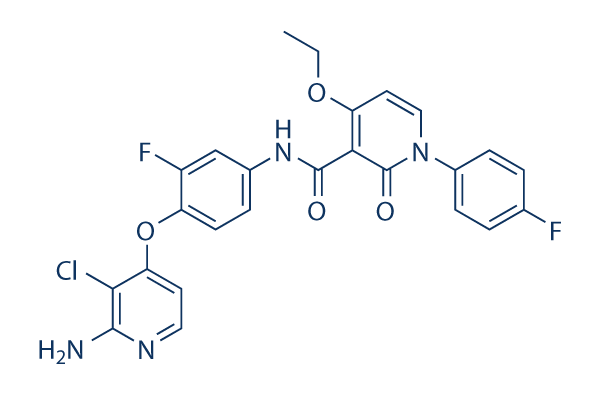
Chemical Structure
Molecular Weight: 512.89
Quality Control
| Related Targets | EGFR VEGFR FGFR PDGFR Src MEK CSF-1R HER2 FLT3 c-Kit |
|---|---|
| Other c-Met Inhibitors | Tepotinib (EMD-1214063) Dihexa SGX-523 PHA-665752 Foretinib (GSK1363089, XL880) SU11274 JNJ-38877605 Tivantinib PF-04217903 Savolitinib (AZD6094) |
Cell Culture, Treatment & Working Concentration
| Cell Lines | Assay Type | Concentration | Incubation Time | Formulation | Activity Description | PMID |
|---|---|---|---|---|---|---|
| PC-3 | Function assay | 0.1 μM | DMSO | exhibits inhibitory effect on HGF-induced cell scattering | 20515943 | |
| DU145 | Function assay | 0.1 μM | DMSO | exhibits inhibitory effect on HGF-induced cell scattering | 20515943 | |
| PC-3 | Function assay | 0.01 μM | DMSO | suppresses HGF-induced cell migration | 20515943 | |
| DU145 | Function assay | 0.01 μM | DMSO | suppresses HGF-induced cell migration | 20515943 | |
| PC-3 | Function assay | 0.1 μM | DMSO | impairs HGF-mediated cell invasion | 20515943 | |
| DU145 | Function assay | 0.1 μM | DMSO | impairs HGF-mediated cell invasion | 20515943 | |
| PC-3 | Growth inhibitory assay | ~10 μM | DMSO | reduces cell proliferation | 20515943 | |
| KHT | Kinase assay | DMSO | blocks the c-Met signaling pathway with IC50 of 10 nM | 22286523 | ||
| KHT | Function assay | ~1 μM | DMSO | prevents spontaneous KHT cell scattering with IC50 of 0.1-0.5 μM | 22286523 | |
| KHT | Function assay | ~0.5 μM | DMSO | inhibits cell migration | 22286523 | |
| KHT | Function assay | ~0.5 μM | DMSO | inhibits cell invasion | 22286523 | |
| KHT | Growth inhibitory assay | ~10 μM | DMSO | inhibits KHT cell proliferation | 22286523 | |
| T-47D | Growth inhibitory assay | ~5 μM | DMSO | inhibits cell proliferation | 23468529 | |
| ZR-75-1 | Growth inhibitory assay | ~5 μM | DMSO | inhibits cell proliferation | 23468529 | |
| T-47D | Function assay | 10 μM | DMSO | Induces polyploidy by 86 % | 23468529 | |
| ZR-75-1 | Function assay | 10 μM | DMSO | Induces polyploidy by 88% | 23468529 | |
| T-47D | Function assay | 10 μM | DMSO | inhibits AURK-B function and induces its protein degradation | 23468529 | |
| CHRF | Function assay | 10 μM | DMSO | inhibits cell division | 25304900 | |
| HPDE | Function assay | 10 μM | DMSO | blocks constitutive activation and decreased AKT signaling | 26477314 | |
| U118MG | Kinase assay | ~3 μM | DMSO | blocks AXL phosphorylation | 26848524 | |
| SF126 | Kinase assay | ~3 μM | DMSO | blocks AXL phosphorylation | 26848524 | |
| U118MG | Cytoxicity assay | 12.5 μM | DMSO | decreases glioma cell viability | 26848524 | |
| SF126 | Cytoxicity assay | 12.5 μM | DMSO | decreases glioma cell viability | 26848524 | |
| U118MG | Apoptosis assay | 12.5 μM | DMSO | induces glioma cell apoptosis | 26848524 | |
| SF126 | Apoptosis assay | 12.5 μM | DMSO | induces glioma cell apoptosis | 26848524 | |
| U118MG | Function assay | 12.5 μM | DMSO | blocks glioma cell migration and invasive growth pattern | 26848524 | |
| SF126 | Function assay | 12.5 μM | DMSO | blocks glioma cell migration and invasive growth pattern | 26848524 | |
| GTL16 | Function assay | 30 mins | Inhibition of Met phosphorylation in human GTL16 cells after 30 mins, IC50 = 0.02 μM. | 19260711 | ||
| GTL16 | Antiproliferative assay | 72 hrs | Antiproliferative activity against Met-dependent human GTL16 cells after 72 hrs by MTS assay, IC50 = 0.1 μM. | 19260711 | ||
| NCI-H1993 | Antiproliferative assay | 72 hrs | Antiproliferative activity against Met-dependent human NCI-H1993 cells after 72 hrs by MTS assay, IC50 = 0.15 μM. | 19260711 | ||
| U87 | Antiproliferative assay | 72 hrs | Antiproliferative activity against Met-driven human U87 cells after 72 hrs by MTS assay, IC50 = 0.16 μM. | 19260711 | ||
| BAF3 | Cytotoxicity assay | 72 hrs | Cytotoxicity against mouse BAF3 cells expressing TPR-Met assessed as growth inhibition after 72 hrs, IC50 = 0.1884 μM. | 24792774 | ||
| DU145 | Antiinvasive assay | 1 hr | Antiinvasive activity in human DU145 cells assessed as inhibition of HGF-induced cell motility preincubated for 1 hr before HGF treatment measured after 24 hrs by cell scattering assay, IC50 = 0.2 μM. | 24900830 | ||
| MKN45 | Cytotoxicity assay | 72 hrs | Cytotoxicity against human MKN45 cells assessed as growth inhibition after 72 hrs, IC50 = 0.2858 μM. | 24792774 | ||
| NCI-H1993 | Cytotoxicity assay | 48 hrs | Cytotoxicity against human NCI-H1993 cells after 48 hrs by MTT assay, IC50 = 1.108 μM. | 24900830 | ||
| GTL16 | Function assay | 6.25 mg/kg | Cmax in human GTL16 cells xenografted athymic mouse at 6.25 mg/kg, po, Cmax = 4.5 μM. | 19260711 | ||
| GTL16 | Function assay | 50 mg/kg | Cmax in human GTL16 cells xenografted athymic mouse at 50 mg/kg, po, Cmax = 43.7 μM. | 19260711 | ||
| SJ-GBM2 | qHTS assay | qHTS of pediatric cancer cell lines to identify multiple opportunities for drug repurposing: Primary screen for SJ-GBM2 cells | 29435139 | |||
| A673 | qHTS assay | qHTS of pediatric cancer cell lines to identify multiple opportunities for drug repurposing: Primary screen for A673 cells | 29435139 | |||
| SK-N-MC | qHTS assay | qHTS of pediatric cancer cell lines to identify multiple opportunities for drug repurposing: Primary screen for SK-N-MC cells | 29435139 | |||
| Saos-2 | qHTS assay | qHTS of pediatric cancer cell lines to identify multiple opportunities for drug repurposing: Primary screen for Saos-2 cells | 29435139 | |||
| LAN-5 | qHTS assay | qHTS of pediatric cancer cell lines to identify multiple opportunities for drug repurposing: Primary screen for LAN-5 cells | 29435139 | |||
| OHS-50 | qHTS assay | qHTS of pediatric cancer cell lines to identify multiple opportunities for drug repurposing: Primary screen for OHS-50 cells | 29435139 | |||
| A673 | qHTS assay | qHTS of pediatric cancer cell lines to identify multiple opportunities for drug repurposing: Confirmatory screen for A673 cells) | 29435139 | |||
| SK-N-MC | qHTS assay | qHTS of pediatric cancer cell lines to identify multiple opportunities for drug repurposing: Confirmatory screen for SK-N-MC cells | 29435139 | |||
| SJ-GBM2 | qHTS assay | qHTS of pediatric cancer cell lines to identify multiple opportunities for drug repurposing: Confirmatory screen for SJ-GBM2 cells | 29435139 | |||
| TC32 | qHTS assay | qHTS of pediatric cancer cell lines to identify multiple opportunities for drug repurposing: Confirmatory screen for TC32 cells | 29435139 | |||
| MG 63 (6-TG R) | qHTS assay | qHTS of pediatric cancer cell lines to identify multiple opportunities for drug repurposing: Confirmatory screen for MG 63 (6-TG R) cells | 29435139 | |||
| MGHU3 | Antiproliferative assay | 72 hrs | Antiproliferative activity against human MGHU3 cells after 72 hrs by CellTiter-Glo assay | 30309671 | ||
| RT112 | Antiproliferative assay | 72 hrs | Antiproliferative activity against human RT112 cells after 72 hrs by CellTiter-Glo assay | 30309671 | ||
| Click to View More Cell Line Experimental Data | ||||||
Solubility
|
In vitro |
DMSO
: 100 mg/mL
(194.97 mM)
Water : Insoluble Ethanol : Insoluble |
Molarity Calculator
|
In vivo |
|||||
In vivo Formulation Calculator (Clear solution)
Step 1: Enter information below (Recommended: An additional animal making an allowance for loss during the experiment)
Step 2: Enter the in vivo formulation (This is only the calculator, not formulation. Please contact us first if there is no in vivo formulation at the solubility Section.)
Calculation results:
Working concentration: mg/ml;
Method for preparing DMSO master liquid: mg drug pre-dissolved in μL DMSO ( Master liquid concentration mg/mL, Please contact us first if the concentration exceeds the DMSO solubility of the batch of drug. )
Method for preparing in vivo formulation: Take μL DMSO master liquid, next addμL PEG300, mix and clarify, next addμL Tween 80, mix and clarify, next add μL ddH2O, mix and clarify.
Method for preparing in vivo formulation: Take μL DMSO master liquid, next add μL Corn oil, mix and clarify.
Note: 1. Please make sure the liquid is clear before adding the next solvent.
2. Be sure to add the solvent(s) in order. You must ensure that the solution obtained, in the previous addition, is a clear solution before proceeding to add the next solvent. Physical methods such
as vortex, ultrasound or hot water bath can be used to aid dissolving.
Chemical Information, Storage & Stability
| Molecular Weight | 512.89 | Formula | C25H19ClF2N4O4 |
Storage (From the date of receipt) | |
|---|---|---|---|---|---|
| CAS No. | 1025720-94-8 | Download SDF | Storage of Stock Solutions |
|
|
| Synonyms | BMS 817378 | Smiles | CCOC1=C(C(=O)N(C=C1)C2=CC=C(C=C2)F)C(=O)NC3=CC(=C(C=C3)OC4=C(C(=NC=C4)N)Cl)F | ||
Mechanism of Action
| Features |
A potent inhibitor of the Met family, and >40-fold selectivity vs. Lck, VEGFR2, and TrkA/B and >500-fold selective vs. other receptor and non-receptor kinases.
|
|---|---|
| Targets/IC50/Ki |
Axl
(Cell-free assay) 1.1 nM
RON
(Cell-free assay) 1.8 nM
Met
(Cell-free assay) 3.9 nM
Tyro3
(Cell-free assay) 4.3 nM
Mer
(Cell-free assay) 14 nM
FLT3
(Cell-free assay) 16 nM
Aurora B
(Cell-free assay) 78 nM
|
| In vitro |
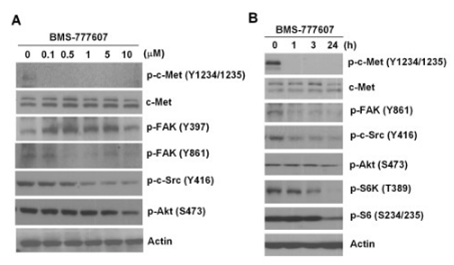
BMS-777607 is a selective ATP-competitive Met kinase inhibitor which potently blocks the autophosphorylation of c-Met with IC50 of 20 nM in GTL-16 cell lysates, and demonstrates selective inhibition of proliferation in Met-driven tumor cell lines, such as GTL-16 cell line, H1993 and U87. This compound inhibits hepatocyte growth factor (HGF)-triggered c-Met autophosphorylation with IC50 of <1 nM in PC-3 and DU145 prostate cancer cells. This compound has little effect on tumor cell growth, but exhibits inhibitory effect on HGF-induced cell scattering in PC-3 and DU145 cells, with almost complete inhibition at 0.5 μM. It also suppresses stimulated cell migration and invasion in a dose-dependent fashion (IC50 < 0.1 μM) in both cell lines. Application of this compound (~10 μM) to the highly metastatic murine KHT cells for 2 hours potently eliminates basal levels of autophosphorylated c-Met with IC50 of 10 nM without affecting the total c-Met, leading to dose-dependent inhibition of phosphorylation of downstream signaling molecules including ERK, Akt, p70S6K and S6. Treatment with this compound (~1 μM) for 24 hours potently inhibits the KHT cell scatter, motility and invasion at doses in the nanomolar range which consists with MET gene knockdown, and modestly affects cell proliferation and colony formation. |
| Kinase Assay |
Met Kinase Assay
|
|
The kinase reaction consists of baculovirus expressed GST-Met, 3 μg of poly(Glu/Tyr), 0.12 μCi 33P γ-ATP, 1 μM ATP in 30 μL of kinase buffer (20 mM Tris-Cl, 5 mM MnCl2, 0.1 mg/mL BSA, 0.5 mM DTT). Reactions are incubated for 1 hour at 30 °C and stopped by the addition of cold trichloroacetic acid (TCA) to a final concentration of 8%. TCA precipitates are collected onto GF/C unifilter plates using a Filtermate universal harvester, and the filters are quantitated using a TopCount 96-well liquid scintillation counter. Dose response curves are generated to determine the concentration required to inhibit 50% of substrate phosphorylation (IC50). This compound is dissolved at 10 mM in DMSO and evaluated at 10 concentrations, in duplicate.
|
|
| In vivo |
Oral administration of BMS 777607 (6.25-50 mg/kg) significantly reduces tumor volumes of the GTL-16 human tumor xenografts in athymic mice with no observed toxicity. Administration of this compound (25 mg/kg/day) decreases the number of KHT lung tumor nodules (28.3%), improves the morphological hemorrhage, and significantly impairs the metastatic phenotype in the 6-8 week-old female C3H/HeJ mice injected with rodent fibrosarcoma KHT cells without apparent systemic toxicity compared to the control treatment. A low dose of this chemical (10 mg/kg) also offers a mild but not significant inhibition of lung nodule formation compared to the vehicle control. |
References |
|
Applications
| Methods | Biomarkers | Images | PMID |
|---|---|---|---|
| Western blot | p-c-Met / c-Met / p-FAK / p-c-Src / p-Akt / p-S6K / p-S6 p53 / p21 / Survivin / p-Rb / Rb |
|
22639908 |
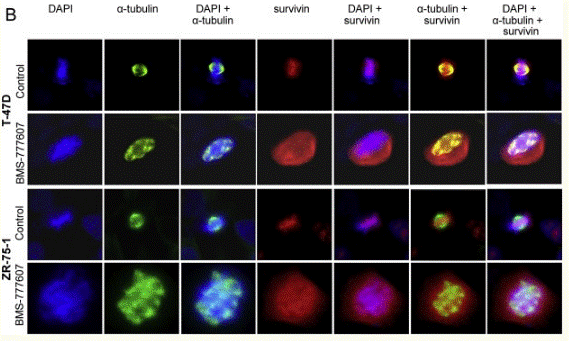
| Immunofluorescence | α-tubulin / survivin |
|
24444656 |
Clinical Trial Information
(data from https://clinicaltrials.gov, updated on 2024-05-22)
| NCT Number | Recruitment | Conditions | Sponsor/Collaborators | Start Date | Phases |
|---|---|---|---|---|---|
| NCT01721148 | Completed | Malignant Solid Tumour |
ASLAN Pharmaceuticals |
October 2012 | Phase 1 |
| NCT00605618 | Completed | Advanced Solid Tumors |
Bristol-Myers Squibb |
March 2008 | Phase 1|Phase 2 |
Tech Support
Tel: +1-832-582-8158 Ext:3
If you have any other enquiries, please leave a message.
Frequently Asked Questions
Question 1:
What formulation can we use to dissolve it for mice in vivo study?
Answer:
S1561 in 1% DMSO+30% polyethylene glycol+1% Tween 80 at 30 mg/ml is a suspension. It is fine for oral gavage. If you are going to use it for injection, please try the following vehicle: 4% DMSO+30% PEG 300+ddH2O. This compound can be dissolved in it at 5 mg/ml as a clear solution.
Signaling Pathway Map

Products are for research use only. Not for human use. We do not sell to patients.
©Copyright 2013 Selleck Chemicals. All Rights Reserved.